Googan Fat Shaddy Swimbait: three joints and a slow-sinking density
Rather not fish it blind? Photograph your spot — CarnaFish cross-checks the conditions and points you the right way.
Jointed swimbaits were a closed shop for a long time: hundred-euro baits, a dedicated rod, and the vague promise that one day a big fish would eat one. The Fat Shaddy is Googan and Catch Co.'s attempt to open that shop up — the second generation of hard baits from the collaboration, with a precise spec sheet and two sizes that cover two very different kinds of fishing.
What the manufacturer's table says
Googan does publish a real dimension table here, and it's worth reading before anything else:
- Fat Shaddy Jr.: 4.5 in, that is 11.4 cm, at 1 oz, that is 28.3 g, rated Slow-Sinking.
- Fat Shaddy: 7 in, that is 17.8 cm, at 1-3/4 oz, that is 49.6 g, also Slow-Sinking.
Those two lines already say a lot. First, both versions are slow-sinking: not a floater you have to drag down, not a fast sinker that dives the moment you stop. You pick your layer by counting seconds after the splashdown, and the bait stays there through the retrieve. Then the density. 28.3 g for 11.4 cm is heavy for the format: the Jr. is a compact, dense bait that casts a long way despite its modest size and drops cleanly without being pushed around by wind. The big model, at 49.6 g, needs a swimbait rod and a reel spooled to match — this isn't a bait you throw on a general-purpose bass outfit.
Three joints, two behaviours
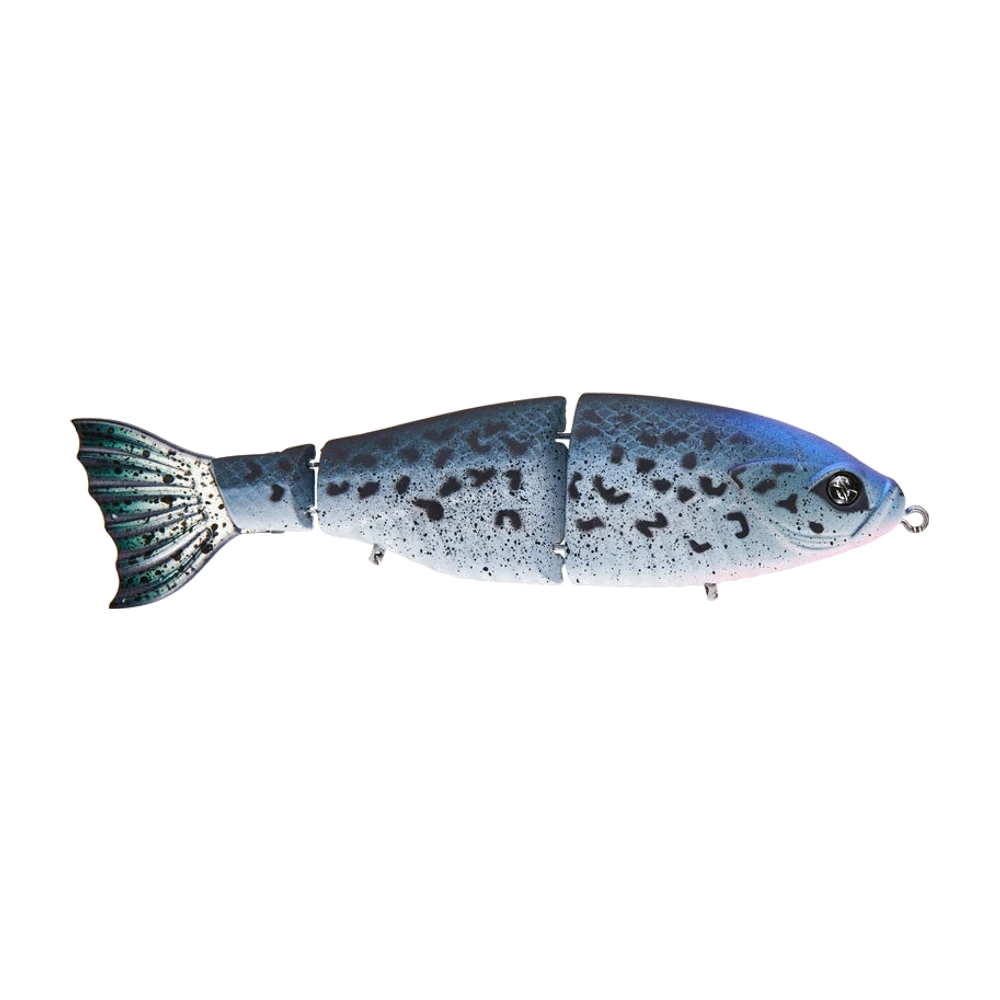
The Fat Shaddy is triple-jointed: three hinges splitting the body into four moving sections. That architecture gives it two distinct registers, and the manufacturer states both.
On a slow, steady retrieve, the segments offset against one another and the bait undulates along its whole length, like a fish swimming without urgency. That's the search retrieve: cast, let it sink for the count you want, and wind without doing anything else. Steadiness matters more than speed — an accidental jerk on the handle breaks the wave and shows immediately.
On a twitch-pause, the behaviour flips. A rod stroke sends the head sideways, the segments follow out of phase, and the bait rolls wide before settling. That's the register for a fish you know is there but that won't look at a clean swim: an apathetic late-summer bass, or a pike that has followed twice without committing.
On a follow with no strike, don't change bait straight away — change register. Run the same line again on a slow retrieve, and when you reckon you're over the fish, give it two sharp twitches and then stop everything. It's the break that triggers, not the next bait out of the box.
The rotating hangers, and why they matter in the fight
Googan fits the Fat Shaddy with 360-degree rotating hook hangers. The point isn't to catch, it's to keep. On a long rigid bait, a fish shaking its head uses the body as a lever to tear the hold — that's the main cause of lost fish on swimbaits. A hanger that spins freely removes the lever: the treble pivots instead of being pinned, and the load stays on the point rather than on flesh.
In the photo on this page, the two belly hangers are clearly visible but no treble is fitted: that's a catalogue shot, the bait ships rigged. If you swap the factory trebles, keep the same gap — a wider treble on a jointed body ends up catching in the next hinge on every cast.
The soft tail, and what it adds
The tail isn't rigid: it's a separate soft part with a matte finish, which the manufacturer presents as a durability gain. On the water it mainly does two things. It damps the end of the undulation, which avoids the whipping effect some fully rigid swimbaits suffer from, and it keeps vibrating during the pause, when the rest of the body has already stopped. That persistence is what makes the pause worth taking.
Not sure what to tie on?
Photograph your spot: CarnaFish reads the scene, cross-checks the conditions and gives you the zone, the lure and the retrieve. Free on iOS and Android.
Where and when to use each size
The 11.4 cm Jr. is the entry model and by far the more versatile. It fishes on a standard medium-heavy rod, it works on bass all year, and it stays within reach of a good perch in late autumn. It's also the format to pick if you're new to swimbaits: a smaller bait forgives rhythm mistakes and produces more bites, so more feedback on what actually works.
The 17.8 cm version changes job entirely. At 49.6 g it's a selective bait: fewer bites, bigger fish, and genuine relevance for pike in Europe, where that calibre matches what the fish actually eats on a roach water. In that case, a titanium leader isn't optional. If you want a soft swimbait in the same spirit to compare against, the Megabass Magdraft covers the same ground with a different approach, while the Deps Slide Swimmer 175 is the high-end, more demanding end of the jointed segment.
The classic mistake
Retrieving too fast. A slow-sinking jointed swimbait loses its undulation past a certain speed: the segments stop offsetting and the bait becomes a stick crossing the water. If you can feel it pulling hard in the rod, you're already too quick. The useful reference is to see the bait undulating two metres from the tip before you let the next cast go.
Colour by water
- Clear water: the spotted trout pattern photographed here, with its blue-grey back and pale flanks. It works even where trout aren't the dominant forage, because the pattern breaks up the silhouette.
- Lightly stained water: a silver shad with a green back, more readable without turning loud.
- Dirty water or low light: a dark, plain back, playing on contrast seen from below rather than on detail.
A bait at this price is wasted on random casting: this is fishing to identified spots. CarnaFish answers that need — a photo of the spot, and the app suggests the zone, the depth and the kind of presentation suited to the day's conditions. To frame bait choice when pike are the target, our guide to choosing a pike lure is a useful companion to this page.
Key takeaways
- Two versions on the table: 11.4 cm at 28.3 g and 17.8 cm at 49.6 g, both rated slow-sinking by the manufacturer.
- The three joints deliver two registers: a wide undulation on a slow retrieve, wide erratic wobbling on a twitch-pause.
- The 360-degree rotating hook hangers exist for the fight, removing the leverage that pulls hooks on swimbaits.
- Too much speed kills the undulation: if it pulls hard in the rod, slow down.
FAQ
What are the exact sizes and weights?
The manufacturer's table lists two versions: the Fat Shaddy Jr. at 4.5 in (11.4 cm) for 1 oz (28.3 g), and the Fat Shaddy at 7 in (17.8 cm) for 1-3/4 oz (49.6 g). Both are listed as slow-sinking.
Does the Fat Shaddy float or sink?
It sinks, slowly. The manufacturer rates both versions Slow-Sinking. In practice you count seconds after the splashdown to choose your layer, and the bait stays there through the retrieve instead of rising.
What rod for the 17.8 cm model?
At 49.6 g you need a swimbait rod, or a heavy able to handle that weight both on the cast and on the hookset. The 28.3 g Jr., by contrast, fishes fine on a standard medium-heavy bass rod.
Can it be fished for pike?
Yes, especially in 17.8 cm, which matches the forage size pike actually work on. In that case fit a titanium leader without exception: a jointed body of that length gets taken deeper than a short bait.
Why does my swimbait stop swimming when I speed up?
Because the segments stop offsetting past a certain speed. A slow-sinking jointed bait works on a very steady, fairly slow retrieve. If you feel strong resistance in the rod, you're already too fast.
Should I replace the factory hooks?
Not necessarily — the rotating hangers already do the most important part. If you do change them, stay with the same treble gap: a wider model catches in the next hinge on every cast with a jointed body.
The full bass lure guideSeason-by-season strategy: which family of lure, when, and why.Go from theory to fish
CarnaFish reads your spot from a photo and gives you the game plan: zone, lure, retrieve. Free on iOS and Android.