Cordell Spot: counting the fall to fish a drop-off for zander
Not sure this lure fits YOUR spot today? CarnaFish tells you in 10 seconds, from a photo.
Your sounder shows fish at four metres on a drop-off. You cast a lure, you retrieve, you touch nothing. The problem is almost never the lure: it is that you spent your entire retrieve between one and two metres, without once putting the lure in front of the fish.
The lipless solves that very simply: it has no lip, so no imposed depth. It goes down as far as you let it go down. The whole technique rests on a single skill — knowing how to count.
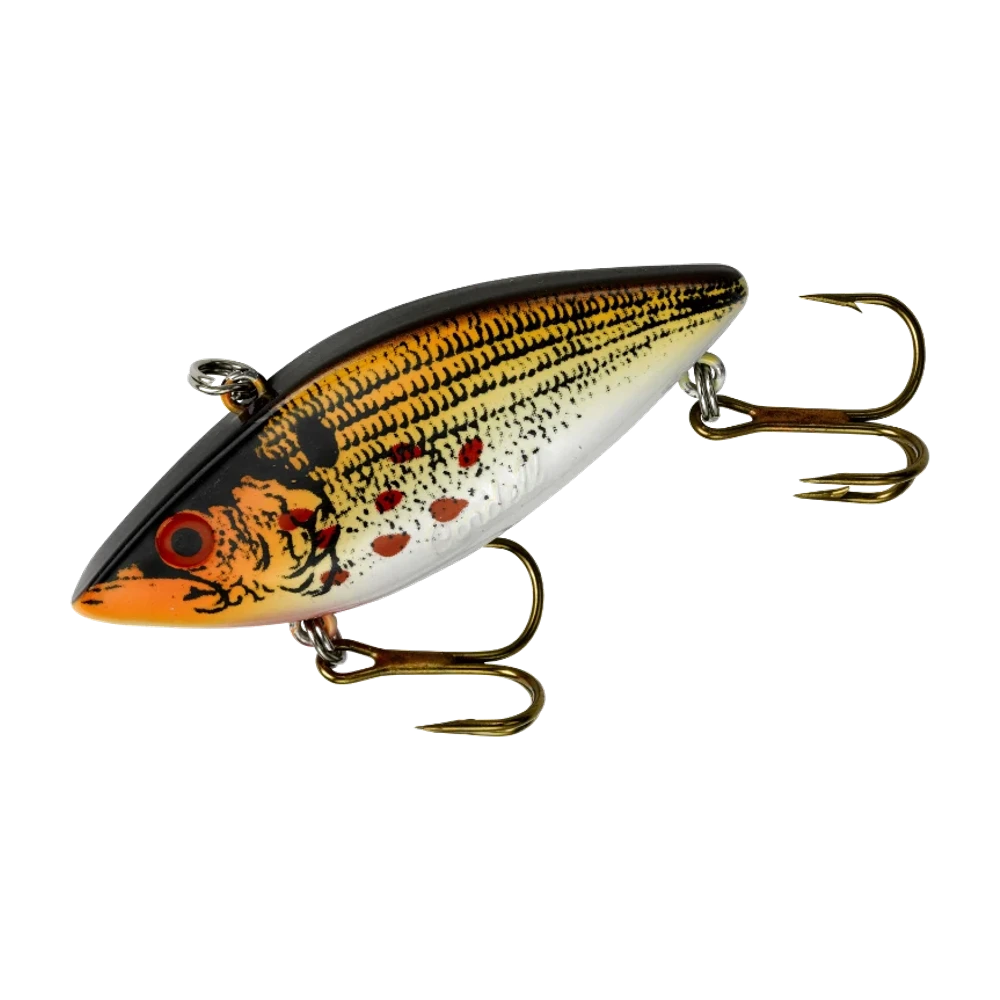
The Cordell Spot is the compact version of that family. A flat, short, dense body that sinks level without spinning off and that comes straight back into vibration the moment you pull on it. That combination is what makes it readable on a yo-yo retrieve along a drop-off, and particularly deadly on zander.
Spot and Super Spot: same bloodline, two sizes
Let us settle this straight away, because the confusion is common on the shelf: the Cotton Cordell Super Spot and the Spot belong to the same lipless family, from the same house. These are not two different inventions, they are two versions of the same principle.
What separates them in practice:
- Volume and mass. The Super Spot is bigger and heavier. It casts further, sinks faster, and moves more water. The Spot is more compact and lighter.
- The sound signature. More volume means a bigger sound chamber and a deeper grain. The Spot has a drier, higher-pitched rattle.
- The slot. The Super Spot is the long-range, deep-water searching tool, for stained water or active fish. The Spot goes down better with less decided fish, in clearer water, and over shallow drop-offs where the big model sinks too fast.
If you only carry one and you mostly fish drop-offs between three and six metres, take the Spot: the slower fall leaves you in control. If you are fishing thirty-five metres out in eight metres of water, take the big one.
Counting the fall, the full method
- Cast and let the line run free, finger on the spool, no braking.
- Count under your breath until the line goes slack — that is the bottom. Note the number: it is your depth reference for the rest of the session.
- Lift firmly from nine o'clock to eleven o'clock, sharply but not violently. The lure lifts off vibrating.
- Lower the rod tip with it, without going completely slack: the lure glides down, staying level.
- Count the fall, two or three seconds depending on the layer you want.
- Start again, picking up the slack on each cycle.
The bite almost always comes on the fall, and it does not feel like a knock: the line stops sinking, or it moves off sideways. It is as much a visual thing as a tactile one.
| Target layer | Fall count | Cycle |
|---|---|---|
| 2 to 3 m | 2 s | Short lifts, quick rhythm |
| 3 to 4.5 m | 3 s | Wide lift, guided fall |
| 4.5 to 6 m | 4 to 5 s | Slow lift, eyes on the line |
On the water: on a drop-off, do not fish parallel to the bank but perpendicular to it, casting onto the shallow and retrieving towards the deep. Each yo-yo cycle then takes the lure one notch deeper, and you sweep the whole slope in a single retrieve instead of being stuck at one depth.
Why zander respond to it so well
Zander are fish of drop-offs and low light, and they feed upwards. Three features of the Spot match that exactly.
First, the flat fall. A lure that sinks level, gliding, stays visible for a long time from below, offering a broad silhouette. A lure that noses down disappears.
Then, the tight vibration on the pull. It is very easy for the lateral line to pick up, which matters in water that is often coloured, or late in the day when sight is no longer enough.
Finally, the compact size. Zander have a hard, bony mouth but a selective appetite: a six or seven centimetre lure hooks better and gets refused less than a model twice the size.
For bass, the same lure is fished differently: a more linear, faster retrieve, grinding through the weed beds and ripping the lure free the moment it grabs vegetation.
Where not to use it
The Spot has zero tolerance for snags. Its two exposed trebles, with no lip to protect them, make it the worst possible choice in deadwood and branches. Over a boulder-strewn bottom you can fish it, provided you never let it touch — which demands rigorous counting.
It is also poorly suited to very shallow, calm water: it sinks too fast to hold in a metre of water without constant effort, and its vibration is too strong for a fish sitting near the surface.
Not sure what to tie on?
Photograph your spot: CarnaFish reads the scene, cross-checks the conditions and gives you the zone, the lure and the retrieve. Free on iOS and Android.
Colours and working depth
The deeper you go, the less colour matters and the more silhouette and sound do the work. That gives a simple rule.
- Above three metres, clear water: chrome and blue, chrome and black. The flash off that flat flank is your best asset.
- Between three and five metres: gold, or gold and red. Gold keeps presence where chrome goes dead.
- Below five metres, or coloured water: dark silhouette or a dark craw pattern. At that stage, it is the vibration doing the work.
Spot or another lipless
The Rapala Rippin' Rap has a narrower profile and a faster, more vertical fall: it is better for very deep work and vertical fishing, less good on a long glide. The Strike King Red Eyed Shad is wider and louder, built for stained water and quick searching over weedy flats.
The Spot sits between the two: dense enough to go down, flat enough to glide, compact enough to get past wary fish. It is a control lure rather than a power lure.
Our beginner's guide to zander lure fishing explains how to identify a drop-off worth fishing. And if you are unsure which depth to attack when you reach the bank, CarnaFish analyses a photo of the spot and gives you an answer.
Key takeaways
- With no lip, depth depends only on your counting: you decide.
- The bite comes on the fall, and you see it on the line before you feel it.
- Fish the drop-off perpendicular to go one notch deeper with each cycle.
- Same family as the Super Spot, but more compact, lighter, with a more controllable fall.
- Keep it out of deadwood: two bare trebles, no protection at all.
FAQ
What is the difference between the Cordell Spot and the Super Spot?
They are two versions of the same lipless. The Super Spot is bigger, heavier, louder and sinks faster: it covers deep water and stained conditions. The Spot is more compact, sinks more slowly and is easier to control over medium drop-offs.
How do I know what depth my lipless is swimming at?
By counting. Let it sink on a free line until the line goes slack, note how many seconds it takes to reach the bottom, then set your falls at a fraction of that time to target a precise layer.
Why can't I feel lipless bites?
Because they come on the fall, when the line is not tight. Watch your line: if it stops sinking or moves off sideways, set immediately without waiting to feel anything.
Does the Cordell Spot work for zander?
Very well. Its flat fall offers a broad silhouette to a fish that feeds upwards, and its tight vibration stays detectable in coloured water. Its compact size also makes it easier to drive a hook into a hard mouth.
Should I change the stock hooks?
Not necessarily, but check them often: on a lipless that regularly touches bottom, the points blunt quickly. Stay with fine trebles of the same size so you do not change the sink rate.
Can you fish it in weed?
Over low vegetation, yes, ripping the lure free with a sharp pull the moment it grabs — that rip often triggers a bite. In dense weed or wood, no: the two exposed trebles make a retrieve impossible.
The full zander lure guideSeason-by-season strategy: which family of lure, when, and why.Go from theory to fish
CarnaFish reads your spot from a photo and gives you the game plan: zone, lure, retrieve. Free on iOS and Android.