6th Sense Panorama: the flat shad you fish like a spoon
One lure, endless conditions. CarnaFish reads your spot from a photo so you are not just guessing.
A school of baitfish at six metres, predators underneath, and you with a box of paddle-tail shads that all send out the same signal. You have already run them through three times. What is missing here is not one more shad: it is a bait that looks like nothing those fish have seen this week. The Panorama Shad is built on that bet, the bet of a radically flatter profile.
A profile between swimbait and spoon
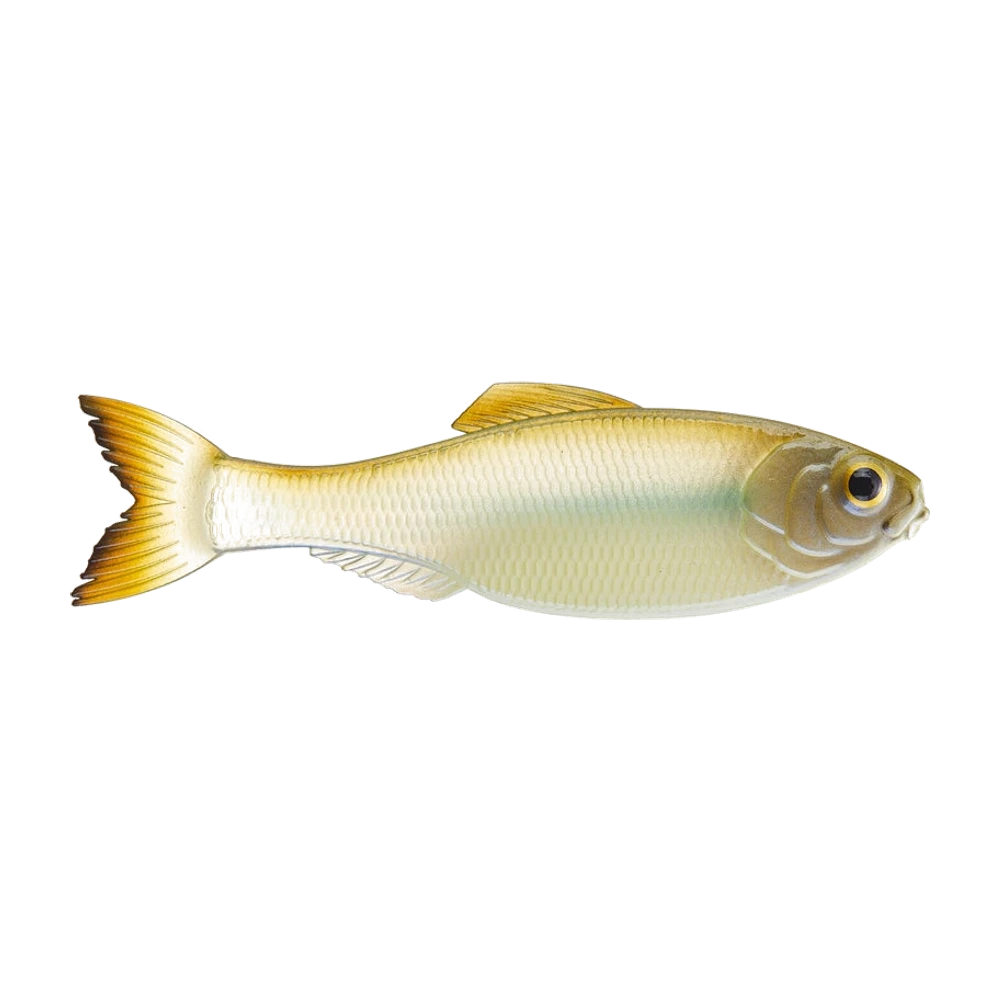
The first thing that strikes you when you pull a Panorama out of the pack is its thickness. Seen from above it is a blade. Seen from the side it is a highly credible baitfish, with a realistic finish and tall flanks. Josh Jones, the Team 6 angler who pushed the bait's development and nicknamed it the Prototype, describes its profile as a cross between a swimbait and a spoon. That is a good description, and it tells you everything about how the bait behaves in the water.
A body this flat behaves like a spoon on the fall: it does not drop straight, it slides off to the side, tips over, shows one flank then the other. It is a passive movement, owing nothing to the shape of a tail, and it happens every time you give line. To a predator watching a bait fall, that glide throws flashes of light that have nothing to do with the regular beat of a paddle.
Under animation, that same thinness makes the body very reactive. 6th Sense worked the softness of the plastic so the bait undulates fluidly whatever the rig. That matters, because the claimed versatility depends on it: plastic that is too firm could not be both a drop shot bait and a heavy Texas rig bait.
Six sizes, three genuinely different ways to fish
The range runs from 5.1 cm to 22.9 cm, that is six sizes. It is not a cosmetic line-up: three steps correspond to three approaches with almost nothing in common.
The small sizes, 5.1 to 8.9 cm
The 5.1, 7.1 and 8.9 cm formats are pure finesse baits. In Europe they concern perch as much as bass, and they produce very well on a light drop shot over located schools. The thin profile works where a Z-Man Finesse ShadZ or a Keitech Shad Impact 3 are already references: the Panorama's edge is a more pronounced lateral glide on the fall.
The 12.7 cm on a drop shot
This is the size Josh Jones favours on a drop shot, with spinning gear and forward-facing sonar. A 12.7 cm shad on a drop shot may look big to a European angler used to finesse sizes, but that is precisely the point: you present the bulk of an adult baitfish at an exact depth, with the slowness of a drop shot rig. On zander as much as on a big bass, that combination of bulk and slowness is formidable.
The 16.5 cm on a power shot and the 22.9 cm on a heavy Texas rig
The 16.5 cm is fished on a power shot — a beefed-up drop shot with casting gear and a heavy leader — and on a Texas rig with a 4/0 hook to pull fish out of cover. The 22.9 cm goes on an 11/0 hook with a 14 g bullet weight pegged against the nose, and is dragged along the bottom, exactly like a vertical spoon. That is a big-fish rig, and in Europe it is mainly a pike and big-zander rig rather than a bass one.
On the larger sizes rigged Texas, do not forget to peg the weight against the nose of the bait. A free weight on a body this flat shifts during the fall and the bait goes sideways instead of gliding cleanly. That is the detail that separates a rig that fishes from a rig that spins.
Working it: let the bait fall
Whatever the rig, the logic is the same: the Panorama mostly works during the descending phases. On a drop shot that means small shakes of the rod tip followed by long pauses, letting the bait settle by itself between sets. On a heavy Texas rig it means dragging in contact with the bottom, then a firm lift and a complete release — the bait rises, tips over, and glides back down over forty or fifty centimetres.
The classic mistake
Reeling the Panorama in on a straight retrieve like a paddle-tail shad. A flat body with no active tail produces no vibration under a continuous retrieve: you drag a blade through the water and nothing happens. All of the bait's appeal is in the fall and in micro movements. The other frequent mistake, on the small sizes, is over-weighting the drop shot: too heavy a sinker keeps the line tight the whole time and stops the body tipping freely.
Where and when this profile makes the difference
The Panorama's ideal ground is clear to moderately clear water, on fish you can locate — on sonar, by sight, or from knowing the spot. It is a visual bait before it is a vibration bait, and that is exactly why it works well on heavily fished waters where fish have grown used to strong signals.
In dirty water or in strong current, on the other hand, a flat body is at a disadvantage: it does not send out enough low-frequency signal to be found, and its large flat surface makes it drift in ways you cannot control. In those conditions a conventional paddle-tail shad or a vibrating bait stays safer. It is a precision bait and, like the 6th Sense Masterclass Strobe Shaker from the same brand, it assumes you already know where the fish is.
One more thing worth knowing: the packs hold few baits in the larger sizes, two pieces in 16.5 cm and a single one in 22.9 cm. That makes sense given the volume of plastic, but it is worth bearing in mind before setting out for a full day in heavy cover.
Not sure what to tie on?
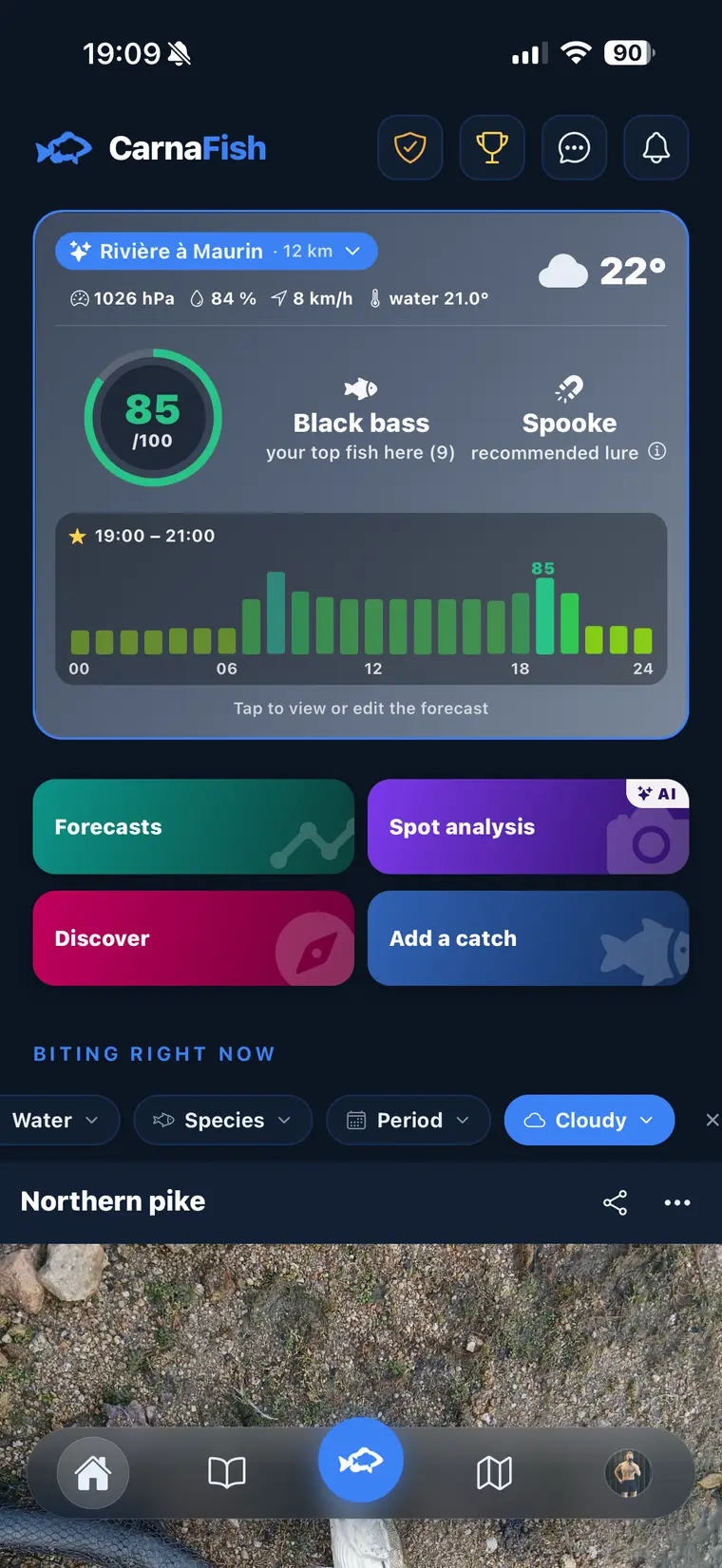
Photograph your spot: CarnaFish reads the scene, cross-checks the conditions and gives you the zone, the lure and the retrieve. Free on iOS and Android.
Colours by conditions
- Clear water: a realistic baitfish finish, natural back and silver flanks. That is this bait's strong point and it should be used where visibility allows.
- Stained water: dark back and pale belly, a vertical contrast that stays readable when transparency drops under a metre and a half.
- Deep work or low light: a light reflective shade, which keeps throwing back residual light during the lateral glide.
A bait that fills an empty slot
The Panorama Shad does not replace a paddle-tail shad, and that is not its aim. It fills a slot that was largely empty between the classic finesse shad and the vertical spoon: a realistic, very flat body that rigs as happily on a light drop shot as on a heavy Texas rig. It is its rigging versatility, more than its own action, that justifies a place in the box.
Which rig you choose depends first on reading the spot, and that is where CarnaFish helps: a photo of the spot, and the AI suggests a zone, a depth and a type of presentation suited to the day's conditions, which saves you reaching for an 11/0 Texas rig where a light drop shot would do. If zander is your target with the mid sizes, our beginner's guide to lure fishing for zander covers the spots and rigs worth knowing.
Key takeaways
- A profile far flatter than a conventional shad, halfway between a swimbait and a spoon: the bait glides and tips over as it falls.
- The appeal is in the descending phases and in micro movements, not in a straight retrieve.
- Three steps of use: small sizes for finesse and light drop shot, 12.7 cm on a drop shot over located schools, 16.5 and 22.9 cm on power shot and heavy Texas rigs.
- On the large Texas-rigged sizes, the bullet weight must be pegged against the nose or the bait goes sideways.
FAQ
Why is the Panorama Shad so flat?
Because its profile is designed to glide sideways on the fall, like a spoon, while keeping the silhouette of a baitfish seen from the side. That is what gives it behaviour different from a paddle-tail shad.
Which size should I start with?
The 12.7 cm on a drop shot if you fish schools located on sonar, or one of the three small sizes from 5.1 to 8.9 cm if you fish perch and bass finesse-style. The large sizes require dedicated tackle.
Can it be fished on a straight retrieve?
That is not its ground. A body this flat with no active tail produces almost no vibration under a continuous retrieve. Its appeal lies in the fall, the shakes and the pauses.
What is a power shot?
A reinforced drop shot: the same principle of a sinker at the end of the line and the bait tied above, but with casting gear, a heavy leader and a strong hook, to fish in cover and land big fish.
Should the weight be pegged on a Texas rig?
Yes, on the large sizes it is essential. A free bullet weight shifts during the fall on a body this flat, and the bait goes sideways instead of gliding. A rubber peg or a bobber stop is enough.
Is it suitable for zander?
Yes, particularly in 12.7 cm on a drop shot rig. The bulk of an adult baitfish combined with the slowness of a drop shot matches well what a zander holding on a break or above a school is looking for.
The full bass lure guideSeason-by-season strategy: which family of lure, when, and why.Go from theory to fish
CarnaFish reads your spot from a photo and gives you the game plan: zone, lure, retrieve. Free on iOS and Android.