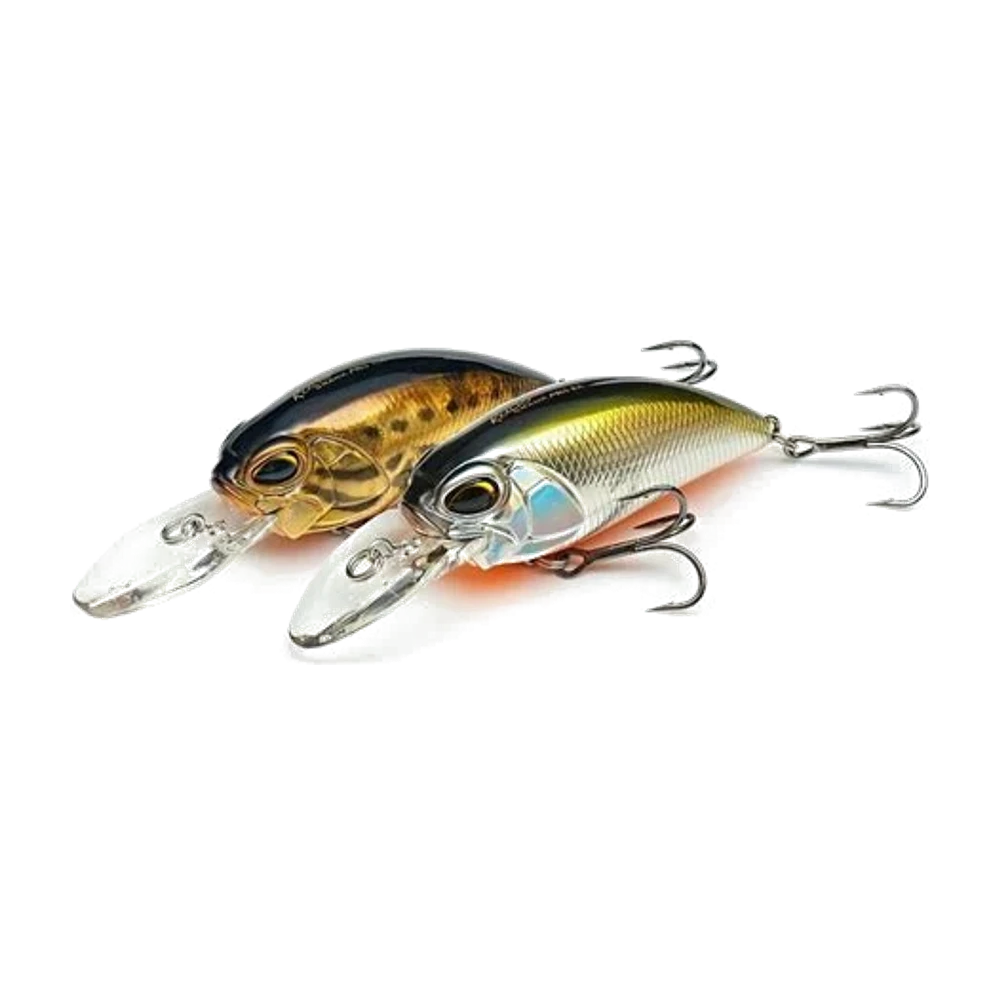
DUO Realis Crank M65: the crank that fills the 3 metre gap
Rather not fish it blind? Photograph your spot — CarnaFish cross-checks the conditions and points you the right way.
Look inside an average crankbait box. You will find squarebills that work between zero and a metre and a half, and deep cranks that go down to four, five or six metres. In between, there is a gap. And that gap corresponds exactly to the depth of most bank drop-offs, gravel plateaus and shoal tops where perch and bass gather for a good part of the year.
The usual result: either you fish above the fish with your squarebill, or you plough the silt two metres below them with a deep crank that snags on everything.
The Realis Crank M65 is built for that two to three-and-a-half-metre band. It is not a spectacular lure — it is a lure that holds its depth without arguing, which is exactly what you want from a crank in that layer.
Holding the layer, not just reaching it
The difference between a crank that "goes down to three metres" and a crank that "fishes at three metres" is enormous, and it comes down to how long the useful swimming phase lasts.
A badly set up crank reaches its maximum depth for only a few metres, then climbs steadily as soon as the line angle changes on its way back to you. On a thirty-metre cast you therefore fish the right layer for ten metres and waste the rest.
The M65 works differently, thanks to two things:
- A lip sized for drag rather than for maximum dive. It favours a stable angle of attack, which lengthens the plateau where the lure stays at its cruising depth.
- Low, centred internal ballast, which stabilises the roll. The lure does not blow out when you accelerate after touching bottom.
The resulting behaviour: a very regular swim with no lurching, a clean deflection and an immediate recovery when the lip clips a stone. That is exactly what you need to fish in contact with the bottom.
Fishing a drop-off in contact, step by step
A medium-diving crank is not fished in open water. It is fished against something.
- Identify the break line: a bank drop-off, the edge of a plateau, a weed bed margin, a gravel line. That is where you are going to work.
- Position yourself to cast parallel to that line, not across it. You want to stay at the productive depth for the whole retrieve.
- Cast long. The depth reached depends directly on distance: a short cast will never get down to the stated depth.
- Retrieve at medium speed, rod low and out to the side, until you feel the first contact with the bottom.
- On every contact, hold a very brief stop — one half turn of the handle less — then carry on. The lure lifts slightly, deflects, and it is that stumble which draws the bite.
- Do not strike on bottom contact. Wait for continuous pull. On a crank, the fish almost always hooks itself.
On the water: do not try to avoid the bottom, try to touch it once every two or three metres. A crank that never hits anything fishes half as well as one that deflects regularly. If you feel no contact at all across the whole retrieve, you are too high: cast further or drop to finer line before you change lure.
Adjusting the depth without changing lure
Three parameters change the cruising depth of the same model, often by fifty centimetres to a metre in total.
| Parameter | Effect on depth |
|---|---|
| 0.30 mm line → 0.25 mm | 20 to 40 cm deeper |
| 20 m cast → 35 m | 30 to 60 cm deeper |
| Rod high → rod low, tip in the water | 20 to 30 cm deeper |
| Slow retrieve → fast | Slightly deeper, then it rises if you force it |
In practice: start with 0.25 mm fluorocarbon, rod low, long casts. If you snag too much, lift the rod tip rather than changing model. That is faster and more precise than rummaging through the box.
Fluorocarbon is preferable to nylon here, because it sinks and transmits contact far better. Avoid braid straight through: with no stretch you lose more fish on a lure with trebles, unless you use a very parabolic rod.
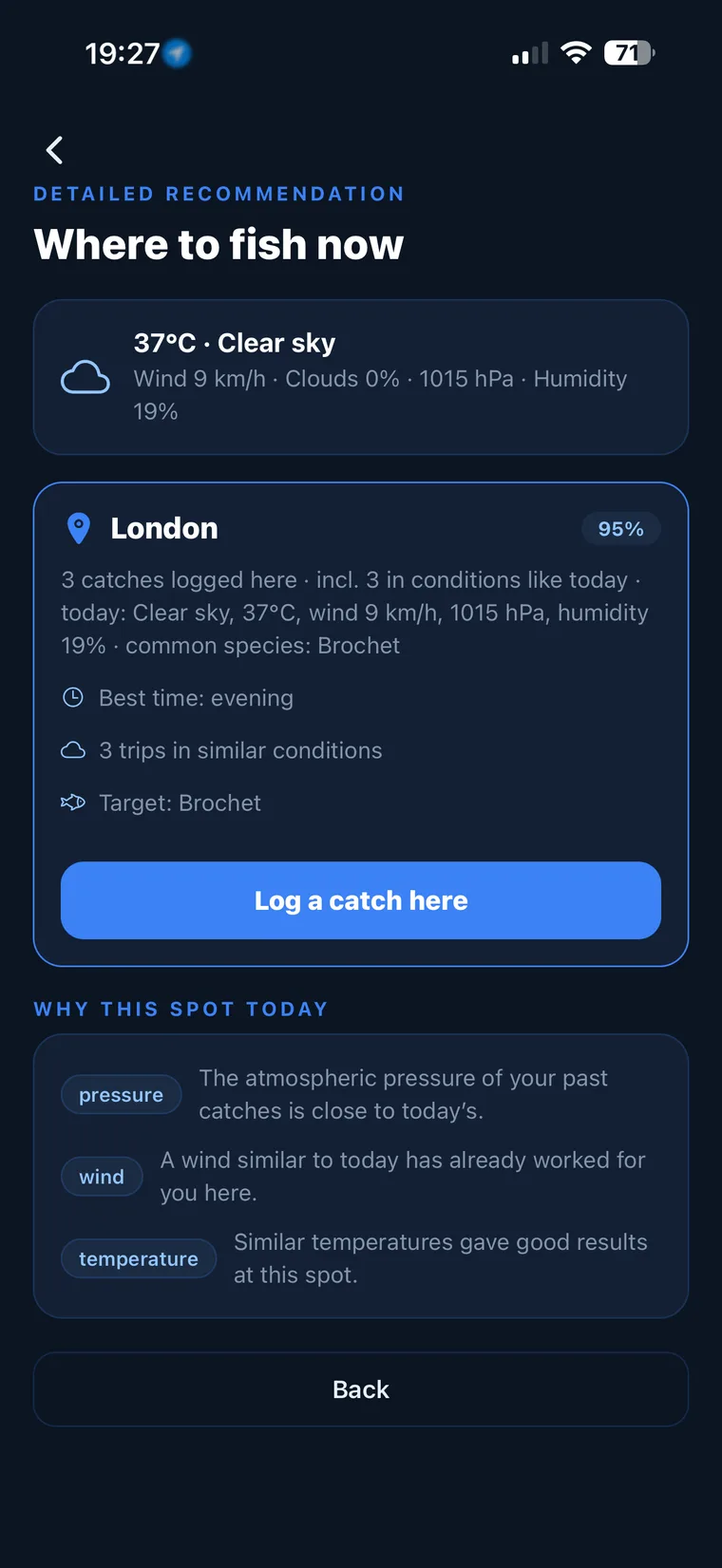
Not sure what to tie on?
Photograph your spot: CarnaFish reads the scene, cross-checks the conditions and gives you the zone, the lure and the retrieve. Free on iOS and Android.
Its windows, and its blind spots
It is at its best:
- On perch grouped on a plateau or a shoal top, between two and three metres, in late summer and autumn.
- On bass sitting on a drop-off after the spawn, when they leave the margins without yet going deep.
- Over gravel and broken rock, where deflections come naturally one after another.
- In lightly stained water, where a regular vibration carries better than a visual signal.
It is out of place:
- In under a metre and a half. You snag constantly; that is squarebill territory.
- Beyond four metres. It will not get there, whatever your technique.
- In dense timber and brush. A long-lipped crank wedges itself in there; a Texas-rigged soft plastic gets through.
- On inactive fish in cold water. A sustained straight retrieve does not suit fish that demand long pauses.
M65 or DT6: plastic against balsa
The Rapala DT6 is the benchmark for the band just above it in the water column, around two metres. It is a balsa crank, with everything that implies: high buoyancy, a fast rise the moment you stop, and a slightly livelier, less mechanical action. That is a real advantage over cluttered bottoms — you stop, it rises, it frees itself — and on fish that like a lure with a strong presence.
The M65 offers the opposite trade-off: a moulded body, a more predictable path, better depth-holding and a crisper deflection. You lose a little of the ability to free itself, you gain precision of layer and consistency from cast to cast.
If you are fishing higher in the column, the Strike King KVD Squarebill covers the zero to one-and-a-half-metre band with a far more violent deflection, cut out for timber. The three together cover the whole useful column in summer cleanly: squarebill along the margins, DT6 on the slope, M65 on the drop-off. And if you do not know what depth to target when you arrive at an unfamiliar water, CarnaFish analyses a photo of the spot and answers.
Our guide to perch fishing with lures goes back over how to locate those groups of fish before choosing your crank.
Key takeaways
- It covers the two to three-and-a-half-metre band, the one squarebills and deep cranks leave empty.
- Cast parallel to the drop-off, never across it.
- Look for bottom contact once every two or three metres: the deflection is what triggers.
- Depth is adjustable without changing lure: line diameter, cast length, rod tip height.
- Off the point in under a metre and a half, beyond four metres, and in dense timber.
FAQ
How deep does the Realis Crank M65 really go?
Between two and a half and three and a half metres depending on the version, with 0.25 to 0.30 mm fluorocarbon and a long cast. A short cast or heavier line can cost it fifty centimetres, which is enough to miss a drop-off.
Should a crankbait touch bottom?
Yes, that is the whole principle. A crank that never hits anything fishes distinctly worse: it is the deflection off a stone, followed by a brief stumble, that draws most of the bites. Aim for contact every two or three metres.
What line should you use?
0.25 to 0.30 mm fluorocarbon straight through. It sinks, which helps with depth, and it transmits contact well. Avoid braid without a leader on this kind of treble-hooked lure, unless your rod is very parabolic.
How do you get it deeper without changing model?
Go from 0.30 to 0.25 mm, lengthen your casts, and fish with the rod low and the tip near the water. Those three adjustments together are often worth close to a metre of extra depth.
How does it differ from a Rapala DT6?
The DT6 is balsa: it floats more, rises fast on the stop and frees itself from cover better, with a livelier action. The M65 has a moulded body, a more predictable path and holds its depth longer on the same cast.
Does it work for perch?
Very well, particularly on perch grouped on a plateau or a shoal top between two and three metres in late summer and autumn. Its 6.5 cm size matches the bait fish they are after at that time of year.
The full perch lure guideSeason-by-season strategy: which family of lure, when, and why.Go from theory to fish
CarnaFish reads your spot from a photo and gives you the game plan: zone, lure, retrieve. Free on iOS and Android.