Bandit 300 Series: the small body that reaches 3.7 m
The right lure in the wrong spot still catches nothing. CarnaFish spots the zone that works, from a single photo.
The fish have dropped. The water cleared up, the temperature fell three degrees in a week, and the bass that were hunting the bank last week are now pinned to the drop-off between 3 and 3.5 m. That is exactly the band of water most shallow crankbaits never touch, and it is the only ground where the Bandit 300 Series has anything to prove.
Same body, a bill three times longer
The 300 Series shares its 2 in body — roughly 5 cm without the bill — with the Bandit 100 Series. Everything else changes: the bill is stretched to almost the length of the lure itself, and the weight climbs to 3/8 oz, a little over 10.5 g. The manufacturer states a range of 8 to 12 ft, that is 2.4 to 3.7 m, in a floating configuration.
That ratio between a tiny body and a 3.7 m dive is what makes the bait interesting. Most crankbaits able to get that deep are bulky, because you need weight to cast far and mass to force the dive. Here you are presenting a 5 cm profile — the size of a young-of-the-year baitfish — to fish holding at a depth normally reserved for big lures. In late summer, when the forage schools are still small, that mismatch makes a real difference.
The trade-off is mechanical: a long bill pulls. The 300 Series resists the rod noticeably throughout the diving phase, and it gets tiring over a full day. A slightly longer rod with a moderate action absorbs that load far better than a short, stiff one.
How to actually reach 3.7 m
A manufacturer's stated depth is always a laboratory depth, measured under specific conditions. Three variables decide what you really get.
The first is cast length. A diving crankbait does not drop vertically: it digs over the first few metres of the retrieve, holds a plateau, then climbs as it nears the rod. A short cast means a short plateau, and sometimes a maximum depth never reached at all. Cast past your target zone and you will fish the plateau instead of the dive.
The second is line diameter. Every extra tenth of a millimetre slows the dive. Fluorocarbon in the 25 lb class gets noticeably deeper than the 35 lb class on an equal cast.
The third is speed. Counter-intuitively, reeling faster does not take the bait deeper past a certain point: beyond the optimal rhythm, the lure starts hunting and rising. A steady medium speed delivers the best depth.
If you never feel bottom, you are not fishing at the right depth, you are fishing open water. With a deep diver, your reference point is not the bite, it is the first touch of the bill on the substrate. Until you feel it, add cast length before you change lures.
Zander, perch and drop-off structure
Across Europe, that 2.4 to 3.7 m band corresponds to channel edges, the heads of drop-offs and the gravel flats of large reservoirs — exactly the early-season zander spots. The 300 Series works there, provided you accept a higher speed than the one usually applied to that fish. Zander will take a fast crankbait when they are active; on apathetic fish, a soft plastic remains the better tool.
Perch respond very well: the big schools often sit on those same breaks, and a 5 cm body with a wide wobble passes through them without spooking them. Bass remain the model's primary target, especially in late summer and autumn on deep bodies of water.
Rigging and line
Snap or loop knot, as with every wide-swimming crankbait: a knot cinched onto the ring chokes the bill and shortens the amplitude. Fluorocarbon in the 25 to 30 lb class is the best balance of stealth, dive and abrasion resistance over gravel. If you fish a pike zone, a thin wire leader remains necessary, accepting that it will lift the running depth slightly.
The mistake to avoid
Tying it on in shallow water just because it is in the box. A deep diver thrown over 1.5 m ploughs the bottom constantly, snags and loses its swim entirely. The 300 Series is only worth it when the spot is at least 30 to 50 cm deeper than its running depth, or when you specifically want to grind a clean hard bottom. Along a bank, go back to the short-billed model.
Not sure what to tie on?
Photograph your spot: CarnaFish reads the scene, cross-checks the conditions and gives you the zone, the lure and the retrieve. Free on iOS and Android.
Colour by water clarity
- Clear water: a natural shad pattern, dark back and pale flanks, still credible at 3 m where the light is already filtered.
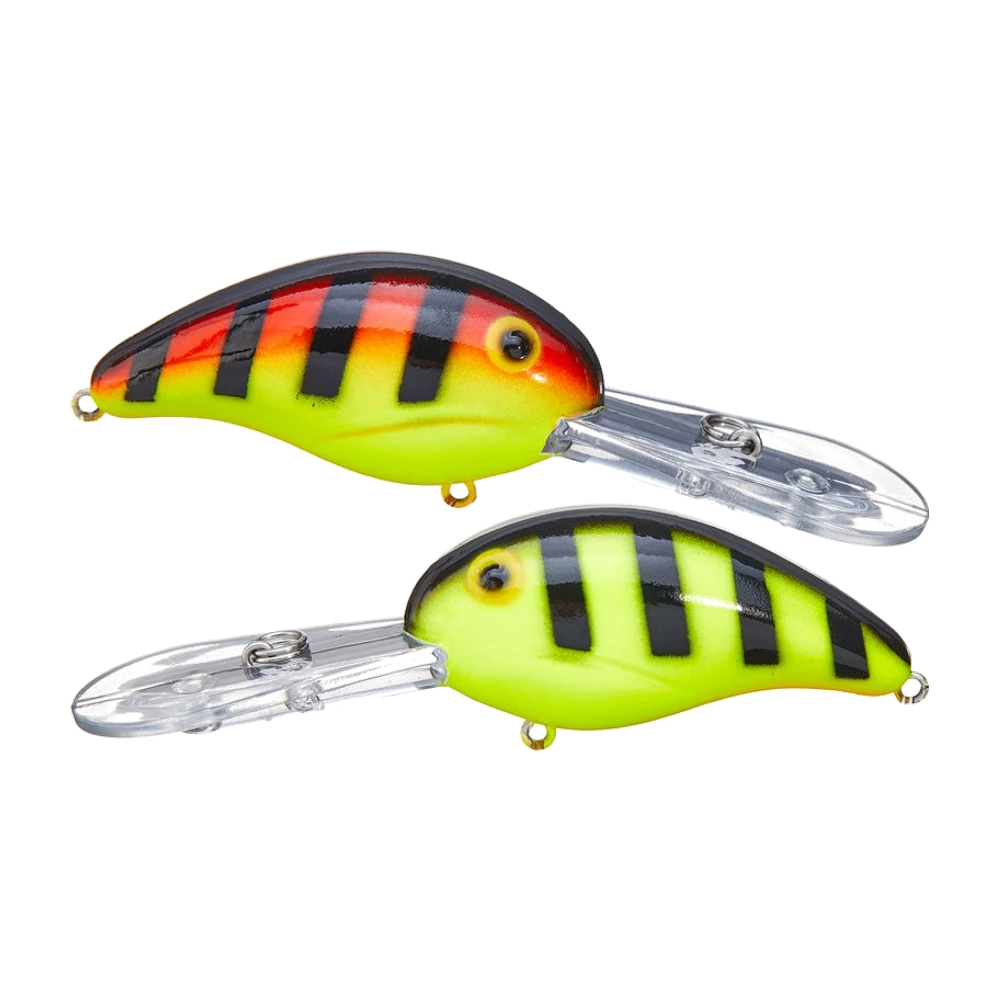
- Stained water: Firetiger, the black-barred orange and chartreuse shown in the photo, which keeps a readable signal down deep.
- Dirty water: black-backed chartreuse, the other finish in the photo. At 3.5 m in loaded water, contrast matters more than realism.
Keep in mind that at this depth red and orange are already heavily attenuated. The finishes that work best remain those built on contrast between a dark back and a pale belly.
Against other deep divers
The 300 Series does not play in the same league as a Bomber Fat Free Shad or a 6th Sense PD10, both far bulkier and built to go deeper still. Its niche is the small silhouette at medium depth — a rare combination, and exactly what makes it useful when the fish are refusing big profiles.
Picking the right bill is pointless if you do not know what depth the fish are holding at that day. That is the whole point of CarnaFish: a photo of the spot, and the app suggests the zone, the depth and the lure type suited to current conditions. To sharpen your reading of drop-offs and bottom structure, our beginner's guide to zander fishing with lures lays out the references to know.
Key takeaways
- A 5 cm body at 10.5 g diving a stated 2.4 to 3.7 m: a small silhouette at an unusual depth.
- Real depth depends first on cast length, then on line diameter, and only then on speed.
- Floating: it rises the moment you stop, which frees it from snags on hard bottom.
- Useless in less than 3 m: in that range, go back to the short-billed model.
FAQ
How deep does the Bandit 300 Series dive?
The manufacturer states 8 to 12 ft, or 2.4 to 3.7 m. The upper figure assumes a long cast and thin line: with a short cast or a heavy diameter, expect the bottom of the range.
Why does my 300 Series never reach bottom?
In the vast majority of cases the cast is too short. A deep diver digs over the first metres then holds a plateau; if the distance is insufficient, it starts climbing before it ever hits maximum depth.
Is it a good crankbait for zander?
It can be, over drop-offs and gravel flats, when the fish are active. It does demand a brisker speed than the one usually applied to zander: on apathetic fish, a soft plastic remains the better choice.
What is the difference with the Bandit 100 Series?
The body is the same 5 cm. The Bandit 100 Series weighs 7 g and stays between 0.6 and 1.5 m on its short bill, while the 300 weighs 10.5 g and dives three times deeper on its extended one.
Do I need a special rod for this lure?
Not special, but suited. A long bill pulls hard during the dive, and a short stiff rod makes the day unpleasant while encouraging pulled hooks with two trebles. A slightly longer medium-power rod with a moderate action is the right compromise.
Does the lure really float?
Yes, the manufacturer classes it as floating. As soon as you stop reeling it rises, which lets you free it from a rock or a branch by simply giving slack instead of pulling.
The full bass lure guideSeason-by-season strategy: which family of lure, when, and why.Go from theory to fish
CarnaFish reads your spot from a photo and gives you the game plan: zone, lure, retrieve. Free on iOS and Android.