Gambler EZ Swimmer: the 4.25 in segmented paddle tail for bass
Rather not fish it blind? Photograph your spot — CarnaFish cross-checks the conditions and points you the right way.
There are days when the 5 in shad you have been grinding for an hour stops drawing anything, while the surface keeps popping with 3 to 4 in fry. Dropping a size costs you a few of the biggest fish but gets the day moving again. The Gambler EZ Swimmer was drawn for exactly that moment: the brand calls it the little brother of the Big EZ, scaled down to 4-1/4 in, which is 10.8 cm. Nothing revolutionary about it, just a well-proportioned paddle tail whose segmented body genuinely changes how it behaves.
A segmented body, not just a shortened shad
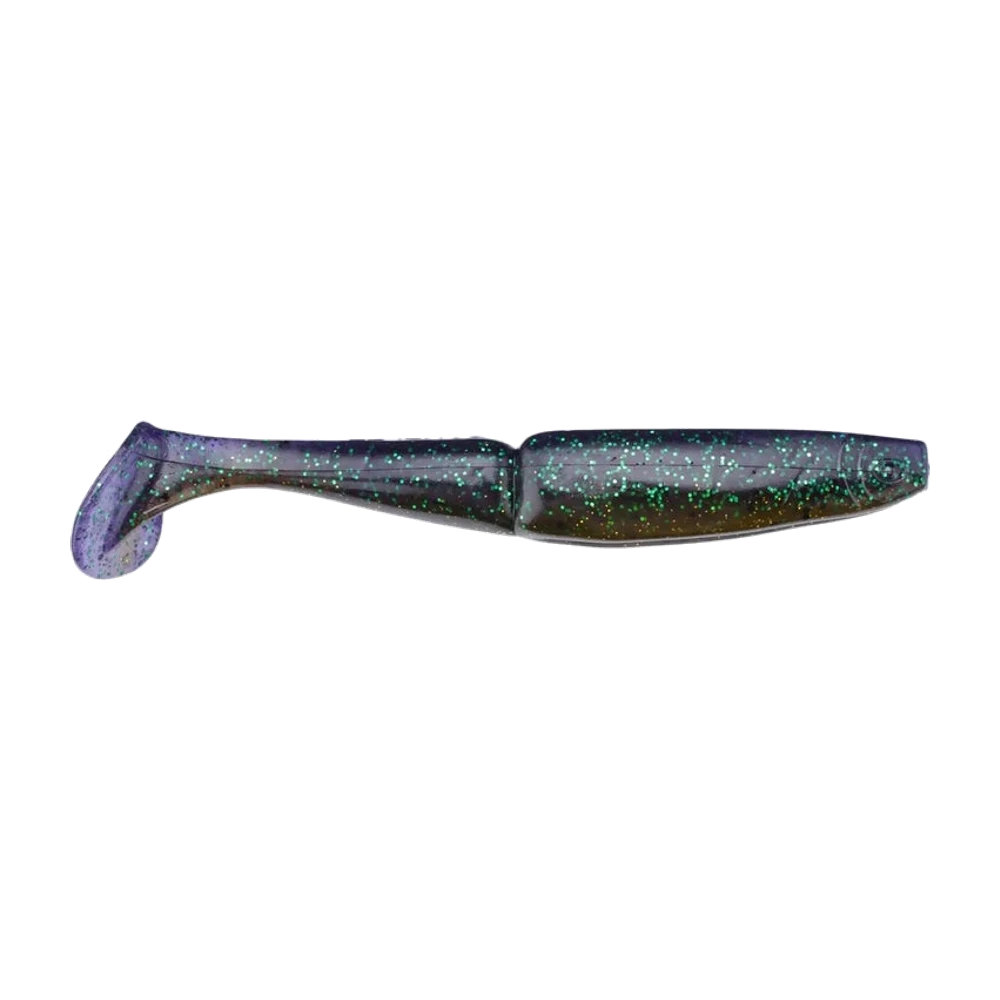
Look at the photo: a segmentation line runs across the body a little behind the shoulder and clearly splits the front section from everything behind it. That is not cosmetic. Gambler credits the thumping swimming action directly to that segmented tail, and the mechanics are easy to follow once you have watched it in clear water.
On a one-piece shad, the paddle's sideways push travels up through the whole body: the lure kicks, but the head rolls a little too, and the faster you wind the more it wants to spin. The segmentation decouples the two masses. The front stays on axis, the section behind the joint swings more freely, and the kick gains amplitude without the head starting to rotate. The description calls the swim erratic, and that should be read literally: it is a swim that is not perfectly metronomic. From one turn of the handle to the next the amplitude shifts slightly, and that small lack of regularity is often what pulls a reaction out of a fish that has already watched ten flawless swimbaits go past.
The practical upshot is that the EZ Swimmer does not need speed to switch on. The tail works from the first few turns of the handle, so you can creep it over a weed flat without it going dead, which is not true of every paddle tail this size.
Weight: what the maker does not tell you
Worth saying straight away, because it is the question that comes up at the tackle counter. The spec table Gambler publishes for this bait has two columns: length and quantity. That is 4-1/4 in and seven baits per pack. No weight line, no density column. So there is no published individual weight, and no official buoyancy rating either, and I am not going to invent one for you.
That is not a scandalous omission, it follows from the product: an unrigged soft swimbait has no fishing weight of its own. What you cast, what you feel through the rod and how fast the bait sinks depend almost entirely on the weighted hook or the lead you add. Always think in terms of total rigged weight, never the weight of the bare bait.
The two rigs Gambler recommends, plus a third
Belly-weighted hook
This is the first option the maker lists and the simplest. A swimbait hook with lead moulded under the shank, nose-hooked through the back with the point flush or buried. The advantage over a conventional jig head is that the weight sits under the belly rather than bunched up in front of the nose, so the bait rides flat and the segmentation keeps its freedom. Figure 3 to 7 g depending on depth and wind. This is the rig to favour over weed and along edges.
Screw-in weight
The second option listed: a screw-in weight driven into the nose and paired with a wide-gap single hook rigged Texas style. It holds far better under load than simply threading the bait on, and it is the cleanest answer as soon as there is laydown timber or pad stems about. The bait tears off less often, which matters on a seven-pack.
Round jig head, as a bonus
Gambler does not mention it, but a light round head works very well on this profile, particularly in Europe for zander on hard bottom. Stay on the lightest weight that keeps you in contact: the classic mistake is the 15 g head that pins the bait down and cancels everything the segmentation was for. If you want a shad designed from the start around a heavy head and vertical work, a Keitech Easy Shiner 4 will do that job better.
Before you cast, swim the EZ Swimmer a foot under the rod tip where you can see it. If it leans on one flank or pulls to one side, the hook has gone in crooked: you lose most of the kick and you put line twist into your braid without noticing. A badly threaded soft bait takes ten seconds to fix, a twisted leader costs you half an hour.
Speed, rhythm and when to pause
Slow straight retrieve is the baseline: fast enough to feel the paddle working in the blank, no faster. The most common error is winding too quickly because you cannot feel enough: a 10.8 cm paddle on a 5 g weight transmits very little vibration to the hand, which does not mean it is not swimming.
Stop and go suits it particularly well thanks to the segmentation: on the pause, the rear section carries on travelling for a fraction of a second before the bait starts to drop. That is precisely the window in which a following bass makes up its mind. Alternate five or six turns of the handle with a one-second stop along a reed edge and count how many bites land on the restart rather than mid-retrieve.
The classic mistake
Treating the EZ Swimmer like a zander shad and weighting it accordingly. This bait was born for a shallow, horizontal, edge-oriented game with a discreet weight. Rigged on 20 g to reach 8 m of water it still functions, but at that game a longer one-piece shad does better. Keep it for the first metre of water over weed and for shallow breaks.
Not sure what to tie on?
Photograph your spot: CarnaFish reads the scene, cross-checks the conditions and gives you the zone, the lure and the retrieve. Free on iOS and Android.
Colours by water clarity
- Lightly stained water: the translucent purple with green flake shown in the photo, a dark but living tone that stays readable without going full silhouette.
- Weedy, green water: green pumpkin, the universal reference point in bass plastics, discreet and never a handicap.
- Clear water over silver baitfish: pearl white or translucent flake, imitating a young roach or bleak without excessive flash.
What it adds to the box
The EZ Swimmer does not replace a very regular swimmer such as the Strike King Rage Swimmer: it brings something else, a kick that is less tidy and wider. If you need to drop further in size on a day when the fish are genuinely eating small, the Gambler TZ Swimmer 3 carries the same idea at 7.6 cm. And when it is vibration rather than size you need to raise, the Gambler EZ Vibez adds a fully ribbed body to the same principle.
Picking the right shad does not help much if the zone is wrong, which is exactly what CarnaFish is built to solve: a photo of the spot, and the AI suggests the water to attack, the depth and the type of presentation that fit the day's conditions. To lay down the tackle basics and learn to read bass lies, our beginner's guide to bass fishing is still the right place to start.
Key takeaways
- The body segmentation decouples front from rear: more tail amplitude, less spin when you speed up.
- Gambler publishes neither an individual weight nor a buoyancy class: only length, 10.8 cm, and quantity, seven per pack.
- Belly-weighted hook or screw-in weight are the two rigs the brand lists; in both cases stay on the lightest weight that works.
- This is a shallow, edge-fishing bait, not a shad for heavy lead.
FAQ
How much does a Gambler EZ Swimmer weigh?
The maker does not say: the table gives only length, 4-1/4 in, and quantity, seven per pack. As with any unrigged soft swimbait, the weight that matters on the water is that of the weighted hook or lead you pair it with.
Does it float or sink?
No density rating is published for this model, so it cannot be stated. In practice the question barely arises: the weight you add decides the sink rate and the running depth.
What hook size should I use?
A swimbait hook from 3/0 to 5/0 depending on how soft the plastic feels and how thick the cover is. Thread it straight: an EZ Swimmer rigged off-axis leans on one flank, loses its kick and twists the line.
Is it a good zander bait?
Yes. In Europe the 10.8 cm format matches zander on hard bottom well, rigged on a light round head. Keep in mind that the bait is designed for shallow horizontal work: for true vertical fishing a denser shad will suit you better.
How does it differ from the Big EZ?
Gambler presents the EZ Swimmer as the little brother of the Big EZ: the same swimming idea in a reduced profile. You switch to the EZ Swimmer when the fish lock onto small baitfish and the bigger profile stops drawing strikes.
How many baits are in a pack?
Seven, according to the maker's table. That is not many if you fish tight cover, which is an argument for the screw-in weight rig, since it wears the nose of the bait out far more slowly than simply threading it onto a hook.
The full bass lure guideSeason-by-season strategy: which family of lure, when, and why.Go from theory to fish
CarnaFish reads your spot from a photo and gives you the game plan: zone, lure, retrieve. Free on iOS and Android.