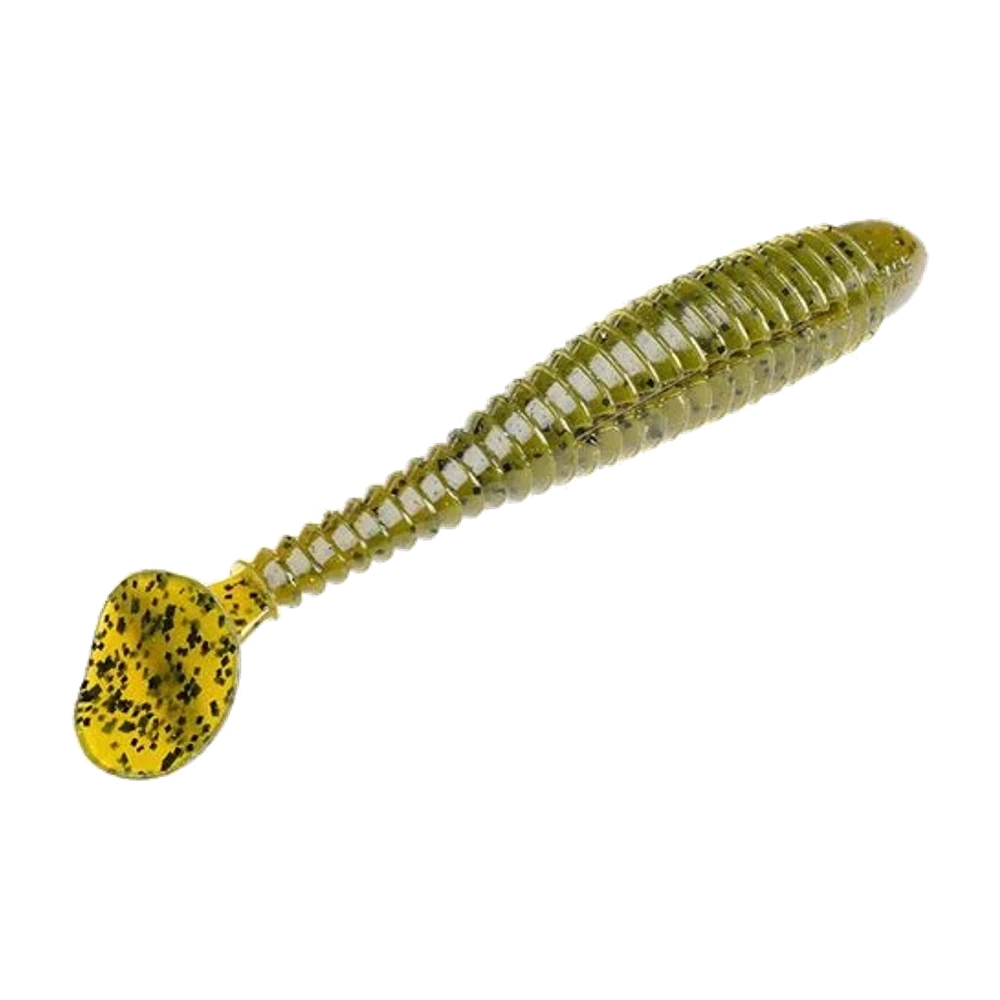
Strike King Rage Swimmer: the shad you retrieve fast when you need to find the fish
Before tying this one on, it helps to know if the spot actually calls for it. CarnaFish reads the scene from a photo.
There are two ways to fish a soft shad. The first, the one everyone teaches, is to slow down: slow pulls, pauses, bottom contact. The second is the opposite — retrieve fast, straight, to cover three hundred metres of bank in an hour and find where the active fish are.
The problem is that most shads cannot take the second. Past a certain speed threshold the tail stalls, the lure rolls onto its flank, rises to the surface and spins on itself. You are forced to slow down, and therefore to give up searching.
The Rage Swimmer is built for that precise window: a deliberately oversized tail that keeps biting into the water when you speed up, and a body that takes the torque it generates without going into a spin.
A tail calibrated for speed, not for slowness
On a standard shad the tail is thin and its joint is soft: it starts at very low speed, which is perfect for slow fishing — that is the whole logic of the Westin ShadTeez or the Keitech Easy Shiner 4. But that same slimness is what makes the tail stall when the flow gets too strong.
The Rage Swimmer takes the problem from the other end. Its tail is wide, thick at the base, and set almost perpendicular to the body. In practical terms:
- The beat is very wide and drags the whole rear of the lure into a pronounced roll. This is not a discreet action, it is a strong signal.
- The vibration carries. In stained water, a fish sitting three or four metres off the path picks it up on its lateral line before seeing it.
- The lure holds its attitude at high speed. That is the practical difference: you can wind twice as fast as with a finesse shad without losing control.
The trade-off is clear: at very low speed this lure is less convincing than a thin-tailed shad. That is not its ground, and trying to fish it slowly in cold water is the main mistake you can make with it.
The rig decides what you can fish
Three ways to rig it, giving you three different lures.
Weighted weedless swimbait hook. This is the reference rig. The hook runs along the axis, point brought back into the lure's back, and the weight sits on the shank. You get through branches, lilies and drowned wood without snagging, and you control depth with the grammage.
Classic round jig head. More bottom contact, a better hookup rate, but you can no longer fish cluttered zones. Keep it for clean bottom, particularly for zander over gravel.
Chatterbait or spinnerbait trailer. The flat body and the wide tail sit very well behind a blade. You gain bulk and vibration without losing the ability to run fast.
| Target depth | Rig | Weight |
|---|---|---|
| 0 to 1 m, over weed beds | Weedless swimbait hook | 3.5 to 5 g |
| 1 to 2.5 m, margins and wood | Weedless swimbait hook | 7 to 10 g |
| 2.5 to 4 m, drop-offs and hard bottom | Round jig head | 10 to 14 g |
| The whole layer, stained water | Chatterbait trailer | as per the chatterbait |
On the water: when you are searching a bank with the Rage Swimmer, do not retrieve at a constant speed. Every five or six turns of the handle, cut dead for half a second then start again. The tail closes, the lure tips slightly onto its flank, then sets off again. Almost every bite on this lure comes within the second following that restart — never in the middle of a steady retrieve.
The retrieve: straight, but not monotonous
- Cast parallel to the bank, not perpendicular to it. You keep the lure in the useful zone for the whole length of the cast instead of pulling it out in three turns.
- Count the drop if you are targeting a depth: two to three seconds is enough for a metre with a 7 g weight.
- Retrieve steadily, rod at ten o'clock, at a speed where you clearly feel the tail beating in the rod tip. If you cannot feel it any more, you are going too slowly.
- Cut for half a beat every five or six turns, then restart immediately.
- Strike by pulling, not by lifting sharply, especially on a weedless rig: the hook has to come through the plastic first.
In colder water or on sluggish fish, the only useful variant is the slow roll: you drop the speed to the minimum at which the tail still beats, and retrieve shaving the bottom. Below that threshold, change lure rather than persist.
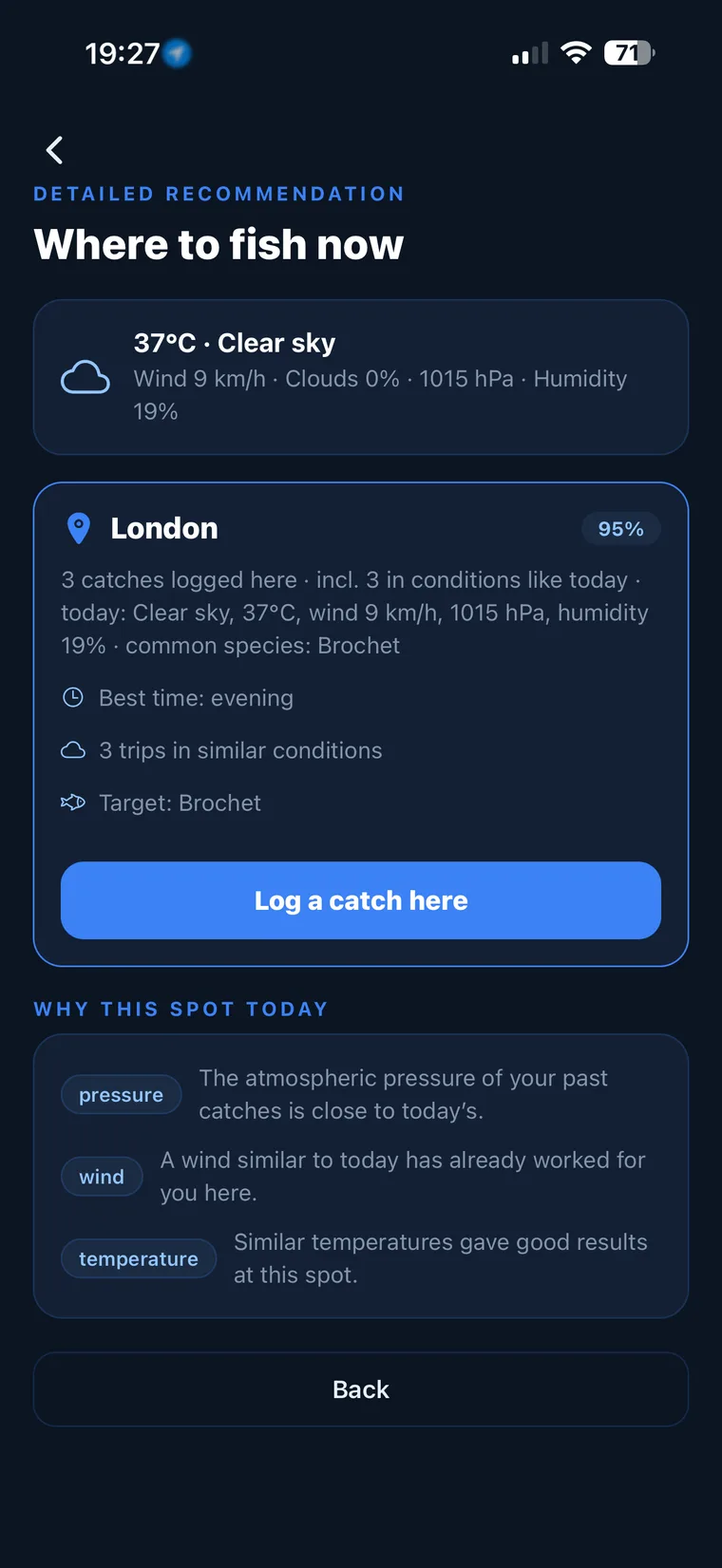
Not sure what to tie on?
Photograph your spot: CarnaFish reads the scene, cross-checks the conditions and gives you the zone, the lure and the retrieve. Free on iOS and Android.
Bass and zander: two distinct uses
For bass, this is a lure for cluttered margins and the warm season. Lilies, dead wood, jetties, submerged weed: the weedless rig goes everywhere, the vibration pulls fish out of their cover, and the fast retrieve lets you treat a lot of spots in a day. Mid sizes, around 9 to 11 cm, cover most of it.
For zander, the use is narrower and often misunderstood. Zander are not generally a fast-retrieve fish — but during feeding phases, when they pin bait in open water or move up onto flats at the end of the day, a high-vibration shad retrieved fast takes markedly more than slow fishing. Rig it on a jig head, target the layer where the bait shows, and retrieve straight and sustained.
Where it does not fit: very clear water and wary fish, cold water below eight degrees, and vertical fishing. In those three cases a thin-tailed finesse shad will do better.
Rage Swimmer or a slow-swimming shad
The difference comes down to one sentence: they are not fished at the same speed and they do not serve the same moment of the session. A Keitech Easy Shiner 4 is what you tie on when you know where the fish are and you need to make them decide. The Rage Swimmer is what you tie on before that, to find out where they are.
The method that works is to run the two in sequence: sweep with the Rage Swimmer until you get a bite or a follow, then go back over the same sector slowly with a finesse shad. The first finds, the second converts.
If you mostly fish cluttered zones, look also at the Texas rig, which pushes the snag-free logic further still at the cost of a little speed. Our beginner's guide to bass fishing covers how to organise a bank search. And if you are unsure what speed to give when you reach the bank, CarnaFish analyses a photo of the spot and answers.
Key takeaways
- Oversized tail: the lure holds its attitude at speeds where a slim shad stalls.
- This is a searching lure, not one for slow fishing in cold water.
- Weedless swimbait hook for cluttered zones, jig head over clean bottom.
- Cut the retrieve for half a second every five turns: the bite comes on the restart.
- For zander, keep it for open-water feeding phases, not for slow bottom fishing.
FAQ
How fast should I retrieve the Rage Swimmer?
Fast enough to feel the tail beating clearly in the rod tip. If the vibration disappears, you are below the lure's working threshold. In practice that means a sustained straight retrieve, faster than for a classic finesse shad.
What hook should I use?
A weighted weedless swimbait hook, with a weight of 3.5 to 14 g depending on the target depth, is the reference rig. Over clean bottom a round jig head improves the hookup rate but rules out cluttered zones.
Does it work for zander?
Yes, but in a specific window: feeding phases, when zander are following bait in open water. Rig it on a jig head then and retrieve straight and sustained through the active layer. For slow bottom fishing, a thin-tailed shad suits better.
Can I use it as a chatterbait trailer?
Yes, and it is one of its best uses. The flat body sits neatly behind the blade and the wide tail adds bulk and vibration without unbalancing the whole thing or capping the speed.
What size should I choose?
Around 9 to 11 cm for bass and zander in general. Drop towards 7.5 cm when the water is clear or the bait is small, and go up to 12 cm when you are after big fish or the water is coloured.
Why do my bites always come at the same moment?
Because most attacks are triggered by a break in rhythm, not by a steady swim. If you briefly cut the retrieve every five or six turns of the handle, you create those breaks deliberately instead of waiting for them to happen by chance.
The full bass lure guideSeason-by-season strategy: which family of lure, when, and why.Go from theory to fish
CarnaFish reads your spot from a photo and gives you the game plan: zone, lure, retrieve. Free on iOS and Android.