6th Sense Option Swimbait: two hook positions, two ways to fish
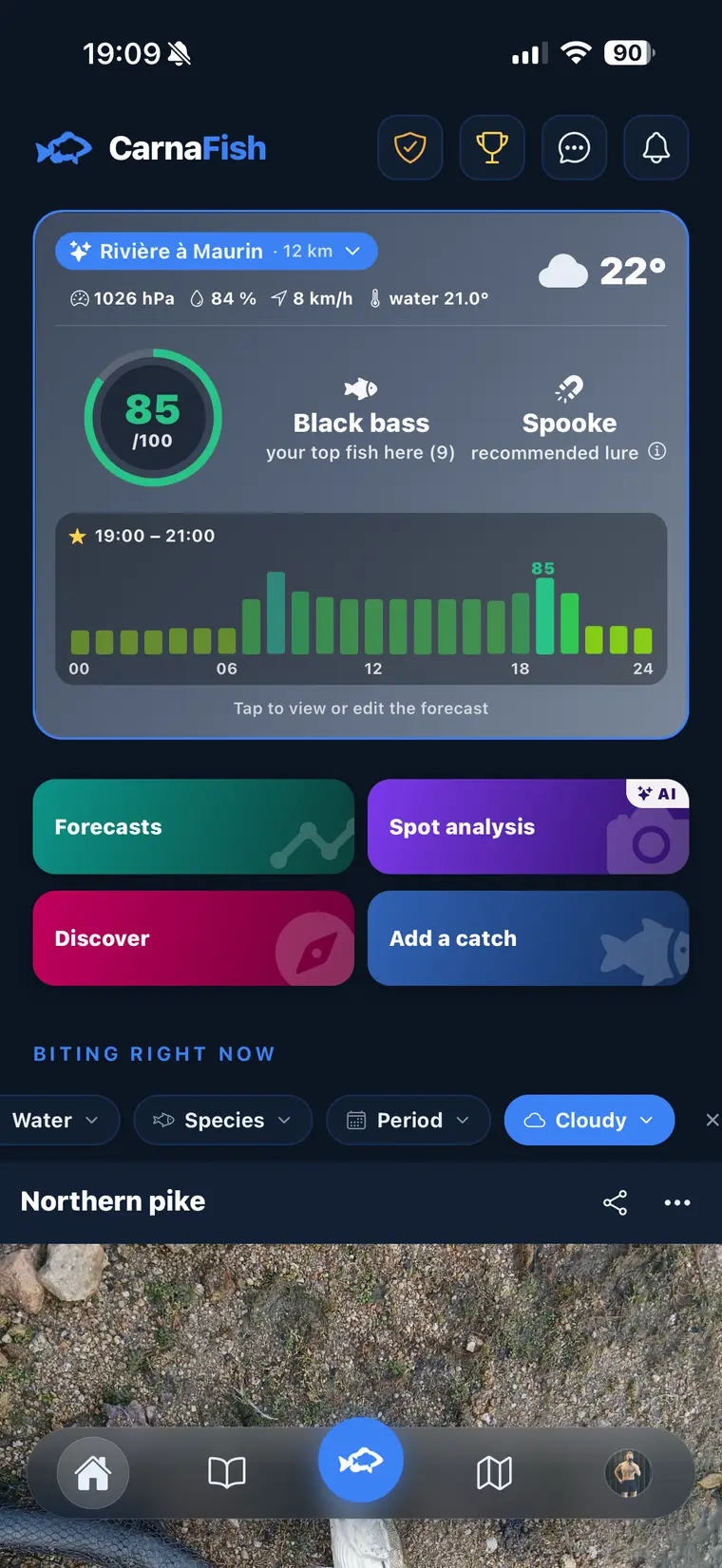
Not sure this lure fits YOUR spot today? CarnaFish tells you in 10 seconds, from a photo.
You are fishing the edge of a submerged weed bed, the kind of area where baitfish gather in late summer. A soft swimbait would be perfect there — except the back treble picks up a handful of vegetation every second cast, and a swimbait dragging weed catches nothing. Most anglers change baits at that point. The Option Swimbait suggests changing the hook position instead.
Two hangers, and what that actually changes
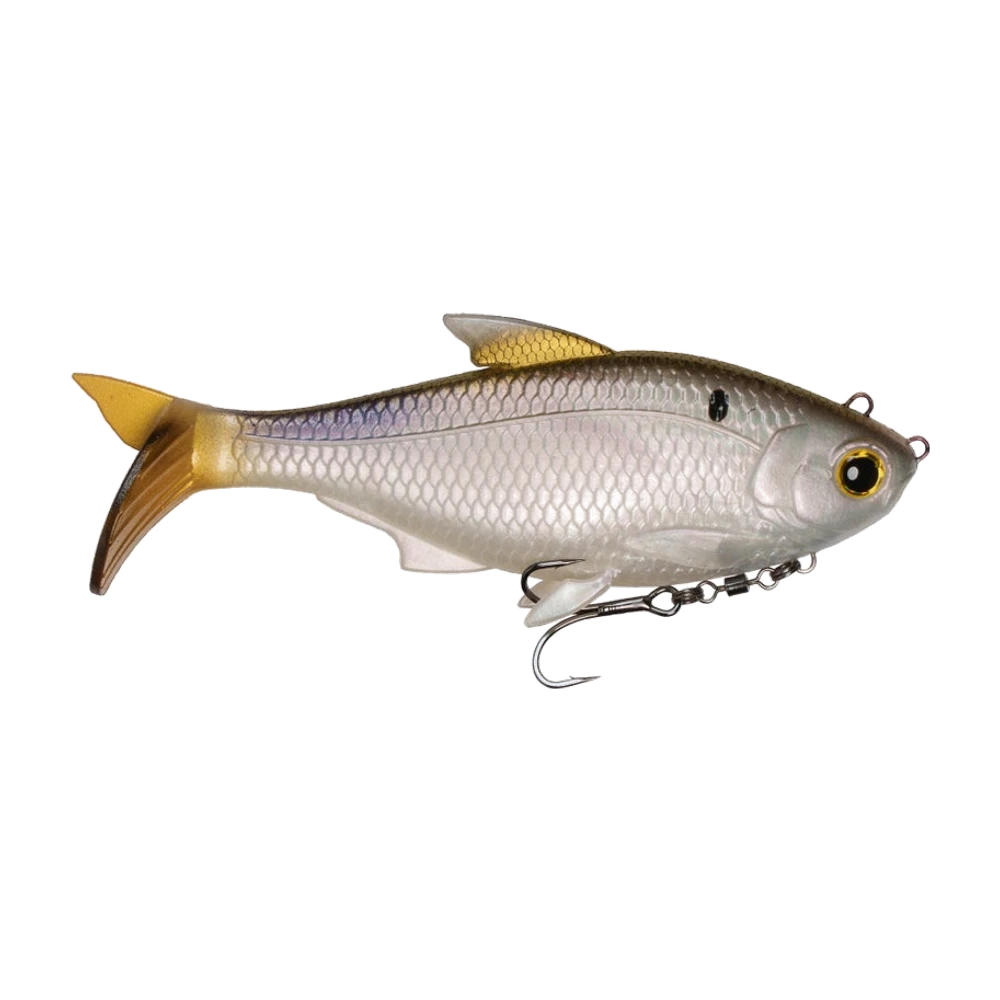
The Option Swimbait's treble is not moulded into the body: it is mounted on a barrel swivel joined by two split rings, an assembly you can unclip and reclip in seconds. And the back of the bait offers two distinct hook hangers.
The bottom hanger sets the treble under the belly, in the classic open-water swimbait position. The points are clear, the penetration angle is ideal, and this is the set-up to use whenever you fish out from a weed bed, along riprap or on a defined break. On a fish that strikes from behind or from below, this is the setting that converts the most bites into fish in the net.
The top hanger lifts the treble up against the back. 6th Sense built a split dorsal fin for that purpose: the treble drops into the slot and sits flush against the body instead of standing out. You give up a little hook exposure, but you gain the ability to bring the bait over a mat of vegetation, across a brush-filled shallow or through a lily field without harvesting half the spot.
Swapping from one position to the other takes less time than retying a leader. That is the practical value of the system: you adapt the bait to the spot rather than the spot to the bait.
Check the treble's orientation every time you bring the bait in, especially on the top hanger. A treble that has rotated a quarter turn on its split ring turns the bait into a spinning mess on the first turn of the handle, and you can fish ten minutes without working out why it no longer tracks straight.
A tall body and a weighted harness
The Option Swimbait has a profile clearly taller than it is wide. That choice targets a broad range of forage: in European fresh water, a tall body reads as a roach, a young bream or a small perch far more than as a slim, torpedo-shaped fish. It is also a silhouette visible from a distance and from the side, which matters when you fish water that is slightly stained.
Inside, a precisely positioned weighted harness gives the bait its attitude and its self-swimming ability. It is the same principle as on a Megabass Magdraft: the internal ballast replaces the jig head, the bait sinks level and swims straight with no tuning. You cast, you reel, the bait works.
The oversized rounded tail does the rest. It produces three things at once: a wide lateral kick, a deep thump you feel in the rod, and a head roll that travels through the whole body. That combination is what separates a swimbait from a plain paddle-tail shad — the action is not only at the back, it runs through the bait.
Picking a size for the fish you are after
Three sizes, three genuinely different jobs.
9.5 cm / 3.75 in for around 24 g
The all-round bass size. It casts on a standard medium-heavy rod, goes anywhere, and stays small enough not to scare an average fish. This is the size to start with if the bait is new to you and you fish normal-sized European waters.
12.7 cm / 5 in for around 40 g
The big-bass size and the first one genuinely credible for pike. Forty grams demand a heavy rod and a properly set drag, but you gain casting distance and signal volume. In Europe this is probably the most interesting version for a predator angler, because it covers two species.
17.8 cm / 7 in for around 88 g
A hunting size, reserved for pike and the very biggest bass in large lakes. Eighty-eight grams is a bait that requires a dedicated swimbait rod, not a compromise. On a pike water this size sorts the fish: fewer bites, but bites that count. Note that a steel or titanium leader becomes mandatory here — an eighty-centimetre pike cuts 0.40 mm fluorocarbon without effort.
The classic mistake
Going up a size beyond what the rod can handle. An 88 g bait cast on a standard heavy rod gives short casts, line twist and, sooner or later, a broken tip. The other mistake, less visible, is trying to work this bait with the rod: the weighted harness and the tail are calculated for a clean straight retrieve. Twitches only disorganise the swimming action.
Where and when it stands out
The Option Swimbait is a search bait for areas where fish are active but scattered: two to four metre flats, weed bed edges, riprap banks, the back ends of arms. Its self-swimming action lets you cast far and reel without thinking, which is exactly what you need to cover ground.
Its best windows are spring after the spawn and late summer, when forage schools are concentrated and predators are patrolling. In very cold water, on the other hand, a wide-kicking swimbait often comes through too fast and too loud: a lightly rigged finesse shad such as a Keitech Fat Swing Impact 4.8 will suit better.
Its main limitation is the cost per bait lost. A weighted soft swimbait this size wears out: the treble mount works the plastic, and a pike hit on a 12.7 cm can tear the back open. That is not a flaw specific to this model, it is the entry price of the whole family.
Not sure what to tie on?
Photograph your spot: CarnaFish reads the scene, cross-checks the conditions and gives you the zone, the lure and the retrieve. Free on iOS and Android.
Colours by water
- Clear water: a silver baitfish imitation with 3D scales and large eyes. The realistic finishes of this line pay off fully when the fish sees the bait from a distance.
- Stained water: dark back and pale belly, a vertical contrast that stays readable as soon as visibility drops under a metre and a half.
- Cluttered bottom or perch present: a contrasted roach or perch pattern, which stands clear of a background of branches or vegetation.
Between the paddle-tail shad and the glide bait
The Option Swimbait sits in a precise place between two families. Against a shad on a jig head, it brings self-swimming ability, bulk, and an external treble that hooks side-on strikes better. Against a hard glide bait such as the Deps Slide Swimmer 175, it is far simpler to fish — no cadence to find, no rhythm to work on — but it triggers fewer of the very big passive fish.
The right bait is still the one that matches the spot, and that is where CarnaFish earns its place: a photo of the spot, and the AI suggests a zone, a depth and a lure family suited to the day's conditions, before you even have to choose between three swimbait sizes. If pike is what you are after with the larger sizes, our guide to choosing a pike lure puts this kind of swimbait back in context among the available families.
Key takeaways
- Two hangers along the back: bottom position for open water and the best hook-up rate, top position with the split fin to come over vegetation.
- Internal weighted harness and oversized rounded tail: the bait swims on its own on a straight retrieve, kick, thump and head roll included.
- Three sizes, three jobs: 9.5 cm for bass, 12.7 cm for big bass and pike, 17.8 cm for pike and dedicated tackle only.
- From the 12.7 cm size upwards on pike water, a steel or titanium leader is mandatory.
FAQ
What are the two hook positions for?
The bottom hanger sets the treble under the belly, the most effective position for hooking in open water. The top hanger pins it against the back, inside a split dorsal fin, so you can bring the bait over vegetation without catching weed.
Which size should I start with?
The 9.5 cm version at around 24 g casts on a standard medium-heavy rod and suits most waters. The 12.7 cm is more versatile if you also fish for pike, but it already requires a heavy rod.
Do I need to work the Option Swimbait with the rod?
No. Its internal weighted harness and its tail are calculated for a straight retrieve. Rod twitches only disorganise the swimming action without adding any appeal.
What leader should I use?
Heavy fluorocarbon is enough on pure bass water. As soon as pike are present, and in particular with the 12.7 and 17.8 cm sizes, a steel or titanium leader becomes essential.
Does the bait really come through weed?
In light to moderate vegetation, yes, with the treble on the top hanger seated in the split fin. In a dense mat of lily pads or milfoil, no bait with an external treble truly comes through: a Texas weedless rig is the answer there.
What is the difference with a shad on a jig head?
The ballast is internal and the hook is an external treble. The bait therefore sinks level with no tuning and hooks side-on strikes better, but it is more expensive and more fragile than a Keitech Fat Swing Impact 4.8 on a jig head.
The full bass lure guideSeason-by-season strategy: which family of lure, when, and why.Go from theory to fish
CarnaFish reads your spot from a photo and gives you the game plan: zone, lure, retrieve. Free on iOS and Android.