Geecrack Bellows Shad Floating Elastomer: the trailer that never lies down
This lure shines under specific conditions. CarnaFish tells you in 10 seconds if today is one of them.
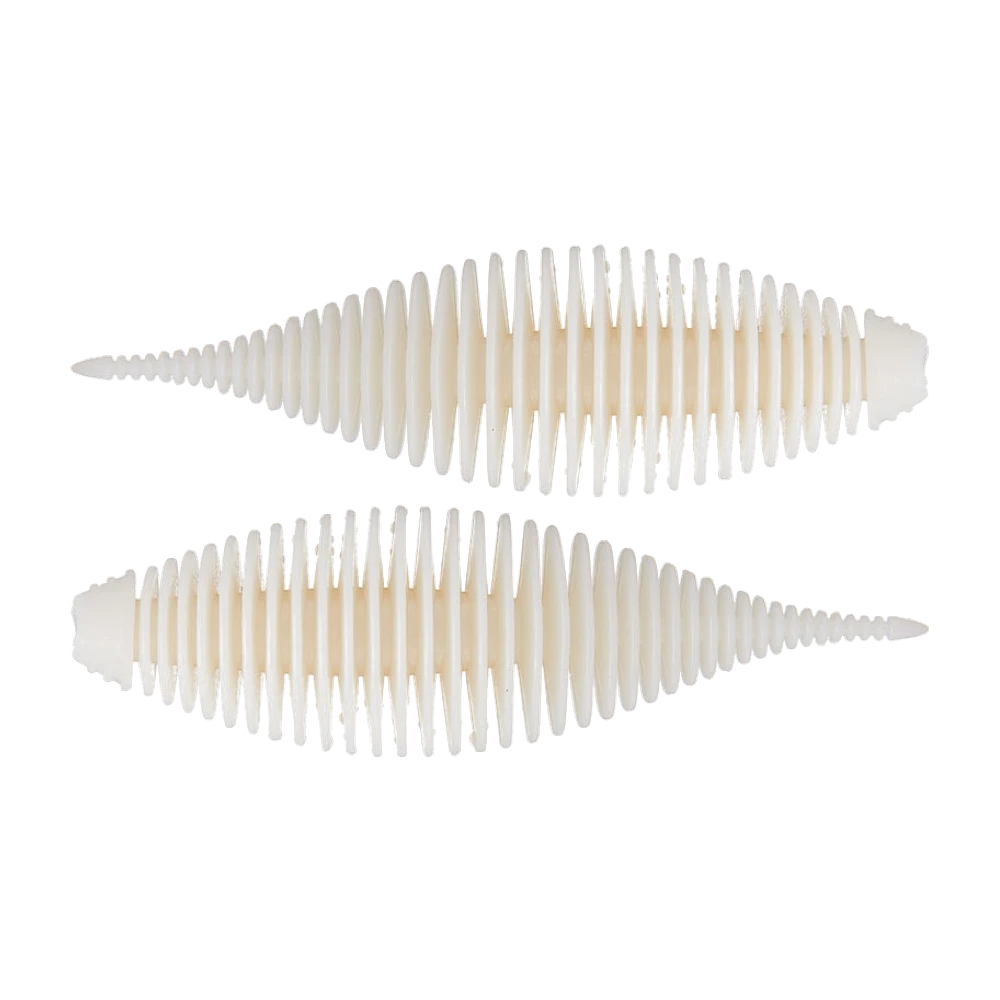
There is one moment in a fishing day that almost no soft plastic handles well: the pause. You drop the bait beside a piece of cover, you stop working it, and instead of staying visible it collapses onto the bottom and vanishes into the silt. The Geecrack Bellows Shad Floating Elastomer exists because of that problem: same body, same size as the original Bellows Shad, but a plastic that floats. The bait no longer lies down, it stands up.
What the maker actually states
For once, the numbers are clear. The table in the description runs two columns, Length and Quantity, and gives 3.8 in and 3 pieces per pack — roughly 9.7 cm long. Careful not to read that 3pk as a weight: it is the pack count, not a mass. Geecrack publishes no per-piece weight for this bait, and you won't find one on the dealer page either.
Buoyancy, on the other hand, is stated outright: the maker describes this rendition as floating, and explains that this is exactly what sets it apart from the original. It also states that it keeps the size and profile of the standard Geecrack Bellows Shad, for which no dimensions are published — which is, in fact, the only way we know the original's size at all.
Why elastomer changes the equation
Elastomer is not plastisol. It is an elastic compound, far more tear-resistant, which absorbs dozens of fish where a conventional soft plastic splits on the third. Geecrack calls the design indestructible; in practice, the real benefit is that you stop replacing the bait after every missed bite, and that changes the rhythm of a day on the water.
That toughness has a downside nobody prints on the packaging. Elastomer dislikes prolonged contact with plastisol baits: left together in a box, the two materials react and eventually melt into one another. Keep them in their original bag or in a separate compartment — that is the only real handling precaution.
A second consequence, less intuitive: elastomer is slippery. A bait that spins on the hook during the cast ruins the presentation. Always rig it with a wire keeper or a drop of glue on the shank — the two minutes spent rigging save you from straightening the bait every fifth cast.
What the buoyancy actually buys you
Neko rig
This is the use the maker puts first, and it is the most telling. A tungsten nail in the head, a hook through the middle of the body, and the Bellows Shad stands nose-down with its tail pointing at the surface. With a conventional soft plastic the tail eventually sags as soon as you stop working it; here it stays upright, and the deep rings keep shivering in the faintest current. On a fish holding beside a rock, that motionless shiver works for you while you do nothing at all.
Spinnerbait or jig trailer
Rigged behind a blade or on a skirted jig, the effect is different but just as useful. On the pause, the back of the bait lifts slightly, which stands the whole rig up instead of letting it topple flat on the bottom. The jig takes a defensive posture, claws or tail raised, exactly what a threatened crayfish does. That is a nuance very few trailers can produce.
Weighted Texas rig for flipping
The compact profile is the original model's: nothing sticking out, nothing to snag. A 7 to 14 g bullet, a wide-gap hook, and you drop into laydowns cleanly. The body's buoyancy slows the fall a little further, which is sometimes an advantage — on lethargic fish — and sometimes a nuisance when you need to get down fast in strong wind. In that case step up one weight rather than changing baits.
When the buoyancy becomes a drawback
Let's say it, because it rarely gets written: there are situations where this bait is the wrong choice. Fishing deep vertical, a soft plastic that rises on every pause forces you to restart the descent constantly and loses you the depth you had gained over a series of hops. In river current, the buoyancy lifts the back of the bait and sends it drifting well above the seam you were targeting, which ruins any bottom-hugging presentation. And in strong wind, the combination of a body that floats and a weight that must be heavier to compensate makes bite detection markedly coarser than with a dense soft plastic.
In those three cases, go back to a conventional plastisol bait and keep the elastomer for what it does well: holding a posture at rest over an identified zone, in shallow or mid depths. It is a bait for a known spot, not a bait for covering water.
Not sure what to tie on?
Photograph your spot: CarnaFish reads the scene, cross-checks the conditions and gives you the zone, the lure and the retrieve. Free on iOS and Android.
SAF, the house scent
Like every Geecrack soft plastic, this version is loaded with SAF — Salt, Aminos, Flavor. The salt densifies the compound, while the amino acids and flavour extend how long a fish holds the bait. On a Neko rig fished by line watching, where you sometimes only register the bite as the line moves off, those extra tenths of a second genuinely change the hook-up rate.
Colour by water clarity
- Clear water, bright light: a pearl white, very easy to track when sight fishing and believable over pale gravel or sand.
- Hard bottom, neutral water: a green pumpkin, the all-purpose tone of American finesse, discreet and never a handicap.
- Muddy water or low light: a dark tone, relying on a crisp silhouette rather than on colour.
The maker advertises a wide assortment without naming a reference finish, so think in tone families.
Where it sits against the rest
Against a Z-Man TRD Ned Rig, the other reference in floating elastic compound, the Bellows Shad Floating Elastomer plays a different tune: the TRD is a stubby stick on a jighead, this Bellows Shad is long, ribbed and designed to be carried by something else or stood up on a Neko rig. And against a Yamamoto Senko 4 on a Neko rig, it trades the shimmy on the fall for a held posture and a lifespan in a different league.
The remaining question is where to put the bait. That is exactly the time CarnaFish saves you: a photo of the spot, and the app suggests the zone, the depth and the presentation type suited to the day's conditions. To learn how to spot the places where a motionless presentation makes sense, our guide to reading a fishing spot lays out the method.
Key takeaways
- Published dimensions: 3.8 in, roughly 9.7 cm, three to a pack. No per-piece weight communicated.
- The buoyancy is stated by the maker, not inferred: it is the whole reason this version exists.
- The Neko rig is the setup that exploits this compound best, because the tail stays upright at rest.
- Elastomer lasts a long time but must never be stored in contact with plastisol baits.
FAQ
How big is the Bellows Shad Floating Elastomer?
The maker states 3.8 in, roughly 9.7 cm, in packs of three. It is one of the few published dimensions in this range, and it doubles as the reference point for the standard version, announced in the same size.
How much does it weigh?
Geecrack publishes no per-piece weight for this bait. If you need a precise mass to work out a weight pairing, put one on a scale yourself rather than trusting a figure found elsewhere.
Does it really float?
Yes, and that is stated explicitly by the maker, not inferred from the name. It is the claimed difference with the original Bellows Shad, and it is what lets the tail stay upright through the pauses.
Can I store it with my other soft plastics?
No. Like every elastomer compound, it reacts to prolonged contact with plastisol and the two materials eventually degrade one another. Keep it in its original bag or in a dedicated compartment.
Which rig benefits most from the buoyancy?
The Neko rig, without hesitation. Tungsten nail in the head, hook through the middle: the bait stands tail-up and the rings shiver even at a dead stop, which a conventional soft plastic will not do.
Is it more durable than a normal soft plastic?
Markedly. Elastomer resists tearing far better than plastisol: where a conventional bait gives up after two or three fish, this one absorbs a whole run of them. Just remember the keeper, because the compound slips on the shank.
The full bass lure guideSeason-by-season strategy: which family of lure, when, and why.Go from theory to fish
CarnaFish reads your spot from a photo and gives you the game plan: zone, lure, retrieve. Free on iOS and Android.