Geecrack Bellows Gill Floating Elastomer: the bluegill that hovers off bottom
One lure, endless conditions. CarnaFish reads your spot from a photo so you are not just guessing.
Almost every soft plastic dragged along the bottom shares one flaw: it stays on the bottom. It lies down in the silt, flattens against a rock, disappears into a mat of dead weed, and the fish sitting thirty centimetres above it never sees it go past. The Geecrack Bellows Gill Floating Elastomer attacks that exact problem with a simple answer — make the plastic itself buoyant.
What Geecrack publishes, and what it doesn't
Let's be clear straight away: there is no size chart for this bait. No length, no weight, no range of sizes. The manufacturer's description is entirely qualitative. We could have borrowed a figure from another model in the range or estimated one from the photo, but that would mean inventing a specification, and an invented specification makes people buy the wrong hook.
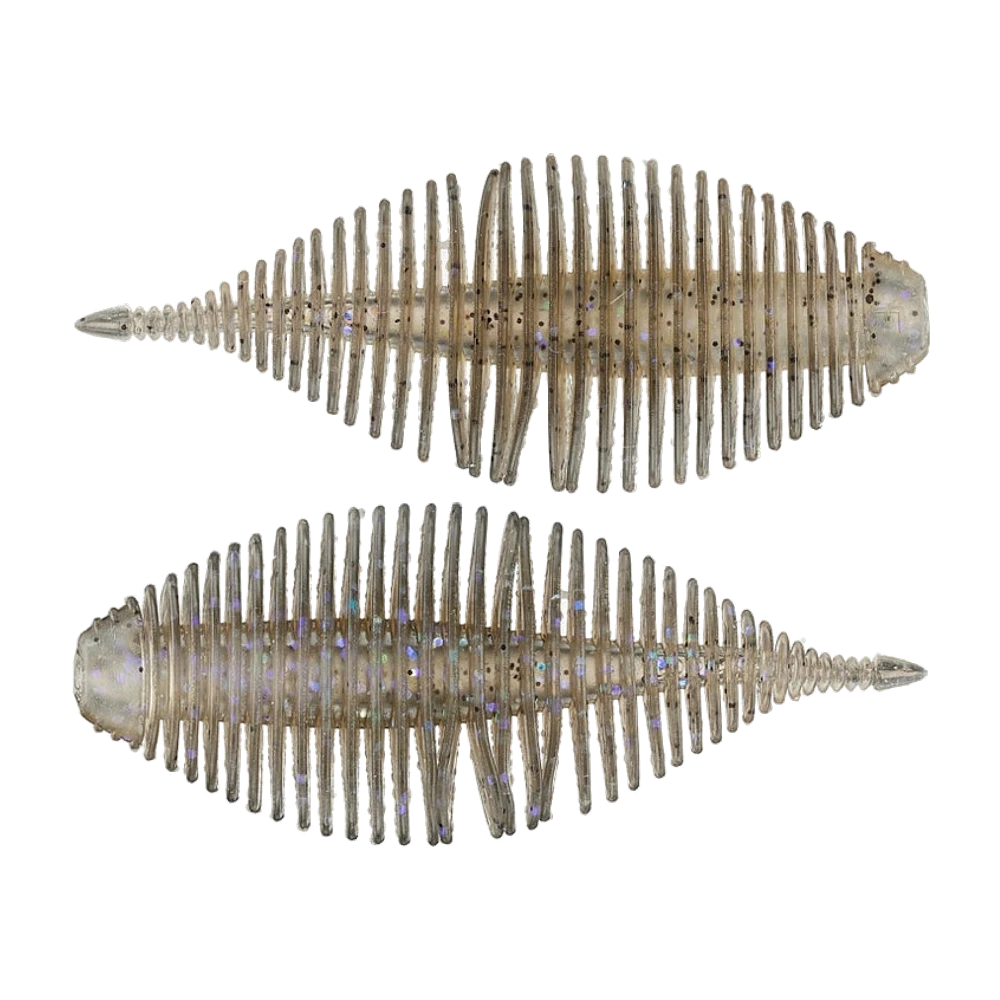
What that means in practice: order this bait from a retailer who states a dimension, or plan on matching your hook once the pack is open. Allow for large rather than small, because the silhouette is bulky — the body is flat and oval, bluegill-shaped, and it's fringed all the way round with long ribbed strands that add to the apparent size.
The bait's origin, by contrast, is documented: the profile was developed with input from Yuho Ito, a well-known Lake Biwa guide in Japan. It's the same shape as the standard plastic version, here moulded in a different material.
Floating, and what to understand before you buy
Geecrack presents this model as moulded in a floating material and describes the behaviour that follows: the bait flutters down rather than dropping, then stays above the bottom instead of lying on it. That's the central difference from the standard version and the whole reason this variant exists.
Don't misread what "floating" means here. It's the plastic that floats, not the rig. The moment you add a hook, a bullet weight or a Carolina sinker, the whole thing sinks; what you gain is a body that rights itself and hangs a few centimetres off the substrate between pulls instead of sprawling in it. Over a bottom strewn with debris or decaying vegetation, that difference in height changes everything.
The description also sets out two uses that look contradictory: the profile was originally designed to be rigged weightless on a wide gap hook, yet the manufacturer states this floating version performs best on a lightly weighted Texas rig or dragged on a Carolina rig. There's no error there, just a logical evolution: if the plastic floats on its own, the point is no longer to let it rise but to force it down while preserving its ability to hover. A weighted rig makes the best of that property, not the absence of weight.
Drag your Carolina rig and stop dead every three or four pulls. It's during those stops that the bait rises and settles horizontally above the weight — and that's when you feel the line go heavy, not during the pull.
Ribbing from head to tail
The second point of the design is the ribbing. It runs from head to tail and forms the long soft fringes along the flanks that are so visible from above. The manufacturer credits it with two effects.
The first is water displacement that's considerable for the bait's size: each strand creates its own turbulence, and the whole thing sends out a signal well beyond what such a flat body suggests. The second is tactile: a fish biting down finds a soft, irregular texture rather than a block of hard plastic, and holds on a moment longer. On a dragged rig where the bite registers as nothing more than a tightening line, that moment matters.
The three rigs
The lightly weighted Texas rig is the starting point: a wide gap hook, a 1.8 to 3.5 g bullet weight, no more. Cast to an edge, let it glide down, drag it gently. It's the easiest rig to get right.
The Carolina rig makes the best use of the buoyancy: the weight scrapes the bottom while the bait, separated by a 50-90 cm leader, hovers above it. Lengthen the leader when the water is clear and fish are wary.
As a jig trailer, finally, the Bellows Gill adds bulk and lift to a heavy jig that would otherwise nose down. It's a secondary use, but a real one, and the manufacturer names it.
The mistake to avoid
Weighting it heavily to fish deeper. A 10 g weight completely cancels the material's lift: the bait lies on the bottom like any other plastic, and you've paid for a floating elastomer for nothing. If you need to reach a deep spot, go for a longer Carolina leader rather than a heavier bullet on a Texas rig.
Not sure what to tie on?
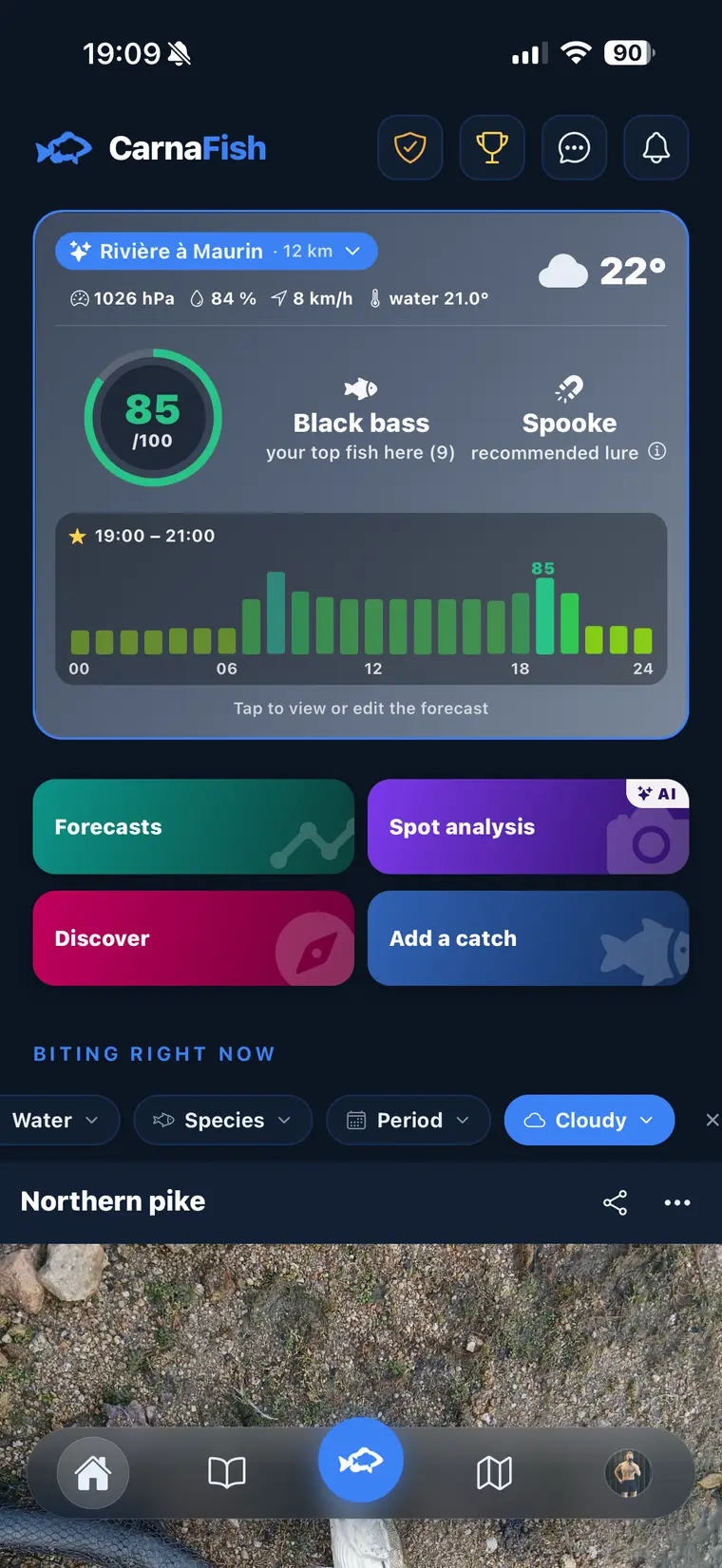
Photograph your spot: CarnaFish reads the scene, cross-checks the conditions and gives you the zone, the lure and the retrieve. Free on iOS and Android.
Colour by water
- Clear water: the translucent smoke with black pepper and holographic flake from the photo, discreet and very convincing over light or sandy bottom.
- Lightly stained water: Green Pumpkin, the tone that never lets you down when visibility drops a notch.
- Vegetated bottom or dark water: a dark bluegill with a near-black back, which keeps a readable silhouette against weed.
Alongside the other bluegill imitations
The Geecrack Bellows Gill Swimmer uses the same body but ends it with a paddle: that's a swimming bait, where the floating elastomer version is a dragging and hovering bait. Neither replaces the other. Against a 6th Sense Flipgill, more compact and built for flipping, the Bellows Gill plays lift rather than penetration into cover. And against a Berkley PowerBait Gilly Swimbait, it is fished far more slowly.
None of that helps if you're dragging in the wrong place: CarnaFish turns a single photo of the spot into a zone, a depth and a presentation type consistent with the day's conditions. To go back over how to read a spot before you even pick a lure, our guide to reading a fishing spot gets straight to the point.
Key takeaways
- No dimensions published by Geecrack: no length, no weight, no size range. Plan on matching your hook with the pack in hand.
- The material is stated to float, not the rig: the bait hovers off the bottom, it doesn't rise to the surface.
- Originally designed weightless, it's now rated best on a light Texas or Carolina rig — buoyancy changed the recommendation.
- A heavy weight cancels everything the model exists for.
FAQ
How big is the Bellows Gill Floating Elastomer?
Geecrack publishes no dimension for this bait, neither length nor weight. We'd rather say so than put forward a figure: check the size with your retailer before ordering hooks.
Does the bait really float on the surface?
The material is stated to float, but a rig always includes a hook and usually a weight: the whole thing sinks. What you get is a body that rights itself and hovers a few centimetres off the bottom between pulls.
Should I rig it weighted or weightless?
The profile was originally designed weightless on a wide gap hook, but the manufacturer states this floating version does better on a lightly weighted Texas rig or a Carolina rig. Start with the light Texas rig, it's the easiest to balance.
What weight should I use?
Stay light, 1.8 to 3.5 g on a Texas rig. Beyond that the bait lies on the bottom and loses the very property this version exists for.
What is the full-body ribbing for?
The manufacturer credits it with two roles: displacing a lot of water for the bait's size, and giving a biting fish a soft texture that makes it hold on a little longer.
Can it be used as a trailer?
Yes, the manufacturer names it explicitly as a trailer. Its bulk and lift sit well behind a heavy jig that would otherwise nose down on the bottom.
The full bass lure guideSeason-by-season strategy: which family of lure, when, and why.Go from theory to fish
CarnaFish reads your spot from a photo and gives you the game plan: zone, lure, retrieve. Free on iOS and Android.