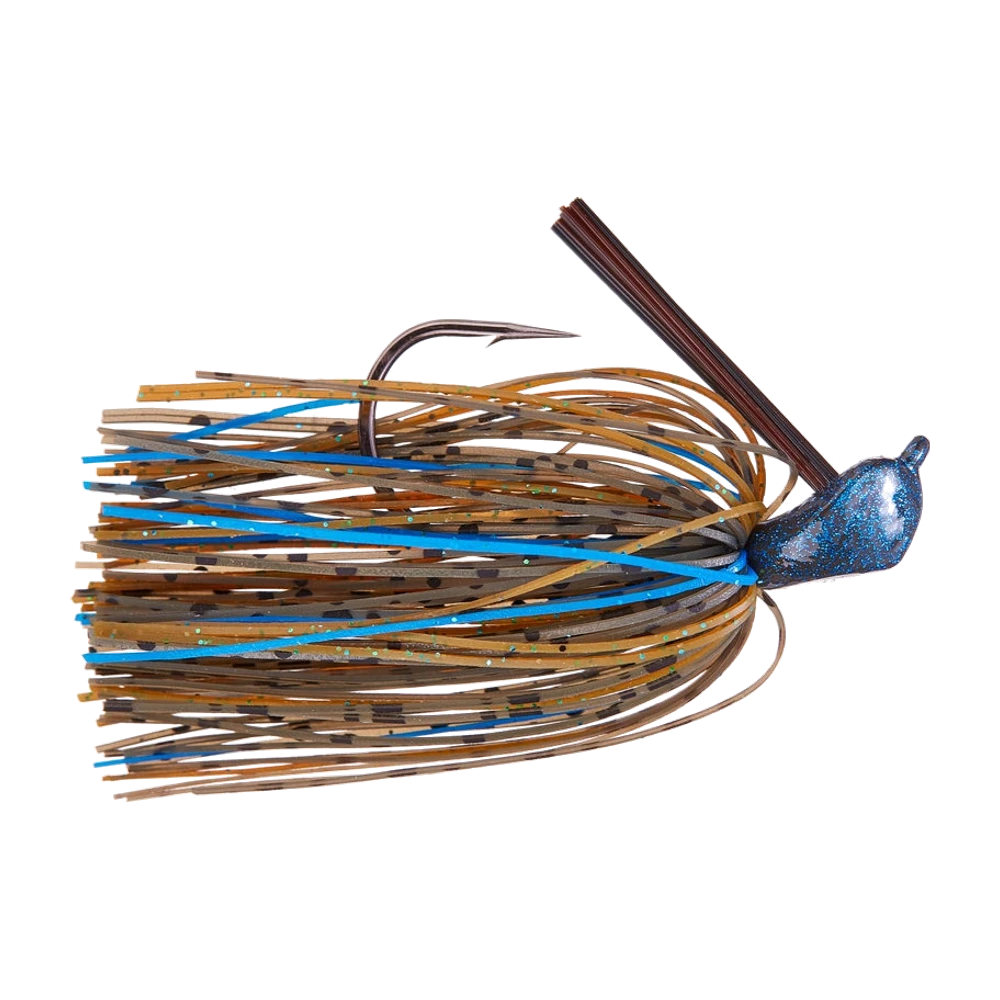
Googan Juicee Casting Jig: the do-it-all Arkie head on a 5/0 hook
Rather not fish it blind? Photograph your spot — CarnaFish cross-checks the conditions and points you the right way.
If you had to keep one lure for bass, it would be a jig. Not the most spectacular, not the one that produces the most bites in a day — but the one that, year after year, pulls out the best fish of the season. The Googan Juicee Casting Jig belongs to that class of generalist jigs you tie on when you reach the water and never take off. What is worth understanding is what its geometry allows, and what it rules out.
An Arkie head, and why that matters
The Juicee uses an Arkie-style head: a compact shape, flattened on the sides, with a slightly beveled underside and a line tie exiting forward off the top. It is the oldest and most versatile bass jig head, and it owes its longevity to three properties.
First, it sits stable. On hard bottom the Arkie head rests on its flat base, hook up, in a crayfish-on-the-defensive posture rather than flopped on its side. Second, the front bevel makes it stand up and climb when it meets a rock or a branch instead of wedging. Third, the flattened profile skims across water when thrown flat under an obstacle: that is the shape that makes skipping possible, which a round head cannot do.
One note on the name so you can find the product: it circulates at retail under two very close spellings, with and without the second letter e. It is the same jig.
Four presentations with one lure
The manufacturer claims a universal jig, and for once the geometry backs it up. Here is what that looks like on the water.
Flipping timber
Short casts, sometimes pitched by hand, thirty centimeters off a submerged branch. The jig drops vertically, you let it touch down, give two small pulls, lift and start again a meter further along. The bite almost always comes on the fall, and it feels like the line simply stopping, rarely like a thump.
Skipping docks
This is where the flattened head earns its keep. Thrown sidearm with the rod low, the jig skips across the surface and settles three or four meters under a platform, somewhere no direct cast could ever reach. Expect to practice: skipping is missed many times before it is landed, and an over-bulky trailer kills the bounce.
Swimming grass and dragging rock
Two opposite presentations with the same bait. In grass, a slow steady retrieve, the jig passing through vegetation with the skirt breathing. Over rock, the opposite: drag it in contact, feel it climb a stone, tip over and drop down the other side. Each of those micro-falls is a bite opportunity.
When you drag a jig over rock, never lift over an obstacle with the rod. Move the bait with the reel and keep the rod low: if the jig wedges, you can still feed slack and let it free itself. With the rod already high you have no margin left, and a snag becomes a break-off.
The U-shaped weedguard and the 5/0 hook
The Juicee carries a fiber weedguard arranged in a U, with the strands wrapping the point rather than standing over it. The assembly shields all the way around and lets the fibers splay sideways on the hookset, which preserves penetration.
Behind it sits a 5/0 Mustad hook. That is useful information, because hook size dictates trailer choice: a 5/0 wants a decent-sized soft plastic, a 10 cm craw for instance, and does not forgive a tiny trailer that leaves too much shank bare. A Googan Krackin' Craw, or any big-clawed craw, is the most logical pairing.
The trailer keeper is a double barb, which holds soft plastic far better than a single prong. A detail that shows up in your budget across a season: you reposition one trailer ten times instead of throwing one away per fish.
Not sure what to tie on?
Photograph your spot: CarnaFish reads the scene, cross-checks the conditions and gives you the zone, the lure and the retrieve. Free on iOS and Android.
Weights, and what the description does not say
Googan paints the weight directly on the underside of each head. That is an excellent idea, and it is also your only reliable source, because the manufacturer's description publishes no size chart for this model. So we cannot tell you here which sizes exist. Read the bottom of the head before you tie on, especially if you are fishing a specific depth or alternating between skipping and deep work — the behavioral gap between two neighboring weights is enormous on this kind of bait.
The classic mistake
Fishing the jig too fast. A jig is not a search bait: it works a known spot, meter by meter, with long pauses. Reel a jig continuously and you lose exactly what makes it strong, the fall. Count two to three seconds of complete stop after every pull, with the line lightly tensioned so you feel it move off to one side.
Second mistake: line that is too light. In cover that means 40 lb braid or 15-20 lb fluorocarbon, no less. Not to beat the fish, but to beat the wood and the rock.
Colors by water and season
- Clear water, crayfish bottom: green pumpkin with a few blue strands, as in the photo. It is the default jig color in clear water and it works nearly everywhere.
- Stained water: black and blue, a clean silhouette that stays readable when visibility drops.
- Late winter and early spring: brown and orange, which reproduces the livery of a molting crayfish at a time when it makes up most of a bass's diet.
Choosing a jig over a soft plastic comes down mostly to the nature of the cover and the bottom, a read you learn by studying the spot. That is what CarnaFish sets out to accelerate: one photo of the swim, and the AI suggests the zone, the depth and the lure family that fit the moment. For the fundamentals of gear and spots, our beginner's guide to bass fishing covers everything you need before taking up the jig.
Key takeaways
- Arkie head: it sits stable, stands up over obstacles and skips flat, which is what makes dock skipping possible.
- A 5/0 Mustad hook calls for a decent-sized trailer such as a 10 cm craw, not a small plastic.
- No weight chart is published, but the size is painted under every head: that is your only reliable source.
- The bite nearly always comes on the fall. Two to three seconds of stop after each pull, line tensioned.
FAQ
Which sizes does this jig come in?
The manufacturer's description publishes no weight chart, so they cannot be listed reliably here. The weight is, however, painted on the underside of every head: that is the thing to check in the shop.
Which trailer should I put on this jig?
With a 5/0 hook, go for a decent-sized soft plastic. A big-clawed craw gives a pronounced kick during the fall; a more compact chunk slows the drop less and suits cold water better.
Can you really skip a jig?
Yes, and it is one of the Arkie head's strong points, its flattened profile skimming across the surface. Throw sidearm with the rod low and parallel to the water, and avoid over-bulky trailers that kill the bounce.
Jig or Texas rig, how do I choose?
The jig offers more bulk and a skirt that pulses at rest, which carries better in stained water and on larger fish. A Texas-rigged creature bait stays more subtle and passes through very dense vegetation more easily.
Should I trim the weedguard?
No. The U-shaped fibers splay sideways under the pressure of a closing mouth and do not hinder the hookset. Trimming them means losing exactly the protection that lets you fish wood and rock in the first place.
How fast should this jig be worked?
Far slower than your instinct suggests. Short pull, then two to three seconds of complete stop. Most bites arrive during that falling phase, not during the pull.
The full bass lure guideSeason-by-season strategy: which family of lure, when, and why.Go from theory to fish
CarnaFish reads your spot from a photo and gives you the game plan: zone, lure, retrieve. Free on iOS and Android.