Picasso Old School Dock Rocket Jig: the jig built to skip docks
This lure shines under specific conditions. CarnaFish tells you in 10 seconds if today is one of them.
A low dock, forty centimetres between the planking and the surface, and black shade behind it. That is where the best fish on a lake sit in high summer, and it is exactly where most lures never arrive. The Picasso Dock Rocket is drawn for that situation: a compact head that skips across the water like a flat stone, and a hand-tied skirt that does not crush on the first impact.
Flat rubber, and why Picasso refuses round
The first thing the brand puts forward is the skirt material. Picasso uses flat rubber in medium cut exclusively for its hand-tied skirts, and states that flat rubber undulates better than round rubber — which is why no round strand is found on this model.
The argument is easy to follow: a flat strand presents a wide surface to the water when it moves sideways and a tiny one when it moves along its own axis. That imbalance makes it flutter and twist at the slightest movement. A round strand offers the same resistance in every direction, so it follows the flow without really working.
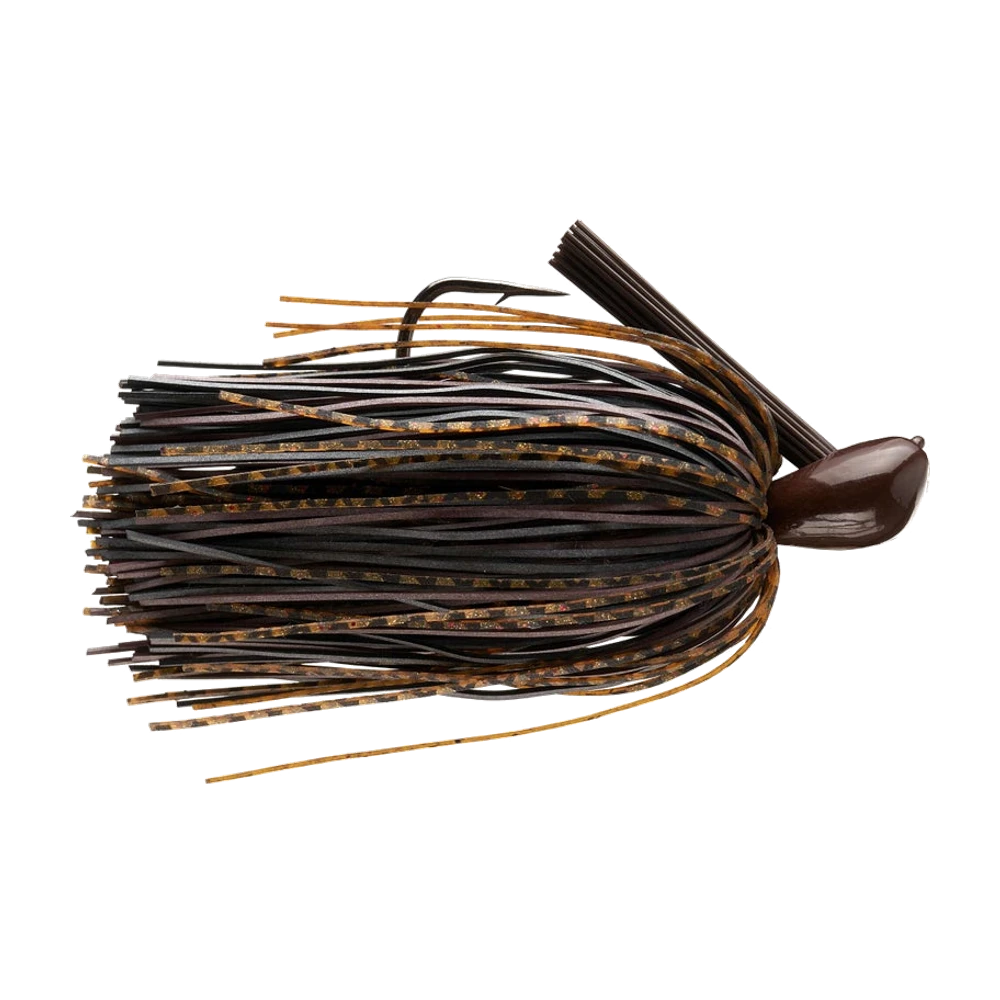
The brand adds that each colour mixes this flat rubber with silicone, to bring back the vivid tones only silicone delivers. In the product photo both materials are clearly identifiable: matte strands in dark brown and purple, which are the rubber, and amber strands loaded with copper and gold flake, which are the silicone. That is not a cosmetic detail — it is two different hydrodynamic behaviours inside one skirt.
Pro Metal: lead made deliberately harder
Picasso states that the head is moulded from what it calls Pro Metal, lead combined with much harder metal alloys, and claims greater sensitivity and a better feel of the bottom than pure lead.
That is consistent with materials physics: a harder, less ductile metal passes vibration along with less damping. Soft pure lead absorbs part of the impact against a rock or a stump; a hardened alloy sends it back up the braid. In a style of fishing where you read the bottom through your hand alone — and flipping under a dock is exactly that — the gain translates directly into bites you notice.
Do not confuse it with tungsten, though. Picasso describes an alloyed lead, not a dense substitute metal: the claimed gain is sensitivity, not a smaller head for the same weight. If you want a more compact head for a given weight, a Strike King Tungsten Football Jig answers a different brief.
A head drawn to skip
The model name states its purpose: Picasso says the head shape and its balance were worked out for skipping docks, blowdowns and other cover. The brand also notes that the jig makes a good casting and flipping or pitching jig.
In the photo the head looks compact, lacquered dark brown, tapering towards the front with slightly flattened sides. That is the classic geometry of a head that bounces off the water instead of burying into it: the flat underside hits the surface flush and sends the lure forward, exactly like a flat stone thrown sidearm.
The brush guard and the recessed line tie
Two details complete the picture, and both serve the same end: not getting snagged. Picasso states a brush weed guard angled specifically to let the jig come through structure, and a line tie recessed into the head for fewer hang-ups. In the photo the brown fibre brush is clearly visible, raked up over the hook point.
A guard that is too stiff blocks the hookset, one that is too soft protects nothing. If you find this one denser than you like, pull two or three fibres out rather than crushing it between your fingers: you keep the correct rake and simply lower the resistance.
The classic mistake
Setting the hook too early. With a jig under a dock the bite almost always comes on the fall, and the reflex is to strike the second the line moves. On a 4/0 hook shielded by a brush guard you first have to let the fish close its mouth and come tight, then set hard upwards — not sideways, or you will tear the jig into the piling.
Not sure what to tie on?
Photograph your spot: CarnaFish reads the scene, cross-checks the conditions and gives you the zone, the lure and the retrieve. Free on iOS and Android.
The trailer, and what it changes
Picasso specifies a wire bait keeper on the hook shaft to hold the soft trailer and prevent slippage. That is a concrete detail: without a keeper, a trailer slides down onto the bend after three skips and the lure becomes useless without your noticing.
Trailer choice governs the fall rate almost as much as head weight does. A big-clawed trailer such as a Keitech Crazy Flapper brakes the drop and opens the skirt, which suits shallow docks. A compact, slim trailer speeds the fall, useful when you want to reach the bottom of a rip-rap edge fast. Start with the braking option: under a dock, it is almost always the slow fall that triggers.
Before skipping in earnest, make three practice casts into open water to check the skirt is still seated and the trailer has not rotated. A jig that leaves crooked on the first bounce ends up under the dock upside down, and you will have burnt your best presentation of the day on a spot you cannot fish again for an hour.
Colours by bottom and water
- Hard bottom, clear to lightly stained water: the greenish brown with copper flake from the photo, imitating a crawfish without overstating it. It is the default around docks over gravel.
- Dark water or late-day sessions: black and blue. Silhouette contrast takes over, and a dark skirt stays readable against the light coming through the water.
- Spring, over rock: an orange crawfish tone. In the season when crawfish are active, orange on the trailer claws makes a real difference to a fish that is grubbing the bottom.
Picasso adds that the finish is a Duraseal coating described as chip-resistant, and that the jig is made in America. The description publishes no weight chart, though: check the figure on the exact item you order, because a light skipping jig and a heavy flipping jig are not fished the same way at all.
Knowing which dock to pick matters as much as knowing how to skip under it. That is exactly what CarnaFish helps with: one photo of the spot, and the AI suggests the zone, the depth and the presentation that fit the day. To build a method around this species, our guide to getting started with bass fishing covers the groundwork on spots and tackle.
Key takeaways
- A skirt made exclusively of medium-cut flat rubber, mixed with silicone for colour: two materials, two behaviours, one skirt.
- A Pro Metal head claimed to be more sensitive than pure lead — a gain in feel, not a reduction in volume as tungsten would give.
- Recessed line tie and raked brush guard: everything is aimed at not hanging up inside cover.
- The wire bait keeper holds the trailer, and the trailer alone sets much of the fall rate.
FAQ
Why flat rubber rather than silicone?
Picasso states that flat rubber undulates better than round and uses only that material as the base of its hand-tied skirts. Silicone is still present, to supply vivid tones that rubber alone cannot reach. The skirt therefore mixes both.
Is Pro Metal tungsten?
No. Picasso describes lead combined with harder metal alloys and claims a better feel of the bottom than pure lead. It is not a dense substitute metal: for the same weight, the head stays roughly the same size as a conventional lead head.
What weight should I choose?
The description publishes no weight chart and several values exist at retail. For skipping docks, lighter models are easier to bounce; for flipping into deep laydowns you need to go heavier. Check the exact item before ordering.
What trailer should I use?
A wide-clawed trailer slows the fall and opens the skirt, which suits shallow docks. A compact trailer speeds the drop so you reach the bottom faster. The wire bait keeper on the shaft holds either one in place.
How do I skip without a backlash every time?
Cast low, keep the wrist loose, and above all thumb the spool as the jig touches down so it skips instead of diving. A compact flat-headed jig like this one is more forgiving than a big round-headed jig, but the technique still has to be practised in open water before you aim at a real dock.
How does it differ from a standard pitching jig?
The emphasis is on the head and its balance for skipping, where a model like the Dirty Jigs Luke Clausen Compact Pitchin Jig prioritises vertical penetration into dense cover. The two are fished similarly, but the line of approach is not the same.
The full bass lure guideSeason-by-season strategy: which family of lure, when, and why.Go from theory to fish
CarnaFish reads your spot from a photo and gives you the game plan: zone, lure, retrieve. Free on iOS and Android.