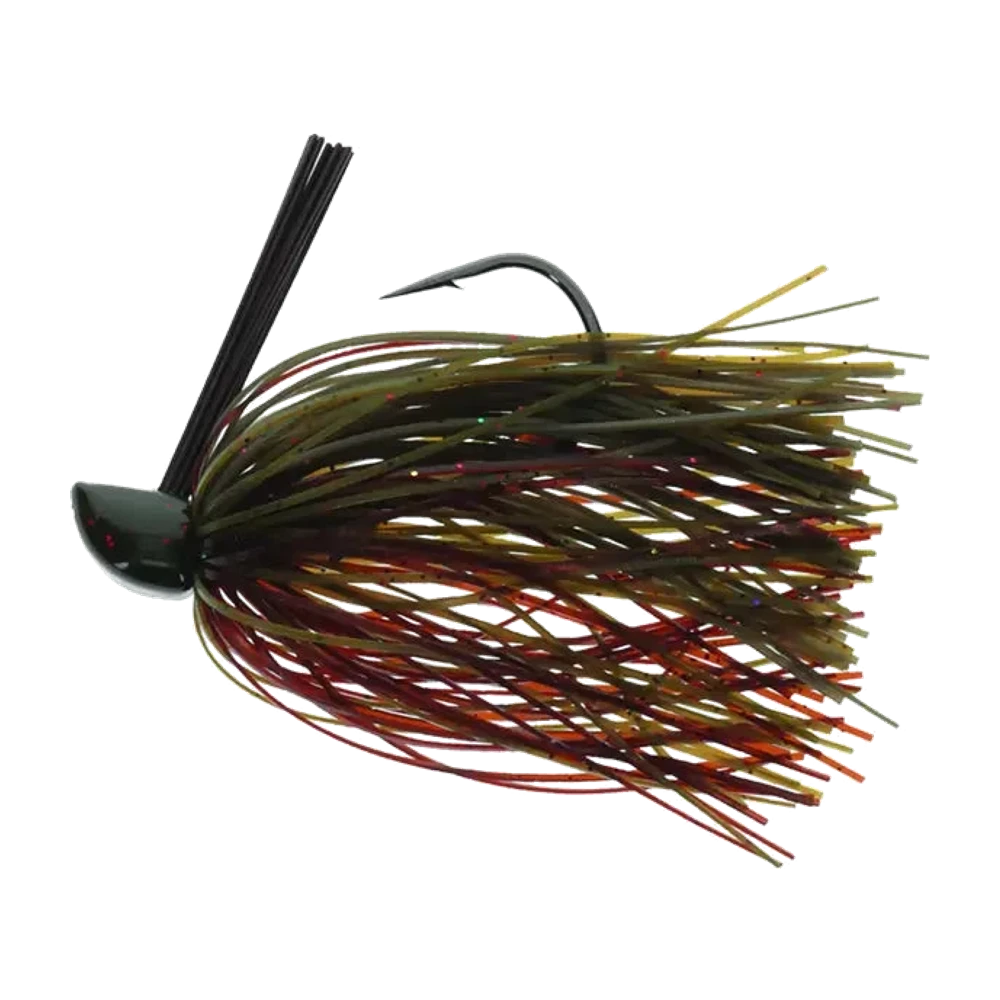
Strike King Tungsten Football Jig: reading the bottom with your fingers
Not sure this lure fits YOUR spot today? CarnaFish tells you in 10 seconds, from a photo.
On a rocky drop-off, the question is never "are there fish here". It is "where exactly". A thirty-metre rock slide is not fished end to end: the bass settle on three or four precise points, a slab that breaks off, a change in stone size, a rock-to-gravel transition. If you cannot feel those transitions, you are fishing blind and you miss them.
The football jig's job starts before it is even a lure: it is a sensor. Its tungsten head, twice as dense as lead for the same weight and therefore far more compact, feeds your rod tip information nothing else gives you. You do not feel "the bottom", you feel gravel, then a boulder, then sand. And its rugby-ball shape stops it lying down between two stones.
Why the head shape changes everything
A round head rolls. A flat head lies over. A football head has two wide flanks and a short axis: set down on uneven bottom, it naturally settles flat, eye upwards, hook and skirt lined up on the vertical.
There are three concrete effects:
- The clean topple on an obstacle. When you pull and the head jams against a stone, it rolls onto one flank then rights itself. That topple reads as a sharp knock in the rod — your transition signal — and as an abrupt sideways jump of the lure, which is often the second in which the fish makes up its mind.
- Standing upright at rest. The hook stays pointing up, so the skirt opens into a crown and the trailer works above the bottom instead of being crushed into it.
- A gentler pull-free. On rock, a football head jams less than an arrow or flat head, because it does not slot in between two stones: it goes over the top.
Tungsten adds the finesse. At 14 g, a lead head is big and soft to the touch; the same in tungsten is compact and hard, so it is more discreet and a great deal more talkative on contact.
The retrieve: drag, pause, and above all nothing else
- Cast beyond the target zone and let it drop on a controlled line, counting the seconds. Note that count: it is your depth measurement from one cast to the next.
- Take up the slack until you feel the head, without lifting it.
- Drag slowly with the rod tip, from three o'clock towards two o'clock, over thirty to fifty centimetres. You are not lifting the jig, you are making it crawl.
- Follow the tip back down, line semi-tight, and let the jig fall. That is where 70% of the bites happen — most often showing as a line that moves off sideways or stays slack longer than it should.
- Pause three to five seconds, skirt open, then start again.
The overall rhythm should have you taking a good two minutes to bring back a 25 m cast. Any faster and you are no longer fishing a jig.
On the water: when the head clears an obstacle and topples, do not start the next drag straight away. Stop everything and count to three. The topple has just created a puff of silt and the sound of stone — exactly the signal a bass associates with a crawfish flushed out of cover. That is the moment it comes to look, and if the lure is still moving then, all it does is follow.
Choosing the weight
The right weight is the lightest one that lets you keep permanent contact. The moment you lose the feel of the bottom, go up a step.
| Situation | Weight | Trailer |
|---|---|---|
| 2 to 3 m, little wind, clear water | 10 g | Compact craw, subtle profile |
| 3 to 5 m, standard conditions | 14 g | Craw with wide claws |
| 5 to 8 m, or crosswind | 18 g | Chunk or low-drag craw |
| More than 8 m, drifting from a boat | 21 g | Compact chunk, short appendages |
The trailer is not an accessory: it sets the sink rate as much as the weight does. A craw with big flat claws noticeably slows the fall and makes the jig glide; a compact chunk drops it straight down. On apathetic fish, choose the version that glides. A Z-Man Hella CrawZ works particularly well here because its floating claws stay raised when the jig stops. A Strike King Rage Craw gives the opposite effect: more kick during the drag, less life at rest.
The tackle: the rod does half the work
A football jig with the wrong rod behind it is useless. You need:
- A 1.95 to 2.10 m rod, medium-heavy to heavy, a sensitive tip but with the backbone to drive a heavy-wire hook home at 6 m.
- Braid of 0.16 to 0.20 mm: it does not stretch, so every grain of the bottom comes back up.
- A one-metre 0.35 to 0.40 mm fluorocarbon leader, for abrasion on rock.
- A sideways sweep hookset, not an upward one: with 25 m of line out, a vertical hookset loses half its travel.
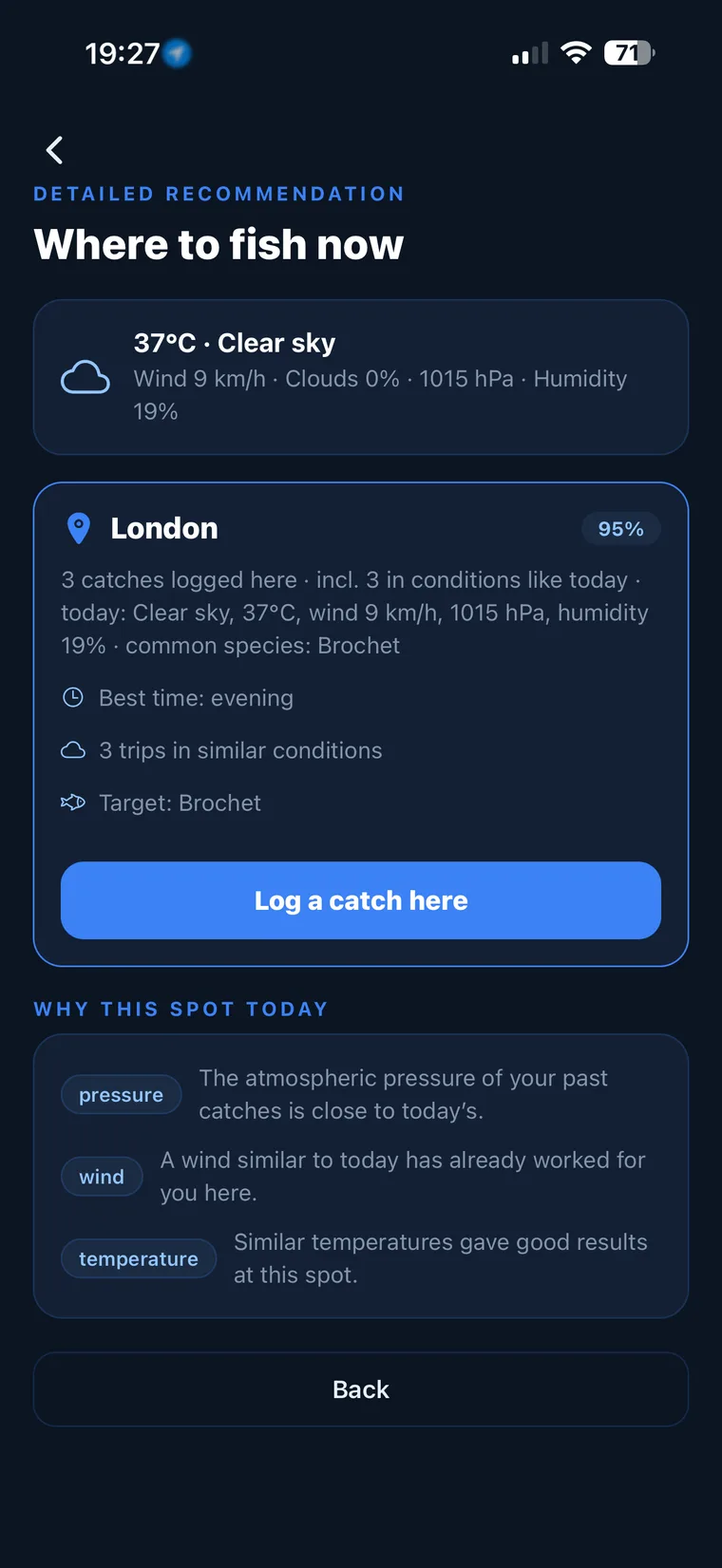
Not sure what to tie on?
Photograph your spot: CarnaFish reads the scene, cross-checks the conditions and gives you the zone, the lure and the retrieve. Free on iOS and Android.
Where not to take it out
The football jig is a hard-bottom tool. On soft silt, the head sinks in, the skirt fouls and you feel nothing. In dense weed and tight timber, its wide shape snags where an arrow jig or a Texas rig would go through without trouble. And in shallow water — under 1.5 m — even the lightest weight drops too fast, and you are on the bottom before you have fished anything.
Its seasonal window is wide but not universal: excellent from late summer to the end of winter, it loses ground in spring when bass move up onto the flats.
Football jig or Texas rig
Both fish the bottom, but not in the same way. The Texas rig is a weedless setup: separate weight, buried hook, slim profile. It goes everywhere, timber and weed included, and it presents a single bait with no skirt.
The football jig adds three things the Texas rig does not have: a skirt that breathes at rest and creates volume without mass, a wide head that topples and generates contact noise on the bottom, and a much stronger hook, which changes everything on a big fish hooked at distance. In exchange it snags more and it is more visible.
In practice: the Texas rig to dig fish out of cover, the football jig to fish hard, open, deep structure. Our guide to reading a fishing spot helps you pick out the drop-offs and transitions that justify taking the jig out. And if you are unsure which weight to tie on in front of an unfamiliar rock slide, CarnaFish analyses a photo of the spot and answers.
Key takeaways
- The football head settles flat on hard bottom: hook up, skirt open, trailer above the rock.
- Tungsten feeds the nature of the bottom to the rod tip: you can tell gravel from boulder from sand.
- Slow drag then a controlled fall. Most bites come during the drop.
- After every topple over an obstacle, stop for three seconds before moving again.
- Hard, open, deep bottom. Useless on silt, in thick weed or under 1.5 m of water.
FAQ
Why choose tungsten over lead?
For the same weight, a tungsten head is about twice as compact and far harder. So it is more discreet and, above all, much more sensitive: the vibrations of bottom contact travel up to the rod tip instead of being absorbed by a soft mass.
Which weight should I start with?
14 g covers most situations between 3 and 5 m. Then add a 10 g for shallow zones and an 18 or 21 g for wind and real depth. Basic rule: the lightest weight with which you keep permanent contact.
What trailer should I rig behind it?
A craw or a chunk. Wide flat claws slow the descent and make the jig glide, which suits apathetic fish. A compact trailer with short appendages drops the jig straight and suits you better when you want to cover water quickly.
How do I recognise a bite on a football jig?
Rarely as a sharp knock. Most often the line moves off sideways, or stays slack when it should have tightened at the end of the expected fall. At the slightest doubt, take up the slack and set with a sideways sweep.
Can you fish it in sunken timber?
That is not its ground. Its wide head and exposed hook snag far more than a Texas rig. Keep it for hard, open bottom: rock, slides, gravel, slabs.
Which season is it most effective in?
From late summer to the end of winter, when the fish settle deep on hard structure. In spring, when they move up onto the shallow flats, faster lures cover the water better.
The full bass lure guideSeason-by-season strategy: which family of lure, when, and why.Go from theory to fish
CarnaFish reads your spot from a photo and gives you the game plan: zone, lure, retrieve. Free on iOS and Android.