Greenfish Swim Jig: the jig that swims like a baitfish
Before tying this one on, it helps to know if the spot actually calls for it. CarnaFish reads the scene from a photo.
A weed bed breaking the surface along two hundred metres of bank, and the odd swirl every minute or so. A Texas-rigged plastic would pass underneath, a topwater would pass over, and neither really covers the layer where the fish are feeding - those thirty centimetres right above the vegetation. The swim jig was invented for exactly that: crossing cover at mid-height, without hanging up, with a baitfish silhouette rather than a crawfish one.
A jig that isn't fished like a jig
One common confusion is worth clearing up. A classic flipping jig is a vertical bait: it drops, it settles, it imitates a crawfish. The swim jig does the opposite. It's retrieved horizontally, never touching bottom, and it imitates a baitfish. That's why its head is wedge-shaped rather than round: it slices through water and weed instead of ploughing them.
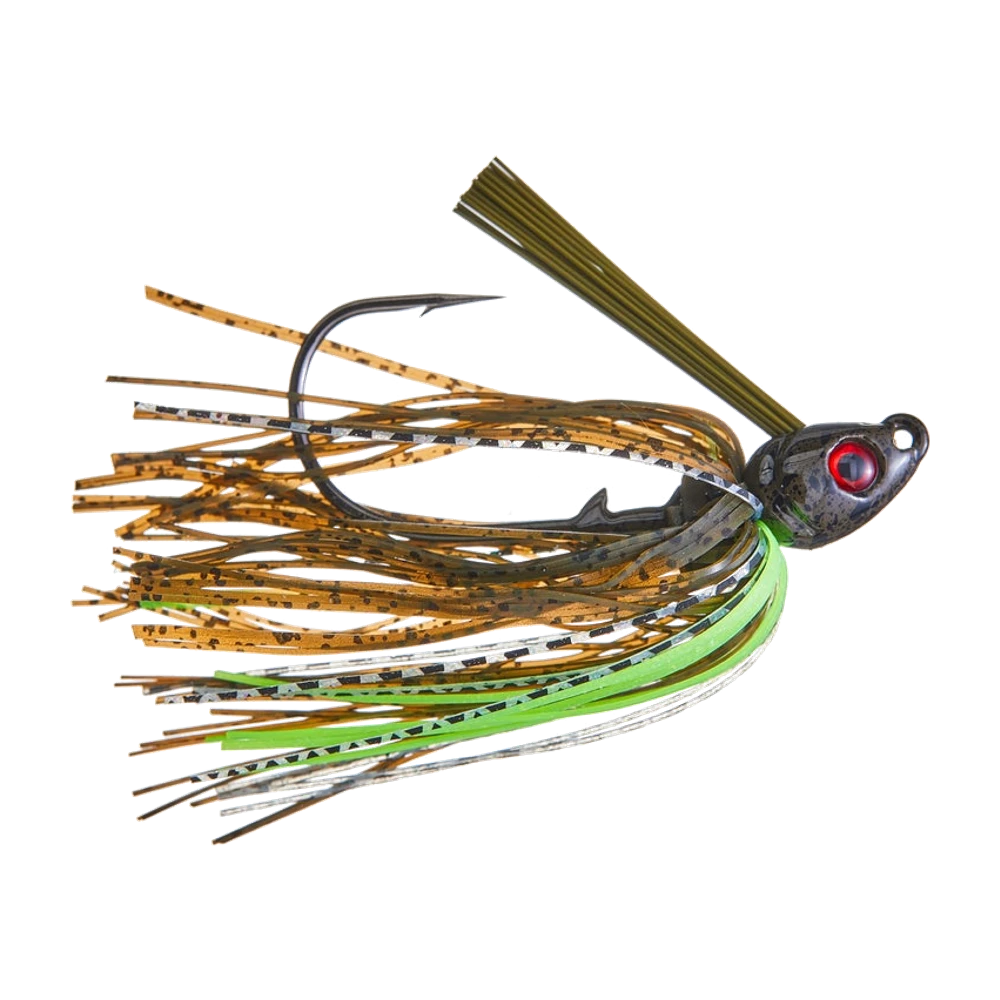
Greenfish takes that logic right down to the finish. The head carries a 3D eye and moulded gill plates, with a premium paint job. On the sample photographed, the red eye ringed in black is especially crisp, and the gill plate relief shows behind it. You can reasonably argue about how much a painted eye matters at a metre of visibility; in clear water on a wary fish, though, that kind of detail has never done any harm.
The weed guard, the part that decides everything
This is the component that makes or breaks a swim jig, and Greenfish went with a fibre weed guard set on top, over the point of the Mustad hook. The brand claims a compromise: dense enough to part vegetation, supple enough to collapse on the hookset. That's exactly the balance you're after.
In the product photo the bundle is generous - a good twenty straight fibres. That's a lot, and it's deliberate: a weed guard gets trimmed, it never gets added to. In thick weed, leave it alone. In open water, or on fish eating near the top, cut away a third of the fibres with scissors and shorten the rest slightly: your hook-up rate climbs immediately without losing much weedlessness.
Check the weed guard's alignment after every fish. A bundle that has taken a knock and now points sideways turns a jig that never hangs up into a jig that catches everything. Two seconds straightening it by hand is the difference between ten clean casts and ten wasted ones.
The hand-tied centreless skirt
Greenfish's other technical argument concerns the skirt: premium silicone, hand tied, and built without a centre band. That last point deserves an explanation, because it isn't intuitive.
In a conventional skirt, the strands are gathered in a collar and held tight around the head. They move together, as a block. Without a centre, the strands are free to splay radially: on the pause or at the slightest slowdown, the skirt flares open, then closes again as soon as you pull. That breathing is what creates variable bulk, and variable bulk is what triggers a fish that follows without committing.
The practical consequence: with this kind of skirt, micro-variations in speed matter more than average speed. A swim jig retrieved perfectly steadily throws away half its appeal.
How to swim it
The punctuated straight retrieve
Cast past the zone, let it sink a second or two depending on how deep the vegetation sits, then reel steadily, keeping the jig just above the cover. Every five or six turns of the handle, give a crisp rod twitch: the jig veers off, the skirt flares, and that's when the bite lands. The mistake to avoid is running it too deep - a swim jig ploughing through weed is no longer a swim jig.
Deliberate contact with the vegetation
The most productive technique is letting the jig dig into the weed and then ripping it free with a sharp pull. That violent release imitates prey tearing away from shelter. A lot of bass bites arrive in the half second that follows.
Choosing the trailer
A swim jig is always fished with a trailer, and that choice changes the lure completely. A paddle-tail shad such as a Keitech Easy Shiner 4 adds steady vibration and reinforces the baitfish silhouette: that's the default. A craw trailer, bulkier, slows the swim and widens the profile, which helps in stained water. Avoid trailers that are too long - they unbalance the swim and produce short strikes.
Not sure what to tie on?
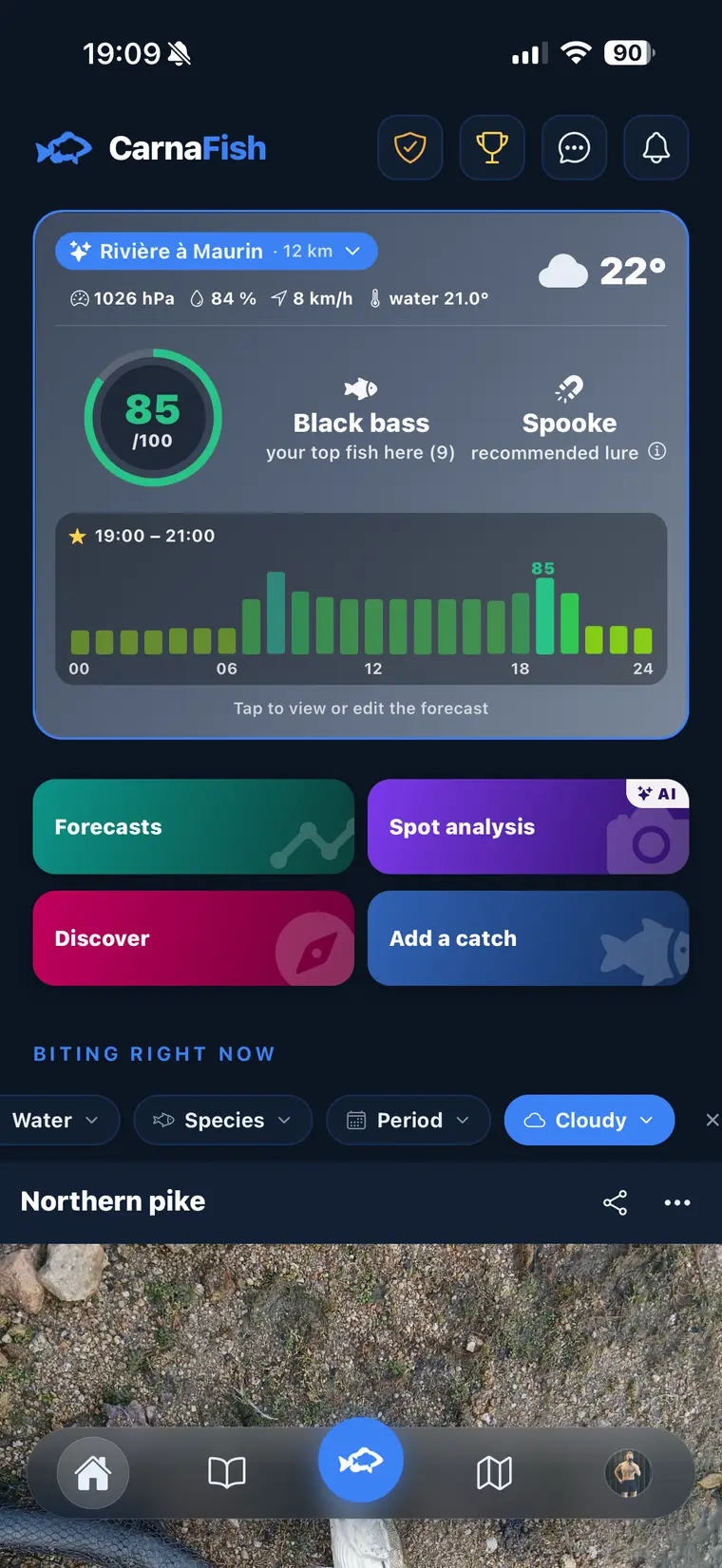
Photograph your spot: CarnaFish reads the scene, cross-checks the conditions and gives you the zone, the lure and the retrieve. Free on iOS and Android.
What the manufacturer doesn't say
Greenfish publishes no spec table for this swim jig: no weight, no length, no hook size. That's a genuine gap, because a swim jig's weight dictates the depth it holds at a given speed. Usual formats in the family run 7 to 18 g / 1/4 to 5/8 oz, but that's a category range, not a manufacturer figure - read the label of the exact model before buying, and take two different weights if you fish varied depths.
Colour by water clarity
- Stained water: the colour photographed here, speckled brown with chartreuse and barred strands, which reads as a small perch and stays visible without overdoing it.
- Clear water over baitfish schools: white and silver with a translucent trailer, to match the dominant silhouette.
- Dirty water or heavy cloud: black and blue, playing on the outline rather than on colour.
The right lure never replaces reading the spot, and that's exactly what CarnaFish makes easier: a photo of the spot, and the app suggests the zone, the depth and the type of presentation suited to the day's conditions - enough to tell whether that weed bed calls for a swim jig or a frog. To build your tackle and spot-reading fundamentals, our beginner's guide to bass fishing is a good starting point.
Key takeaways
- The swim jig is retrieved horizontally just above the cover; it has nothing in common with a flipping jig fished on the bottom.
- The fibre weed guard is the decisive part: trim it to suit the cover, never add to it.
- The centreless hand-tied skirt opens and closes with your speed changes - a perfectly steady retrieve wastes the point of it.
- Greenfish publishes neither weight nor length: check the label before buying.
FAQ
What's the difference between a swim jig and a classic jig?
A classic jig is fished on the bottom and imitates a crawfish, with a rounded head built to sit still. A swim jig has a wedge-shaped head, is retrieved horizontally just above the cover and imitates a baitfish.
What trailer should I put on this swim jig?
A paddle-tail shad for vibration and the baitfish silhouette, or a craw trailer if you want to slow the swim and widen the profile. Either way, stay close to the skirt's own length so you don't invite short strikes.
Should I trim the weed guard?
Yes, as soon as you fish open water. Remove a third of the fibres and shorten the rest slightly: the hook-up rate goes up noticeably. In thick weed, leave it as it is.
What weight should I choose?
Greenfish publishes no figures, so the only reliable source is the label of the model you buy. Swim jigs usually run 7 to 18 g / 1/4 to 5/8 oz, light for just under the surface, heavy to hold deeper or in strong wind.
Can you catch pike on a swim jig?
In Europe a pike will regularly grab a swim jig worked over a weed bed. It isn't the use the maker intended, and it calls for a wire leader, otherwise you lose the lure on the first bite.
How does it differ from other swim jigs on the market?
It all comes down to the head, the weed guard and the skirt. The Dirty Jigs Swim Jig and the Googan Grass Hero play on the same parameters; here, Greenfish puts the emphasis on head finish and on a skirt tied without a centre.
The full bass lure guideSeason-by-season strategy: which family of lure, when, and why.Go from theory to fish
CarnaFish reads your spot from a photo and gives you the game plan: zone, lure, retrieve. Free on iOS and Android.