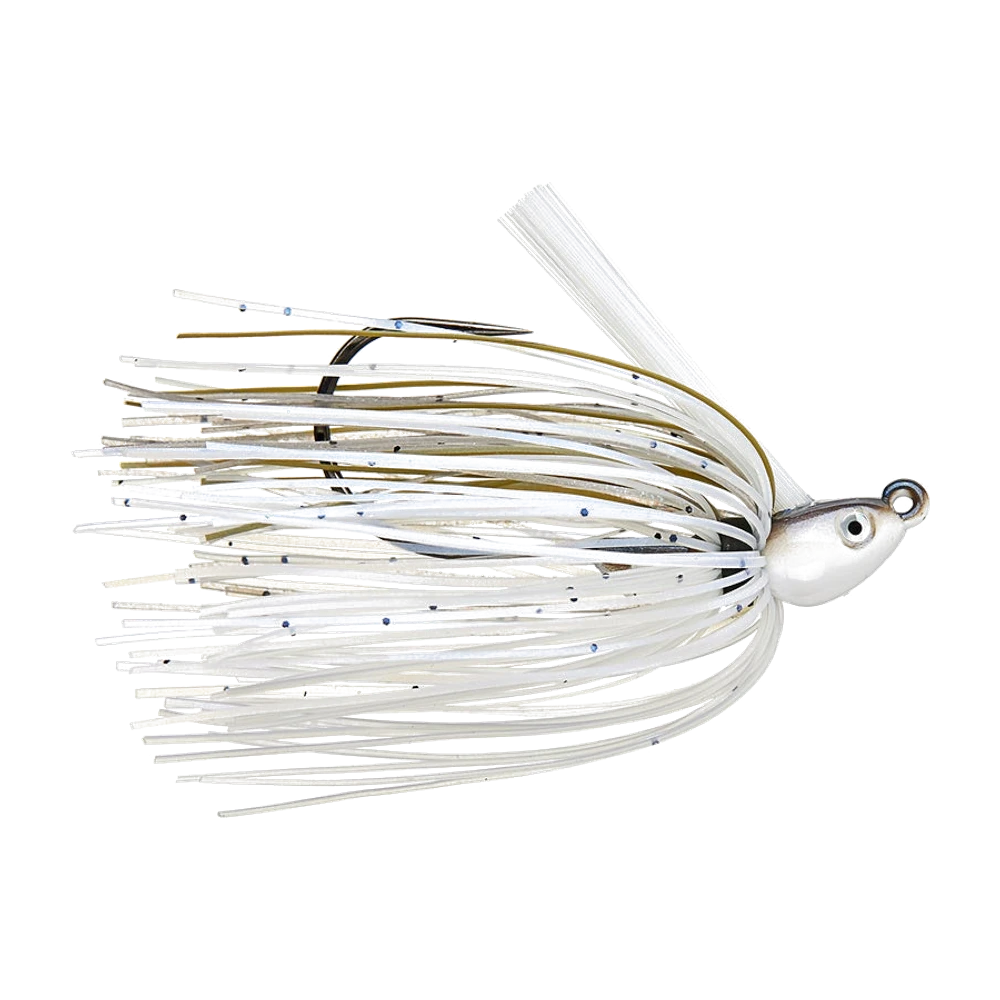
Dirty Jigs Swim Jig: a full skirt and a 5/0 VMC hook
The right lure in the wrong spot still catches nothing. CarnaFish spots the zone that works, from a single photo.
Late spring, a reservoir arm that has come up after three days of rain. Visibility has dropped to half a metre, the fry have pushed into the weed edges and the bass are following them. In that water a subtle bait simply does not get seen: you need bulk, a silhouette that stands out, and hardware that holds when a fish decides to take it back into the grass. That is the Dirty Jigs Swim Jig's natural ground.
Bulk, on purpose
The description is clear about the intent: a full fifty-strand skirt, a bulky profile, built for dirtier water or for the times bass are targeting large shad or bream. That is not presentation detail, it is the bait's main setting.
A dense skirt does three things. It increases the surface seen from the side, so the bait's reach when visibility drops. It slightly slows the swim at equal speed, letting you retrieve more slowly without the jig nosing down. And it keeps pronounced bulk even on the move, where a sparse skirt collapses against the shank the moment you speed up. The cost is credibility in very clear water in front of a wary fish — that is where a slimmer model like the Berkley Finesse Swim Jig takes the advantage back.
Dirty Jigs also ties this model to what it calls the Coosa River design. That is a lineage reference more than a specification: what counts in practice is the shape described right after it, bullet head and vertical line tie.
The hardware, and why it changes the fishing
This is the most concrete part of the description. The hook is a 5/0 VMC with a 30-degree line tie, and the maker makes a point of saying it is not light wire: it claims the strength of a heavy wire flipping hook while staying sharp enough to stick fish with little effort.
That distinction matters. Plenty of entry-level swim jigs carry thin wire that penetrates beautifully and opens up the moment you drag a fish through a weed bed. On a bait whose whole job is to swim in vegetation, that is incoherent. Here the hook is sized for the intended use. The brand's other model, the No-Jack Swim Jig, pushes the same logic with a reinforced Gamakatsu.
Under the skirt, a large barbed lead baitkeeper locks the soft plastic in place. The head, described as bullet-shaped with a vertical line tie, is built for better movement through vegetation: the pull axis sits in line with the point of the head, which helps the jig part stems rather than catch on them. The multi-coated head finish is matched to the skirt, which avoids the pale-head-on-dark-skirt look once the paint starts wearing.
What is missing is the head weight and the length. No invented figures: check the packaging. On a swim jig, weight sets the running depth, so it is exactly the information you want before ordering.
How to swim it
The high retrieve, in contact with weed
Cast past the weed edge, raise the rod to one o'clock, and retrieve at a constant pace keeping the bait twenty or thirty centimetres under the surface. The jig should brush or touch vegetation constantly. Retrieve through open water and you get a bait that swims nicely and catches nothing.
The best trigger on a swim jig is not speed, it is the break. Every time the bait tears free of a stem it surges forward — that release is what draws the strike. When the weed is sparse, create the break yourself: a sharp snap of the rod tip every three or four turns of the handle imitates exactly the same event.
The slowed-down pass along hard edges
Along a reed wall or a line of docks, alternate retrieve and one-second pauses. During the pause the bait drops slightly and the skirt collapses; on the restart it flares open at once. That breathing is what makes followers commit. One caveat: with a full skirt the pause sinks slowly, so do not count on this presentation to explore depth.
Not sure what to tie on?
Photograph your spot: CarnaFish reads the scene, cross-checks the conditions and gives you the zone, the lure and the retrieve. Free on iOS and Android.
Trailer and rigging
The trailer sets both the swim and the final bulk. A paddle tail shad completes the silhouette well and steadies the track — the logical choice when fish are on fry. A trailer with flapping appendages widens the profile further, worth it in genuinely dirty water. Either way, thread it straight onto the barbed keeper: a crooked trailer has the whole jig spinning within two casts.
For line, 50-60 lb braid is standard as soon as the weed is thick. If you fish water in Europe that holds pike, add a thick fluorocarbon or soft titanium leader: a bulky white swim jig retrieved at mid depth is exactly what a pike attacks, and a heavy wire 5/0 is worthless if the braid is cut twenty centimetres above it.
The classic mistake
Fishing this model as if it were a subtle bait. Its full skirt makes it a signal lure, not a finesse one: brought out in clear water on a pressured lake, it gets followed and refused. Keep it for stained water, spring rises, thick weed and periods when fish are on large forage — and switch to a slim swim jig the rest of the time.
Colours by water and forage
- Fish on fry, lightly stained water: White Shad, which reads as a clean silver silhouette, consistent with the white finish on the product photo.
- Clear water over grass: Bluegill, a green-blue tone matching the small fish that live in vegetation.
- Dirty or rising water: Black and Blue, because in reduced visibility it is silhouette contrast that carries, not colour.
That leaves the real question: which weed bed to fish, and when. A swim jig only earns its keep where vegetation borders a depth change or a current line. That is exactly what CarnaFish saves you — a photo of the bank, and the app suggests the zone, the depth and the kind of presentation that suits the day. For the general method, our guide to reading a fishing spot details the markers to look for.
Key takeaways
- The 50-strand skirt is the bait's real setting: bulk for dirty water and large forage, at the cost of stealth in clear water.
- The stated hook is a heavy wire 5/0 VMC at 30 degrees, chosen so it does not open when you drag a fish through grass.
- Bullet head and vertical line tie serve movement through vegetation, not running depth.
- Neither weight nor length appears in the description — check the packaging, since weight is what sets depth.
FAQ
What is a vertical line tie for on a swim jig?
It puts the pull axis in line with the point of the head, which helps the bait part stems instead of snagging them and keeps the swim tracking straight. It is a choice aimed at getting through vegetation rather than at sensitivity.
Is this swim jig suited to clear water?
Less so than slim models. Its full skirt is built for dirty water or for when fish are feeding on large forage. In clear water on wary fish, a finesse swim jig will touch more of them.
How does it differ from the brand's No-Jack Swim Jig?
Mainly the hook. This one is stated with a heavy wire 5/0 VMC at 30 degrees; the No-Jack Swim Jig uses a Gamakatsu that Dirty Jigs presents as reinforced over their original swim jig. The swimming principle is the same.
Do I always need a trailer?
Yes. Without one the silhouette is cut short and the swim less stable. The barbed lead keeper moulded into the head exists precisely to hold the soft plastic in place cast after cast.
Does this bait catch pike?
A bulky white swim jig retrieved at mid depth clearly interests pike in Europe, and the heavy wire 5/0 takes the load. The weak link is the line: run a bite-resistant leader or you will lose the bait.
How fast should I retrieve?
Fast enough for the skirt to stay flared and the bait not to nose down, slow enough for it to keep touching vegetation. In practice, a steady pace slightly brisker than a standard soft plastic on a straight retrieve.
The full bass lure guideSeason-by-season strategy: which family of lure, when, and why.Go from theory to fish
CarnaFish reads your spot from a photo and gives you the game plan: zone, lure, retrieve. Free on iOS and Android.