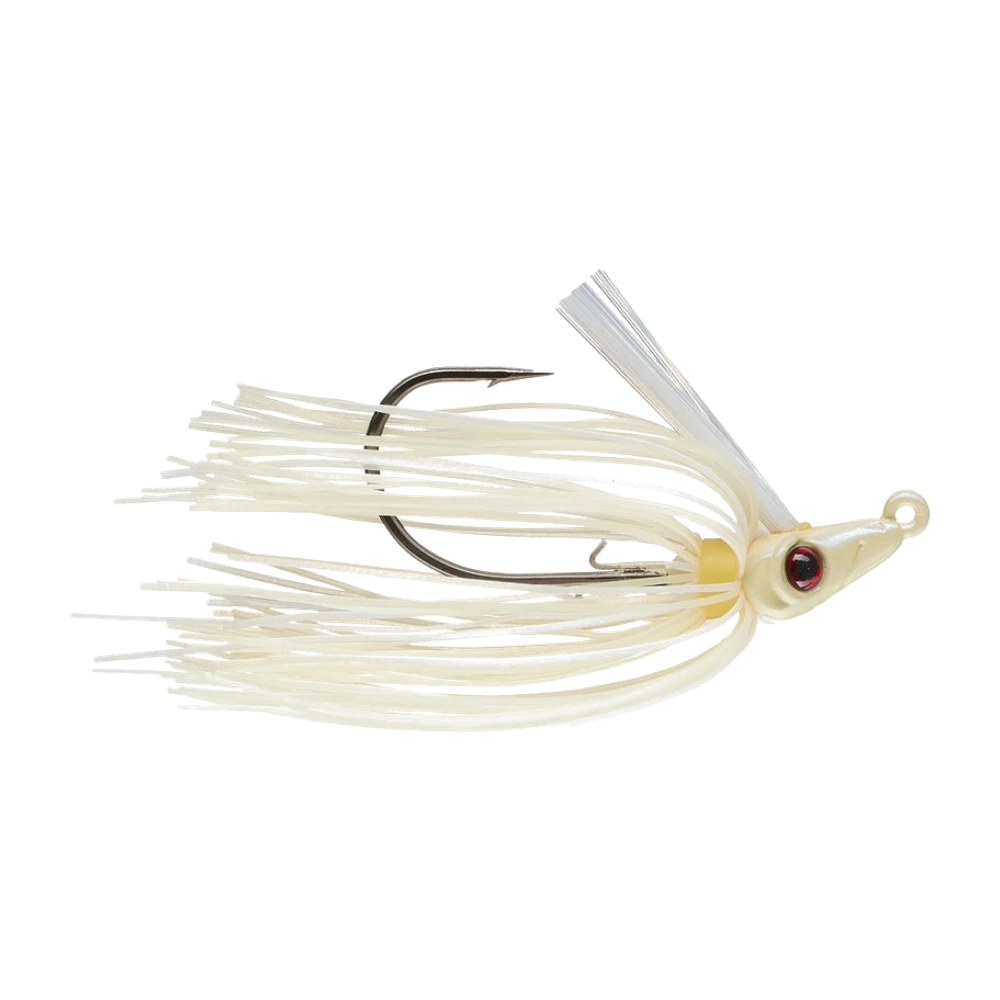
Booyah Mobster Swim Jig: the swim jig that crosses every kind of cover
Before tying this one on, it helps to know if the spot actually calls for it. CarnaFish reads the scene from a photo.
There's one category of target almost nobody really fishes: the three-metre band where grass turns into brush, brush turns into a laydown, and the laydown touches the pilings of a dock. A crankbait snags there, a Texas-rigged plastic is too slow, and a frog only works above the vegetation. The swim jig is the tool that crosses all four without changing anything, and Booyah's Mobster is built exactly around that idea.
Three design details that do the work
The vertical line tie
This is the most important point and the one people look at least. On a bottom jig, the eye exits at 60 or 90 degrees so that the pull lifts the nose. On the Mobster it exits vertically, on top of the head. The pull therefore works upward and forward, and the jig holds a stable attitude on the retrieve instead of nosing down.
The second effect is mechanical: when the head meets a blade of grass, the line slides over the eye and along the bait's back, never forming a hook. That's what separates a real swim jig from a bottom jig you happen to be reeling.
The head shape
The head is wedge-shaped, pointed head-on and flattened on the sides. It parts grass stems instead of pushing them along in front. A round-headed jig gathers a bundle of weed in three metres; a wedge splits through and comes out clean. In wood, the same profile makes the jig slide along a branch instead of jamming in a fork.
The angled weedguard
Booyah emphasises the angle of the weedguard rather than its bulk, which fits the job. A weedguard that's too stiff stops the hook penetrating on a long-range set; one that's too soft lets cover through to the point. The Mobster's angle aims at the compromise: it shields the point during the horizontal swim and collapses when a fish takes the jig sideways.
How to swim a swim jig
The principle fits in one sentence: you don't hop it, you make it flee. Cast, let it sink for a second or two depending on depth, then retrieve steadily at medium speed, rod between ten and eleven o'clock. The jig should travel at constant height, just above the cover or inside it.
What triggers isn't the steady swim, it's what breaks it. Three moves worth drilling:
The deliberate contact. You run the jig into a branch, a stake, the edge of a grass mat on purpose and let it stall. Coming free produces a stumble nothing else imitates as well.
The rod snap. A short, sharp twitch mid-retrieve flares the skirt and shoots the bait forward. It's the equivalent of twitching a hard bait.
The controlled drop. You stop reeling for half a second while keeping the line tight. The jig dips, the skirt opens, and it climbs again as you resume. That's when the majority of bites come from a following fish.
The giveaway: when the jig suddenly feels heavy without having touched anything, that's a fish. Don't set by lifting — set with a sideways sweep, rod low. An upward set pulls the bait out of a mouth that hasn't closed on it yet.
The trailer, half the lure
The Mobster comes bare: the silicone skirt makes the profile, the trailer makes the swim. Booyah fitted a dual wire keeper on the shank, and that's what lets you use bulky trailers without them sliding after three casts.
Three families to know. A paddle-tail swimbait, such as a Strike King Rage Swimmer, adds clear vibration and steadies the jig at medium speed: the default choice in stained water. A flat-clawed craw slows the bait, adds bulk and works mostly during the pauses: useful in cold water or on lethargic fish. A slim twin tail is the most discreet compromise in clear water, when you want movement without adding signal.
Trailer choice also changes fall rate, and therefore running depth at a given speed. A bulky trailer lifts the jig; a compact one lets it ride lower. It's a setting, not decoration.
The classic mistake
Swimming it too fast. Plenty of anglers retrieve a swim jig like a spinnerbait, when its whole point is staying readable and keeping the skirt alive. If you can see the line cutting a wake, you're too quick. The right speed is the one where you still feel the skirt's resistance in the rod.
Not sure what to tie on?
Photograph your spot: CarnaFish reads the scene, cross-checks the conditions and gives you the zone, the lure and the retrieve. Free on iOS and Android.
Tackle and teeth
The hook is heavy wire in a black nickel finish, consistent with setting through a skirt and a weedguard, often at twenty metres and in vegetation. It needs a line that doesn't stretch: 25-35/100 braid, and a medium-heavy to heavy rod with some backbone in the butt.
In Europe, a white swim jig worked along a weed edge also draws pike, and that's especially true in late summer on shallow flats. The lure has no protection at all: the line runs straight to a bare eye. If the spot holds them, add a supple 20-30 cm wire leader. You lose a little finesse, and that's the price.
Compared with a bladed jig like the Z-Man ChatterBait JackHammer, the Mobster is far quieter and far cleaner through thick grass. What it gives up is long-range detection: in very dirty water, the blade takes the advantage back.
Colour by water and forage
- Clear water, silver forage: the pearl white in the photo, which passes for a bleak or a young roach perfectly when paired with a white trailer.
- Grass and lightly stained water: Green Pumpkin, which reads as a crawfish or a small sunfish depending on the trailer you fit.
- Dark water or low light: black and blue, for a clean silhouette seen from below.
A swim jig is only as good as the bank you choose to work, and that's exactly where CarnaFish saves time: a photo of the spot, and the app suggests the zone, the likely depth and a lure family suited to conditions. To build the fundamentals, our beginner's guide to bass fishing starts from scratch, and the 6th Sense Divine Swim Jig page gives a direct comparison within the same family.
Key takeaways
- The vertical line tie is what makes the jig swimmable on a straight retrieve without nosing down or gathering weed.
- The wedge head splits vegetation and slides along wood instead of jamming.
- The dual wire keeper holds bulky trailers without letting them creep down the shank.
- Bites come from the breaks: deliberate contact, rod snap, short controlled drop.
FAQ
What's the difference between a swim jig and a regular jig?
The eye and the head shape. A regular jig has an angled eye and a round or football head, designed to work on the bottom. A swim jig has a vertical eye and a wedge head, designed to travel horizontally through vegetation.
What weight should I pick for the Mobster?
The maker doesn't publish a detailed chart. Work from depth and cover density: light to swim 30-60 cm above a grass bed, heavier to run at a metre and a half or to punch through a thick mat.
Do I really need a trailer?
In practice, yes. The skirt alone gives a profile but little movement. The trailer supplies the vibration, the bulk and much of the fall rate: it's what sets the bait's behaviour.
Will the Mobster come through very dense weed?
It handles sparse grass, brush, wood and pilings well, which is its stated terrain. Over a genuinely continuous floating mat, a hollow-body frog like the Booyah Pad Crasher is still the better tool.
How do you set the hook on a swim jig?
With a sideways sweep, rod low, never with a vertical lift. Fish often take the bait across the body, and an upward set has a good chance of pulling it out before the hook finds purchase.
Do I need a wire leader?
Only if the spot holds pike, which is common along weed edges in Europe. On a bass-only water, braid alone is enough and stays more discreet in clear conditions.
The full bass lure guideSeason-by-season strategy: which family of lure, when, and why.Go from theory to fish
CarnaFish reads your spot from a photo and gives you the game plan: zone, lure, retrieve. Free on iOS and Android.