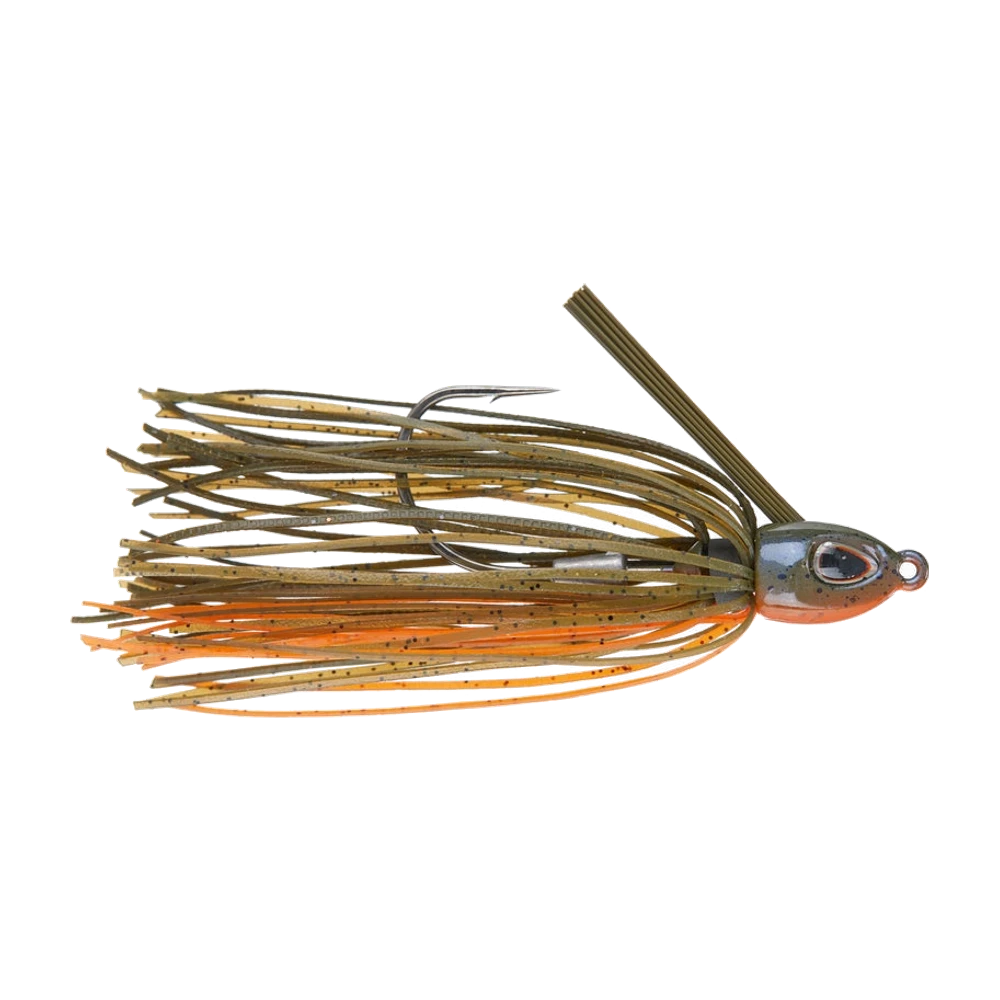
Berkley Finesse Swim Jig: a compact jig for thick grass
One lure, endless conditions. CarnaFish reads your spot from a photo so you are not just guessing.
There comes a point in late summer when the weed bed is so thick that a spinnerbait collects a salad on every cast and a crankbait simply will not go through. The fish are still in there. A swim jig is the tool for going in after them without stopping every three metres to clean the lure — provided it was drawn for the job.
Why a pointed head changes everything in grass
The difference between a swim jig that goes through and one that collects weed is almost entirely head geometry. The Finesse Swim Jig's head is pointed and tapered, neither rounded nor flat: it parts the stems instead of piling them against a blunt face. The line tie sits on top of the point, in the pulling axis, so the jig travels nose first and the grass slides either side.
That is not the same logic as a flipping jig, which you drop vertically and whose broad head is there to bounce off hard cover. Everything here is built for a horizontal, continuous track. If you want to drop vertically into a hole in the grass, a Berkley Powerbait Flippin' Jig is the tool, not this one.
The medium weedguard: the right compromise, and why
The weedguard on this jig is deliberately medium in stiffness. That is a trade-off the manufacturer owns, and it is worth understanding because it defines where the jig belongs.
A stiff weedguard protects the point better but pushes back on the hookset: on a fish that takes the jig softly, sideways, it can be enough to let the hook slide out. A weedguard that is too soft collapses on the first branch and the jig fouls. Medium goes through thick grass and loose vegetation, then folds away under hookset pressure without getting in the way. The flip side is that it was not made for heavy deadwood or stumps.
If you find the weedguard too bushy for your taste you can pull a few fibres with pliers — but always take them from the sides, never from the centre, or you open a channel for grass to wedge against the point.
Work the swim jig with the rod tip low and permanent contact. A swim jig is not fished like a spinnerbait: you want to feel the resistance of the grass continuously, because it is the instant the jig frees itself from a stem — that small surge followed by a second of float — that triggers the vast majority of bites. If you feel nothing, you are going too fast or your tip is too high.
Choosing the trailer is choosing the presentation
The jig comes bare. What you hang off the back decides its behaviour entirely.
A kicking-tail trailer, a small paddle shad, gives a continuous swim and a steady vibration: that is the search setting, the one that lets you sweep a big expanse of grass quickly with the skirt pinned shut by speed. It is the default when you are still looking for the fish.
A claw trailer, like the Berkley Crazy Legs Chigger Craw, adds drag and slows the jig down. The swim becomes slower and flatter, and the skirt opens more between reel turns. That is the precision setting, for once you know where the fish are and want to give them more time to commit.
The classic mistake
Fishing it too slowly. That is the reflex of an angler used to bottom jigs, and it kills more swim jigs than anything else. Below a certain speed the skirt flares permanently, the jig noses down and drags through the grass instead of crossing it. A minimum speed is what keeps the package compact and high in the layer. Speed up until you feel the jig floating through the vegetation rather than sinking into it, then hold that tempo.
Not sure what to tie on?
Photograph your spot: CarnaFish reads the scene, cross-checks the conditions and gives you the zone, the lure and the retrieve. Free on iOS and Android.
Why a finesse model rather than a standard swim jig
A downsized swim jig is not a cut-price version: it is a tool for a specific situation. It earns its keep when the vegetation is so tight that a standard profile has to force its way through, and when the fish are pressured or the water is clear — two cases where a smaller silhouette draws more bites.
The downside deserves stating honestly: with a smaller profile you also catch more average fish, and the jig sorts less. On a lake where you are hunting one big fish, a bulkier model still makes more sense. The same reasoning applies against a 6th Sense Konda Finesse Swim Jig, built on the same downsizing premise.
The hook is worth a mention: it is a needle-point single from the brand's Fusion19 series, meaning a relatively fine wire that penetrates quickly. That is an advantage on a long-distance hookset through grass, but do not over-tighten your drag on a very stiff rod.
Colours by environment
- Green weed, clear water: black-flecked olive green, which blends into the vegetation and gives a believable silhouette of prey in hiding.
- Clear water with baitfish up top: pearl white, paired with a light trailer to suggest a single small fish crossing the grass.
- Stained water or overcast sky: black and blue, the contrast pairing that stays readable once visibility drops.
One rule covers all three: keep the trailer in the same colour family as the skirt. A trailer in a markedly different colour breaks the silhouette and turns a compact lure into two separate objects.
Whether the weed bed in front of you calls for a swim jig or a frog depends on the spot and on the day, not on the catalogue. That is exactly what CarnaFish does: one photo of the spot, and the AI suggests the zone, the depth and the presentation type that suit conditions. For the fundamentals on tackle and bass holding spots, our guide to getting started in bass fishing covers it from scratch.
What to remember
- The pointed head is what lets it cross grass: that is criterion number one on a swim jig, far ahead of colour.
- The medium weedguard is an owned compromise — good in vegetation, not enough in heavy deadwood.
- Kicking-tail trailer to search fast, claw trailer to slow down and work a spot.
- Too slow and the jig noses down and sinks in: speed is part of the setup, not a comfort setting.
FAQ
What trailer should I run on a Finesse Swim Jig?
A small kicking-tail shad to search fast and keep the skirt pinned, a claw trailer to slow down and give the fish more time. Keep the trailer in the same colour family as the skirt.
How fast should I retrieve it?
Fast enough that the jig stays high in the grass layer and the skirt stays pinned. If you feel the jig nosing down and dragging, you are below the minimum speed.
How much does this swim jig weigh?
The manufacturer's description carries no weight table for this model. Pick the head weight off the density of the grass rather than off a published figure, and check the weight printed on the pack before you buy.
Can it be fished in deadwood?
That is not its ground. The medium weedguard is calibrated for vegetation; in tight branches or around stumps a flipping jig with a stiff weedguard protects the point far better.
What is the flavoured skirt for?
It does not summon an absent fish, but it lengthens the time a fish keeps the jig in its mouth. On a long-distance hookset with grass between you and the fish, that extra fraction of a second genuinely counts.
Finesse swim jig or standard model?
Finesse when the vegetation is tight, the water clear or the fish pressured. Standard when you want to sort out bigger fish: a smaller profile draws more bites, but on average from smaller fish.
The full bass lure guideSeason-by-season strategy: which family of lure, when, and why.Go from theory to fish
CarnaFish reads your spot from a photo and gives you the game plan: zone, lure, retrieve. Free on iOS and Android.