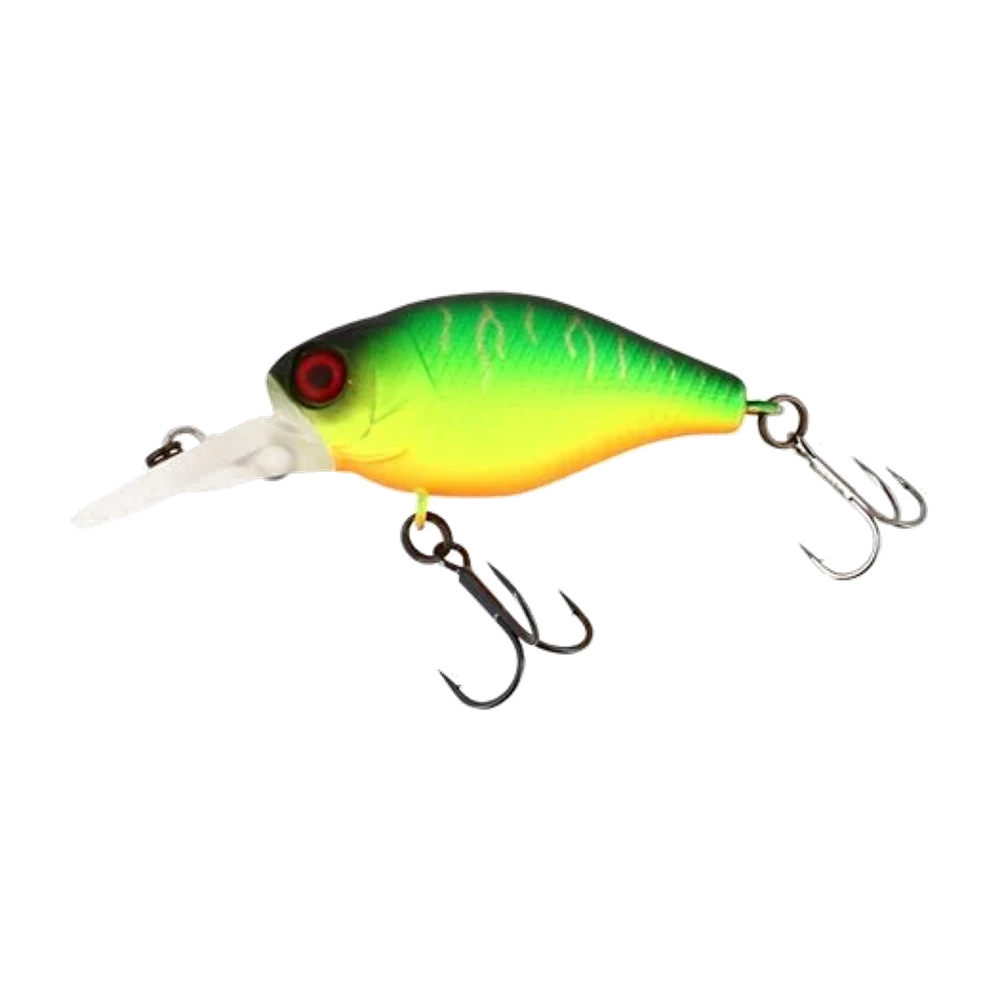
Illex Chubby 38: the margin crankbait that fishes the first metre
The right lure in the wrong spot still catches nothing. CarnaFish spots the zone that works, from a single photo.
Look at a pond bank on a spring evening. The perch are not out in open water, they are two metres off the bank, between the surface and fifty centimetres down, pinning fry against the sunken branches. Now look at what most anglers send them: a lure that dives straight for the bottom, or a shad on a jig head that crosses the useful layer in one second.
That band of water — the first thirty centimetres to a metre along the structure — is the most fish-holding and the worst fished. It calls for a lure that can stay there a long time, knock into the branches without hanging up, and lift by itself the moment you stop reeling.
The Chubby 38 does exactly that. It is a crankbait under four centimetres, floating, with a short lip, that works in the first metre and rises instantly on the stop. Its value does not come from its action — a crankbait vibrates, that is a given — but from its ability to negotiate structure rather than avoid it.
Tight vibration and buoyancy: the pairing that counts
Two elements define this lure, and they work together.
A very tight, fast vibration. The short lip and the thickness of the body produce a high-frequency beat rather than a wide action. That signal reads up close, it suits small volumes of water, and it looks much more like a nervous fry than a large wounded fish. On perch as on river trout, that is the right register.
Clear buoyancy. The moment you stop reeling, the lure rises immediately. That is the function everything else depends on: when the lip touches a branch or a rock, you stop for half a second, the lure frees itself upwards, and you set off again. A suspending lure would stay stuck; a sinker would go to the bottom.
The body also carries rattles that produce a high-pitched sound on every oscillation. In stained water, or under a branch where visibility is reduced, that signal is what brings the fish into visual detection range.
Three ways to fish it
Bouncing off structure
This is its reference use, and the main reason to pick it.
- Cast parallel to the bank, a metre off the margin, not perpendicular.
- Retrieve at a medium straight pace, fast enough for the lip to bite.
- At the slightest contact — branch, stump, rock — stop dead. Half a second, no more.
- Set off again immediately. That contact / stop / restart sequence is the trigger: the acceleration after the stop produces more bites than a steady action.
- Repeat along the whole length of the margin.
The broken straight retrieve in open water
On a spot with no structure, replace the contacts with deliberate stops: three seconds of retrieve, half a second of stop, then off again. The brief rise on the stop followed by the dive back down creates a change of axis that perch follow very well.
The drift in a trout river
Cast across or slightly upstream, let the current carry the lure down the seam, and give just enough tension for the lip to work. The Chubby holds its position in a medium current without rising to the surface, which lets you fish a riffle or a pool tail cleanly.
On the water: with a floating crankbait along a margin, never retrieve by dragging the lure straight towards you from open water. Cast along the bank and make it travel parallel to the structure. A lure that runs past a stump over three metres passes through the field of vision of every fish holding there; the same lure moving away perpendicular crosses only one, and from behind.
Tackle: do not overload it
With 4 g, everything comes down to the gram.
- An L-power rod of 1.80 to 2.10 m, progressive or semi-parabolic action. A stiff rod tears the lure out of a perch's mouth, and perch mouths tear easily.
- Fluorocarbon in 0.14 to 0.18 mm, or fine braid with a fluoro leader about thirty centimetres long. Beyond 0.20 mm, the line slows the lure and reduces the depth it reaches.
- A 1000 to 2500 reel, with the drag set soft. Lost fish along the margin almost always come from a drag set too tight.
- Snap: optional and to be chosen fine. A heavy snap makes the nose dip and degrades the vibration.
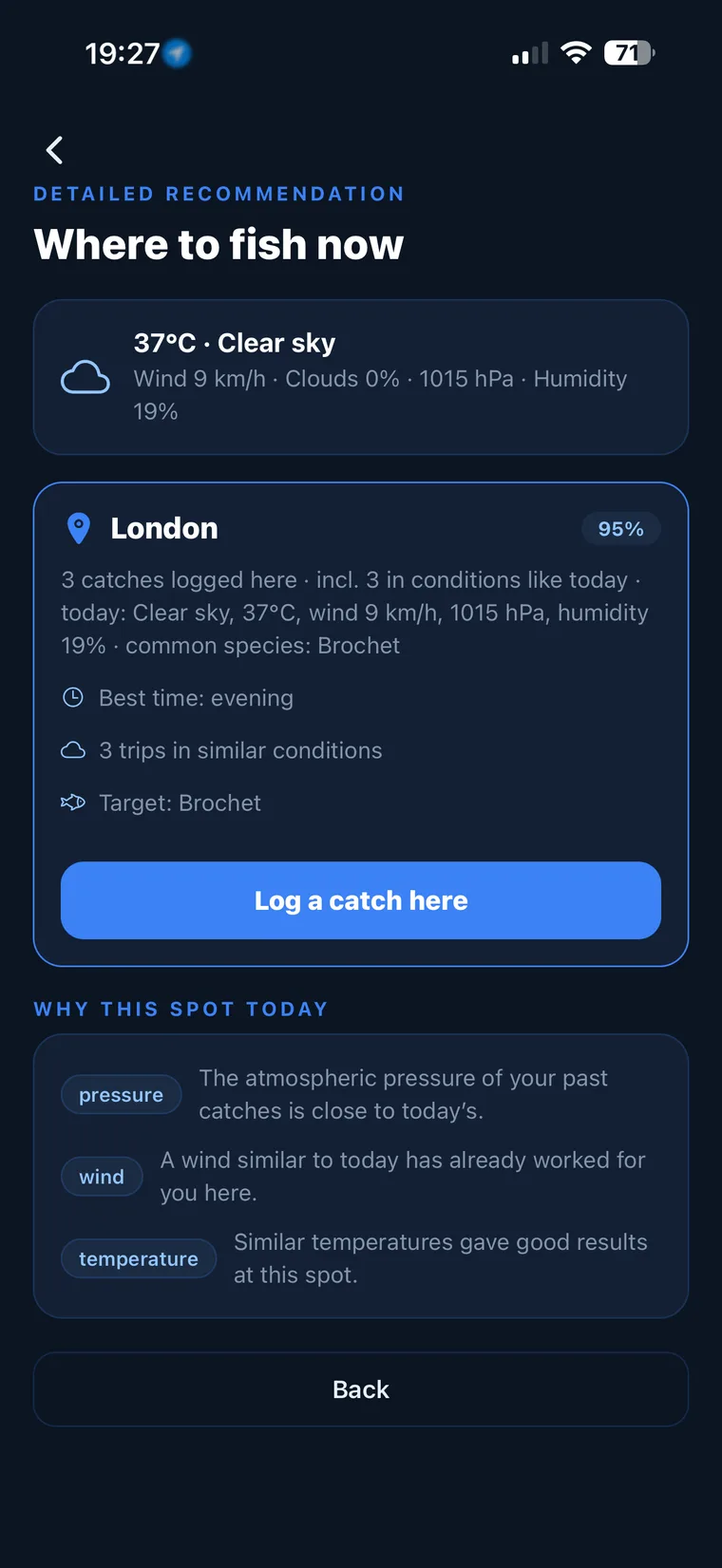
Not sure what to tie on?
Photograph your spot: CarnaFish reads the scene, cross-checks the conditions and gives you the zone, the lure and the retrieve. Free on iOS and Android.
What it cannot do
Its limits need to be stated clearly, because they are sharp.
- It does not go down. Beyond a metre it is out of its domain, whatever the speed.
- It does not cast far. Four grams on a light rod means twenty to twenty-five metres in good conditions, far less into the wind.
- It is not weedless. Two trebles on a four-centimetre body pick up everything in dense weed.
- It does not call from a distance. Its signal is fine: you have to take it past the fish, not hope it will pull one in from fifteen metres.
Chubby 38 or Diving Chubby 38
This is the question everyone asks, and the answer is more clear-cut than people think: these two lures do not fish the same layer of water and are not for the same moment.
The Diving Chubby 38 carries a longer, more angled lip. It reaches down to a metre and a half, knocks the bottom over shallow flats, and becomes the mid-depth tool. It is the right choice when perch are on a drop-off, on a plateau at two metres, or when you want to lift silt to signal your passage.
The standard Chubby 38 stays above. It fishes the layer the Diving crosses without stopping in it, and it is the one to tie on when the fish are high: warming water in spring, surface feeding, fish glued under low branches, very shallow margins where the Diving would scrape.
The right method is to carry both and let the fish decide: start with the standard along the margin, and if nothing moves, switch to the Diving to explore a metre lower.
For an even more discreet signal on fish you have seen but that will not commit, a minnow such as the ZipBaits Rigge 56 changes register entirely. Our guide to lure fishing for perch explains when to favour a crankbait over a soft plastic. And if you are hesitating between fishing high or low when you reach a margin, CarnaFish analyses a photo of the spot and answers.
Key takeaways
- Running depth: 0.3 to 0.8 m, no more, whatever the speed.
- Floating: on the stop it frees itself from branches upwards, which makes it a lure for cluttered margins.
- Cast parallel to the bank, not perpendicular.
- L-power rod and 0.14-0.18 mm line, soft drag for perch.
- The Diving Chubby fishes a metre lower: two complementary tools, not equivalents.
FAQ
How deep does the Chubby 38 swim?
Between roughly 30 and 80 centimetres. Speeding up does not take it significantly deeper: the short lip deliberately caps its dive to make it a shallow margin lure.
What is the difference with the Diving Chubby 38?
The lip. The Diving one, longer and more angled, runs down towards a metre and a half and serves mid-depth. The standard model stays in the first metre: they cover two distinct layers rather than replacing each other.
How do I avoid snagging along the margin?
Use its buoyancy. At the slightest contact with a branch or a rock, stop reeling for half a second: the lure rises and frees itself, then you set off again. That is also the sequence that triggers the most bites.
What line should I use with a 4 g lure?
Fluorocarbon of 0.14 to 0.18 mm, or fine braid with a short fluoro leader. Thicker line slows the lure, reduces the depth it reaches and costs metres on the cast.
Does it work for trout in rivers?
Yes, on a controlled drift. Cast across or slightly upstream, let the current carry the lure down the seam, and hold just enough tension for the lip to work without lifting the lure.
Can it be fished in weed?
No, or very badly. With two trebles on a body under four centimetres, it picks up vegetation as soon as it gets dense. Keep it for hard structure: branches, stumps, rip-rap, jetties.
The full perch lure guideSeason-by-season strategy: which family of lure, when, and why.Go from theory to fish
CarnaFish reads your spot from a photo and gives you the game plan: zone, lure, retrieve. Free on iOS and Android.