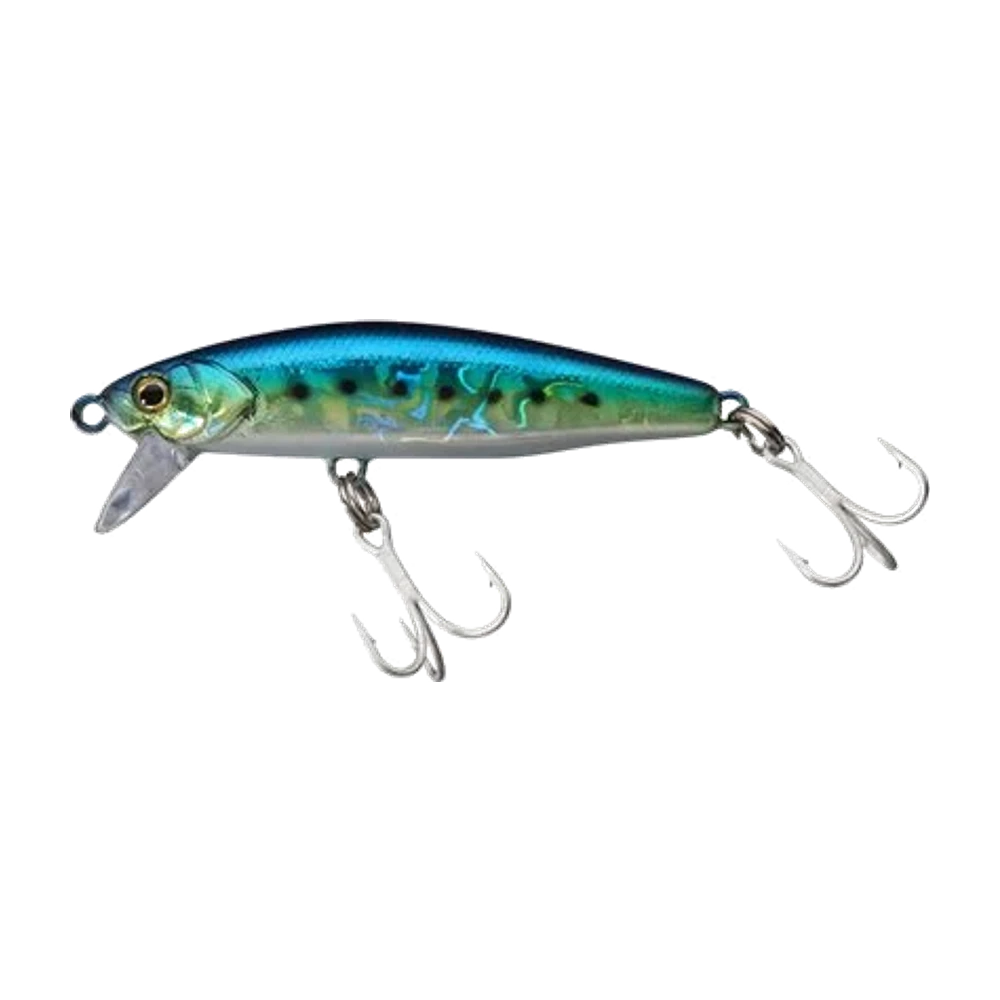
Illex Arnaud 60: dropping a size without losing the edge
One lure, endless conditions. CarnaFish reads your spot from a photo so you are not just guessing.
You are fishing a stream or a small river, the water is 60 cm deep over the flats, and the fish are perch of 20 to 35 cm plus a few trout. You tie on your usual 10 cm jerkbait: it hits bottom on the second twitch, it scrapes, and the perch look at it without touching it anyway. The problem is not technique, it is scale.
The Arnaud 60 applies its big brother's logic — swim high, answer short twitches, settle fast — to a size that fits in a thin layer of water. But shrinking a jerkbait is not just about making it smaller: it changes the tackle, the casting distance, how you deal with wind, and how the lure behaves at the end of the retrieve.
This page starts from what actually changes compared with the Arnaud 100, whose page already covers the model's basic logic and its use on pike rivers.
What really changes compared with the 100
| Parameter | Arnaud 100 | Arnaud 60 |
|---|---|---|
| Running depth | 0.8 to 1.2 m | 0.4 to 0.8 m |
| Weight | around 16 g | around 5 g |
| Recommended line | 0.25-0.30 mm fluoro | 0.16-0.20 mm fluoro |
| Rod rating | 10 to 30 g | 3 to 12 g |
| Target | pike, sea bass | perch, trout |
| Useful casting distance | 25 to 35 m | 12 to 20 m |
The three lines that really matter are weight, line and distance.
Weight. Going from 16 to 5 g is not a nuance: it is different tackle. A rod built for the 100 does not load with the 60, you lose half your distance and you feel nothing. A 3 to 12 g rod with a sensitive tip is the minimum.
Line. A 0.25 mm line on a 5 g lure chokes it completely: the diameter creates drag that stops the darts forming cleanly. Dropping to 0.16 or 0.18 mm gives the action back. With fine braid and a metre of fluorocarbon you gain even more crispness, at the price of slightly less tolerance on the hookset.
Distance. A 5 g lure will not go beyond 20 m in good conditions, and much less into the wind. That transforms the way you fish: you no longer search a stretch from a fixed point, you move. On a stream, this is roving fishing where you cover each spot in two or three short casts before walking twenty metres on.
The retrieve: shorter, faster, less pause
The 100 asks for two or three short twitches followed by a one to three second pause. The 60 asks you to go further in that direction.
- Three to five micro-twitches, wrist only, over a 5 to 8 cm travel. The rod tip stays low, pointed at the water.
- A very brief pause, half a second to a second. On a small lure, a long pause gives the fish time to study it — and refuse.
- Link them with no dead time through the whole retrieve. The sequence should look like a nervous fry, not a wounded fish dying slowly.
- Finish with two fast turns in the last three metres. Perch follow a lot and often commit on that final acceleration.
For trout in a river, adapt: work upstream, cast up, and let the lure come back down with barely any animation while you take up the slack. The trout usually hits during that controlled drift, not during the pulling phase.
On the water: on a 5 g jerkbait, the knot is part of the setup. A knot cinched tight in the eye restricts the darts. Use a loop knot — the lure then pivots around the loop and regains the amplitude it loses with thick fluorocarbon. It is the biggest gain for the least effort.
Perch and trout: two ways of using it
For perch, it is a hunting and margin lure. The spots to aim at:
- The tips of jetties and snags, where perch sit in small groups.
- The reed bed edges, fishing parallel to the vegetation rather than perpendicular.
- Brief surface bust-ups: in that case, no pause at all, fast retrieve in micro-twitches.
When a perch follows without biting, stop the lure dead for a second, then set off again with three very fast twitches. That is the only pause worth making with this model.
For trout, the constraint is discretion. A jerkbait displaces water and is visible from a distance in a clear stream. Approach from downstream, stay low, and do not fish the same spot twice: trout almost systematically refuse the second pass. Fine fluorocarbon is not a luxury here, it is what separates a follow from a bite.
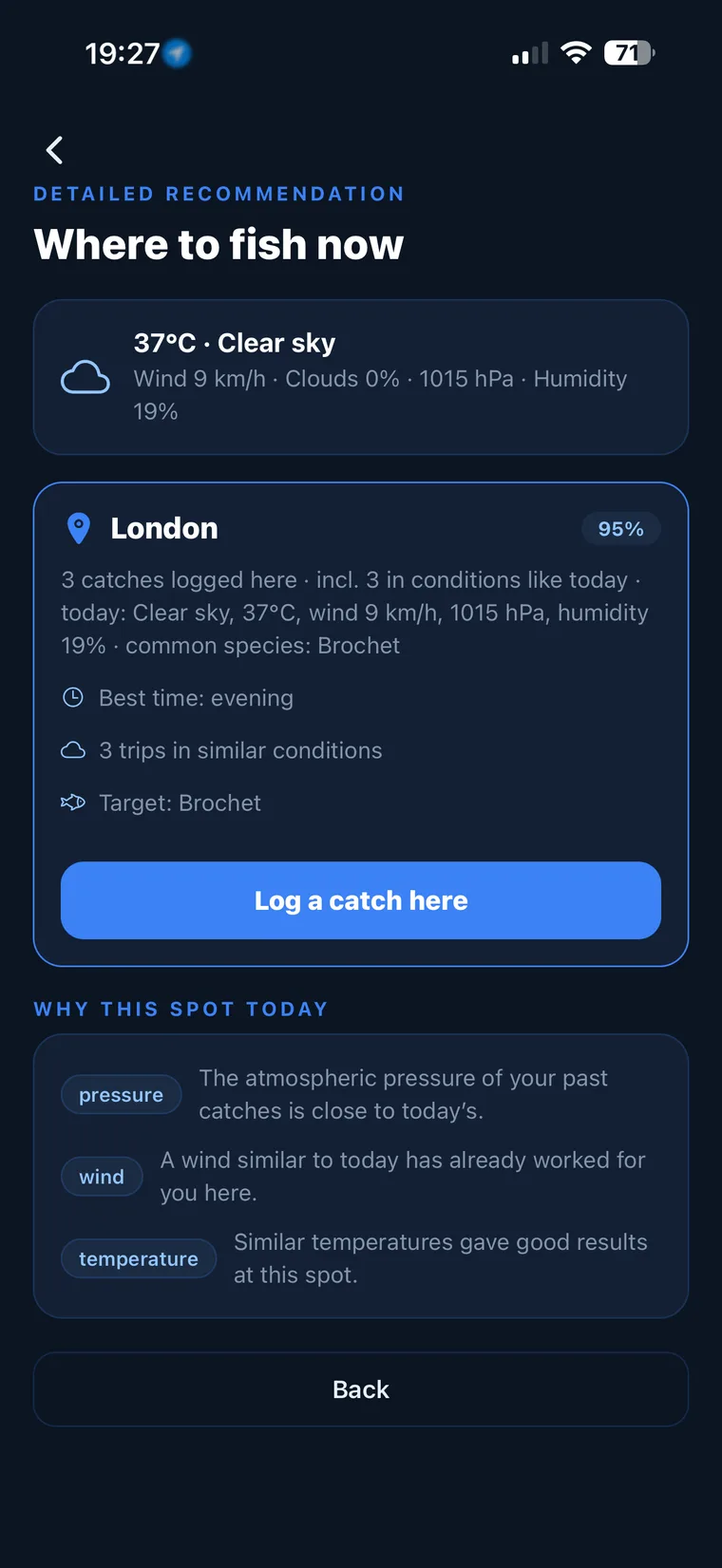
Not sure what to tie on?
Photograph your spot: CarnaFish reads the scene, cross-checks the conditions and gives you the zone, the lure and the retrieve. Free on iOS and Android.
Where it does not belong
- Beyond 1.50 m of depth: it stays too high, and a deeper-diving lure or a light soft plastic will cover the water column better.
- In sustained wind: 5 g into the wind and you cannot cast any more, and the retrieve becomes imprecise.
- On pike holding on a marked spot: it will catch them accidentally, but without a leader it gets cut off, and with a wire leader its action is dead.
- In very stained water: the volume is not enough to create a detectable signal, a small blade or a vibrating lure will be more relevant.
Arnaud 60 or a small soft plastic
Against a small soft shad such as the Keitech Easy Shiner 3, the two lures do not cover the same thing. The shad is fished on the bottom, in steps, and accepts very slow rhythms: it is the choice when perch are sitting still or the water is cold. The Arnaud 60 is fished high, fast, and is there to cover a stretch of margin to find the active fish.
Against a slightly bigger jerkbait such as the Illex Squirrel 61, we are closer, but the purpose differs: the Squirrel leans towards a rolling action and more all-round use, while the Arnaud 60 stays in the nervous, high-running register of the Arnaud range.
Our guide to lure fishing for perch and the one on river trout place this size within a complete box. And if you are hesitating between a small jerkbait and a light soft plastic when you reach a spot, CarnaFish analyses a photo of the spot and answers.
Key takeaways
- It is not a miniature 100: dropping to 5 g means a light rod, fine fluoro and short casts.
- Micro-twitches of 5 to 8 cm, pauses of a second at most, never any dead time.
- For trout, work upstream and let the lure drift between two pulls.
- A loop knot gives the lure back the amplitude the line takes away.
- Unusable in sustained wind and beyond 1.50 m of depth.
FAQ
What is the difference between the Arnaud 60 and the Arnaud 100?
The 60 swims between 0.4 and 0.8 m against 0.8 to 1.2 m for the 100, weighs three times less and targets perch and trout rather than pike and sea bass. The main change is in the tackle: light rod, fine fluorocarbon and short casts.
What rod should I use with a 5 g jerkbait?
A rod rated for roughly 3 to 12 g, with a tip sensitive enough to transmit the twitches. A more powerful rod does not load at that weight: you lose casting distance and precision in the retrieve.
Do I need a wire leader with the Arnaud 60?
Not if you are targeting perch or trout: wire kills the action of a lure this light. If pike are numerous on the spot, accept the risk of a cut-off or change lure — there is no compromise at this size.
How do I fish the Arnaud 60 for trout?
Approach from downstream, cast upstream, and let the lure come back down while you simply take up the slack with very light pulls. The bite almost always comes during that drift, and a spot is only fished once.
Why does my Arnaud 60 not dart properly?
In the vast majority of cases it is the line: too thick a diameter or a knot cinched tight in the eye chokes a 5 g lure. Drop to 0.16 or 0.18 mm and use a loop knot.
How deep does it swim?
Between 0.4 and 0.8 m on fine fluorocarbon. That is deliberately shallow: it is built for thin layers of water and for margins, not for reaching a deep band.
The full perch lure guideSeason-by-season strategy: which family of lure, when, and why.Go from theory to fish
CarnaFish reads your spot from a photo and gives you the game plan: zone, lure, retrieve. Free on iOS and Android.