Fox Rage Tiddler Fast: the little crank that holds its line when you speed up
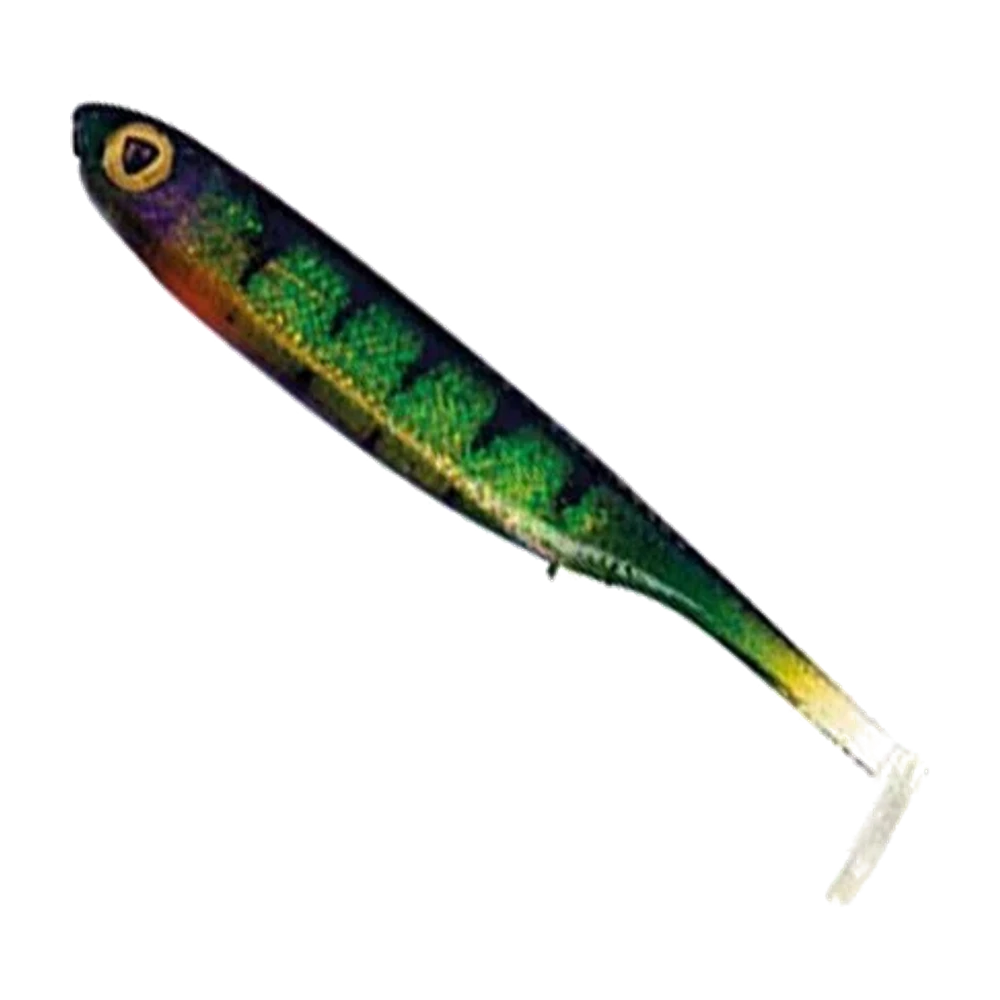
This lure shines under specific conditions. CarnaFish tells you in 10 seconds if today is one of them.
The reflex when perch will not bite is to slow down. You switch to finesse, stretch the pauses, drop a line size. That often works — and it fails completely in one precise case: the perch that follows, comes right to the bank, looks and leaves. That fish has had all the time in the world to inspect your lure. Slowing down gives it even more.
For that fish the right correction is the opposite. You have to remove the decision time, to show it something crossing its zone fast enough that the attack becomes a reflex rather than a choice. The problem is that most small crankbaits cannot handle speed: past a certain rhythm they roll onto their side, rise to the surface and start spinning.
The Tiddler Fast is calibrated for exactly that upper range. Its name is not decoration: this is a small crank whose main point is holding a clean action where its rivals break down.
What keeps it tracking true
Three things work together.
A short, steeply angled lip. It is not chasing maximum depth but stability: the shorter the lip, the less hydrodynamic leverage there is to unbalance the body as speed rises.
A deep belly and a low weight. The centre of gravity sits well below the pulling axis. So the lure has a strong tendency to right itself as soon as it starts to tip over — and that righting force is the first thing to disappear on a badly balanced crank.
A tight, quick wobble rather than a wide one. Reduced amplitude generates less torque on the body. You lose vibration range, you gain directional stability. On a 5.5 cm lure aimed at perch that is the right trade: perch hunt by sight and at close range, they do not need calling from fifteen metres.
The concrete result: you can grind away at five or six handle turns a second without the lure leaving the water, which is precisely the range where the attack reflex takes over from inspection.
The retrieve: constant speed, then a break
- Cast and get straight into a fast, steady rhythm. Unlike a searching crank there is no sink phase to respect: the lip takes it down to its layer in two or three turns.
- Hold the high speed for the first two thirds of the retrieve. The aim is not to look pretty, it is to put the lure through the field of vision fast.
- Look for contact. As soon as you feel a rock, wood or weed, let the lure bang into it rather than avoiding it. The deflection breaks the trajectory and triggers more than any rod work.
- Break for half a second just after the contact: stop winding, the lure rises very slightly, then drive it on sharply. That is the only useful dead time with this lure.
- Finish the cast near the bank by speeding up even more. Plenty of perch follow and only commit in the last three metres, when the lure seems to be escaping.
On the water: if you are not getting hits with this lure, the first correction is not a colour change, it is another notch of speed. Most anglers think they are winding fast when they are at half throttle. Make one cast that is deliberately absurd in its speed: that is often the one that produces.
Real depth and adjustments
The stated depth of a crankbait is always an order of magnitude. Here is what shifts it in the real world:
| Parameter | Effect on depth | Order of magnitude |
|---|---|---|
| 0.20 mm fluorocarbon instead of 0.30 mm | Runs deeper | +20 to 30 cm |
| Fine braid with a short leader | Runs deeper, sharper contact | +20 cm or so |
| Long cast instead of a short one | Runs deeper | +20 to 40 cm |
| Very fast retrieve | Rises slightly | -10 to 20 cm |
| High rod, tip at 45° | Rises noticeably | -30 cm and more |
In practice you steer the water layer with rod angle more than with anything else. Tip pointed at the water, almost in it, to scratch the bottom at 1.5 m. Tip raised to come back over a weed bed.
Two rigging details:
The knot. A knot tied tight on the nose eye restricts the wobble of a 7 g lure. If the lure has no split ring at the front, add a small one or use a fine clip.
The trebles. As supplied, they are sized for perch. Replacing them with bigger models adds weight at the front and removes part of the high-speed stability — exactly what makes the lure worth having.
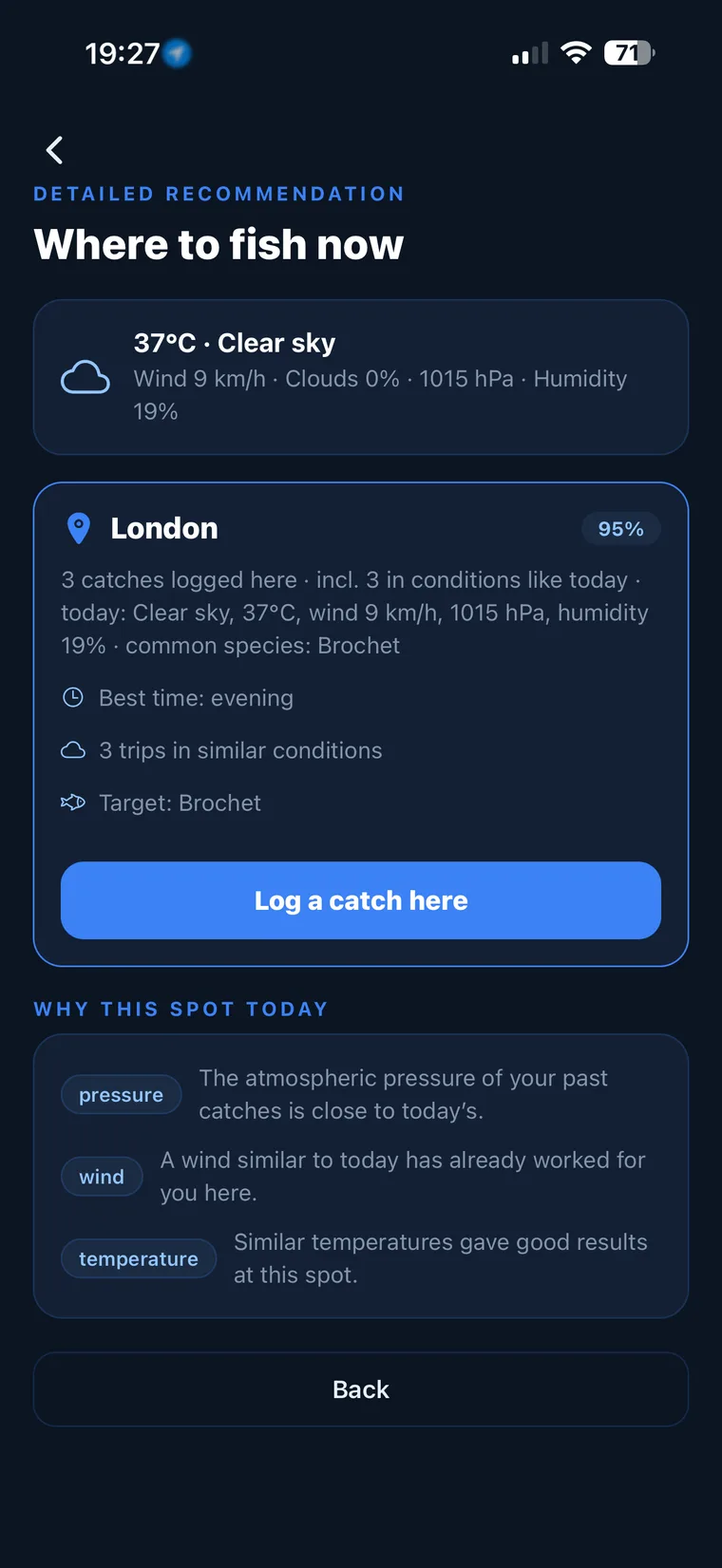
Not sure what to tie on?
Photograph your spot: CarnaFish reads the scene, cross-checks the conditions and gives you the zone, the lure and the retrieve. Free on iOS and Android.
Where it shines and where it is useless
Its real ground:
- River margins in 1 to 2 m of water, with rocks or wood to bounce the lure off.
- Shoaling perch, active but selective, typically from late spring to early autumn.
- Dykes, groynes, canal rock armour, where you need to run fast along a hard line and repeat a lot of casts.
- Followers that refuse a slowly worked soft plastic: speed often solves the problem in one cast.
Its limits are just as clear:
- Cold water, under 8 °C. Perch no longer chase. A fast lure becomes pointless provocation.
- Depth beyond 2.5 m. It does not go there, full stop. You need a long-lipped crank or a sinking lure.
- Dense weed. Two trebles and a fast rhythm in vegetation means picking salad off after every cast.
- Big solitary fish. The size and action call in perch of 20 to 35 cm rather than the late-season loners.
Tiddler Fast or a slow, wide-wobbling crank
A small wide-wobbling crank such as the Illex Chubby 38 bets on something else: it moves more water, is heard from further away and takes happily to being fished with stops, because it floats. That is the choice in stained water, on scattered fish, and when you need to call.
The Tiddler Fast is not trying to call. It is trying to provoke, on a fish that has already seen your lure. The two complement each other in the same box: you search with the wide wobble, and you come back at speed over fish that are located but undecided.
If you would rather work slowly on a located perch, a finely rigged soft plastic like the Fox Rage Spikey Shad covers the opposite register, with short lifts and pauses. Our guide to perch fishing with lures explains how to alternate these three registers through a single day. And if you are unsure what speed to use when you reach the bank, CarnaFish analyses a photo of the spot and answers.
Key takeaways
- Short lip, low weight, tight wobble: built to stay stable where a standard crank breaks down.
- Speed is the retrieve. If it is not working, speed up before you change colour.
- Look for contact with the bottom or wood: the deflection triggers more than the action itself.
- Rod angle steers the water layer more reliably than line diameter.
- Pointless under 8 °C, beyond 2.5 m and in dense vegetation.
FAQ
How deep does the Tiddler Fast run?
Between 1 and 1.5 m with standard fluorocarbon and a medium-length cast. Finer line and a rod tip pointed at the water gain it twenty to thirty centimetres; with the rod held high it stays noticeably higher in the column.
Does it really need a fast retrieve?
Yes, that is its main point: it keeps a clean action at speeds where most small cranks lie over. A fast retrieve removes the inspection time and turns a follow into a reflex attack.
Is it suitable for pike or zander?
That is not its target. Its 5.5 cm size and fine trebles are sized for perch; a pike will go straight through the rig and zander are rarely caught at that speed in that water layer.
What line should I use?
Fluorocarbon of 0.20 to 0.25 mm straight through, or fine braid with a one metre leader if you want more feel on cover. Avoid heavy mono, which floats and lifts the lure out of its layer.
Why does my crank roll onto its side?
Either you have added weight at the front by changing hooks or fitting a big clip, or the lip has taken a knock. Also check the knot is centred on the eye: an off-centre knot makes the lure swim crooked.
When should I prefer a wide-wobbling crank?
In stained water, on scattered fish, or when you need to call from a distance. A wide-amplitude crank moves more water and is detected further away; the Tiddler Fast is reserved for fish you have already located and need to convert.
The full perch lure guideSeason-by-season strategy: which family of lure, when, and why.Go from theory to fish
CarnaFish reads your spot from a photo and gives you the game plan: zone, lure, retrieve. Free on iOS and Android.