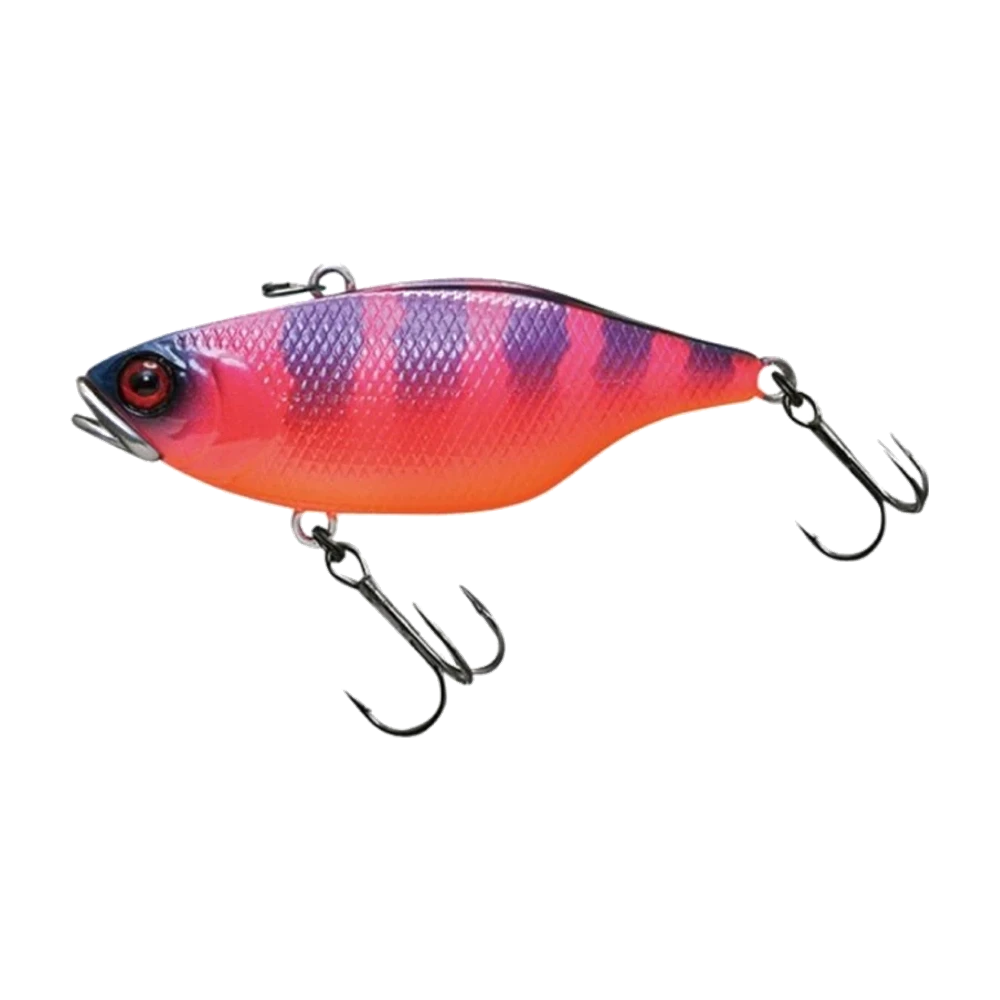
Jackall TN 70: the compact lipless that lifts off the bottom effortlessly
Before tying this one on, it helps to know if the spot actually calls for it. CarnaFish reads the scene from a photo.
European and American lipless baits are generally long and flat. The TN 70 goes the other way: it is short, thick and dense, with its mass concentrated into a small volume.
That geometry produces a particular behaviour: the lure lifts off the bottom instantly on the smallest pull, with no need to build momentum. That is exactly what you want on fish pinned to the bottom in cold water.
Why being compact changes the behaviour
An elongated lipless has to travel a certain distance before its vibration settles. The TN 70, being shorter and denser, reaches its vibration frequency within a few centimetres.
Three practical consequences.
The yo-yo becomes more effective. Every pull produces an immediate, decisive vibration through the whole lift, instead of a dead phase followed by an active one.
The fall is more vertical. A compact body glides less than an elongated one: the lure returns quickly to the bottom, which lets you string cycles together without drifting away from the spot.
The vibration is tighter and higher in frequency. A different signal from that of classic lipless baits, which matters on fish used to seeing the same type of lure go past over and over.
The cold water retrieve
This is the context where the TN 70 gives its maximum.
- Cast and let it sink to the bottom, counting it down.
- One wide pull of the rod — the lure lifts off vibrating hard over 1 to 1.5 m.
- Let it drop back keeping the line just tight, with no slack.
- Wait for bottom contact, then start again.
On the water: in cold water, stretch the pause on the bottom to three or four seconds before the next pull. A zander at 6 °C is in no hurry: it comes over, looks, and takes. Restart the cycle too quickly and you pull the lure out of its decision zone.
The bite almost always comes on the drop. It shows up as a clean tick, or as a line that stops sinking earlier than it should have.
The versions
Jackall makes the TN in several configurations, and the difference is functional, not cosmetic.
| Version | Behaviour | Use |
|---|---|---|
| TN 70 standard | Classic sinking | All-round, 2 to 6 m |
| TN 70 Trigger | Slower fall, pronounced glide | Cold water, apathetic fish |
| TN 50 | Smaller, 5 cm | Perch, clear water, pressured fish |
| TN 80 | Bigger, 8 cm | Pike, deep water |
The Trigger version is the one that brings most in winter: its extended glide keeps the lure in a slow fish's field of view for longer.

Not sure what to tie on?
Photograph your spot: CarnaFish reads the scene, cross-checks the conditions and gives you the zone, the lure and the retrieve. Free on iOS and Android.
Choosing your depth
Like any lipless, depth is chosen by counting down. The TN 70 sinks at around 60 cm per second.
- Three seconds for 2 m
- Five seconds for 3 m
- Eight seconds for 5 m
Over ground you do not know, count down to bottom contact on the first cast: you get the exact depth, and you can then target any layer you like.
TN 70 or classic lipless
An elongated lipless such as the Fat Vibes casts further thanks to its aerodynamic profile and covers ground faster. That is the better choice for locating fish over a large area.
The TN 70 works better on an identified spot: immediate lift-off, closely spaced cycles, a vertical fall. It is a precision lure once the fish have been found.
The effective approach is often to use both in turn: search with the elongated lipless, then work the productive zone with the TN.
Our guide to lure fishing for zander covers cold water approaches in detail. And if you have located a shoal without managing to make them react, CarnaFish analyses a photo of the spot and suggests a line of attack.
Key takeaways
- A short, dense body: the vibration settles within a few centimetres, lift-off is immediate.
- The fall is vertical: you stay on the spot instead of drifting.
- In cold water, hold a three to four second pause on the bottom between cycles.
- Count the fall down — around 60 cm per second — to pick your layer of water.
- A precision lure for an identified spot, not for broad searching.
FAQ
What sets the TN 70 apart from a classic lipless?
Its compactness and density. It is shorter and thicker, which lets it reach its vibration frequency within a few centimetres and lift off the bottom instantly, with no wind-up phase.
How do you work it in cold water?
On a yo-yo: one wide pull that lifts the lure 1 to 1.5 m, then a drop on a tight line, then three to four seconds of pause on the bottom before the next cycle. The bite comes on the drop.
Which version should you choose?
The standard TN 70 for all-round use from 2 to 6 m, the Trigger in cold water for its extended glide, the TN 50 for perch and clear water, the TN 80 for pike and deep water.
How do you choose the running depth?
By counting the fall: the TN 70 sinks at around 60 cm per second. Three seconds for 2 m, five for 3 m, eight for 5 m. On the first cast, count down to bottom contact to learn the exact depth.
When should you prefer an elongated lipless?
To locate fish over a large area: an elongated profile casts further and covers ground faster. The TN 70 takes the advantage once the spot is identified, thanks to its closely spaced cycles and vertical fall.
Do you need a leader for pike?
Yes, fluorocarbon of 0.50 mm minimum or a short titanium trace. The exposed trebles of a lipless easily bring the line into contact with the teeth when a pike attacks.
The full zander lure guideSeason-by-season strategy: which family of lure, when, and why.Go from theory to fish
CarnaFish reads your spot from a photo and gives you the game plan: zone, lure, retrieve. Free on iOS and Android.