Keitech Easy Shaker: the worm that hangs flat under a drop shot
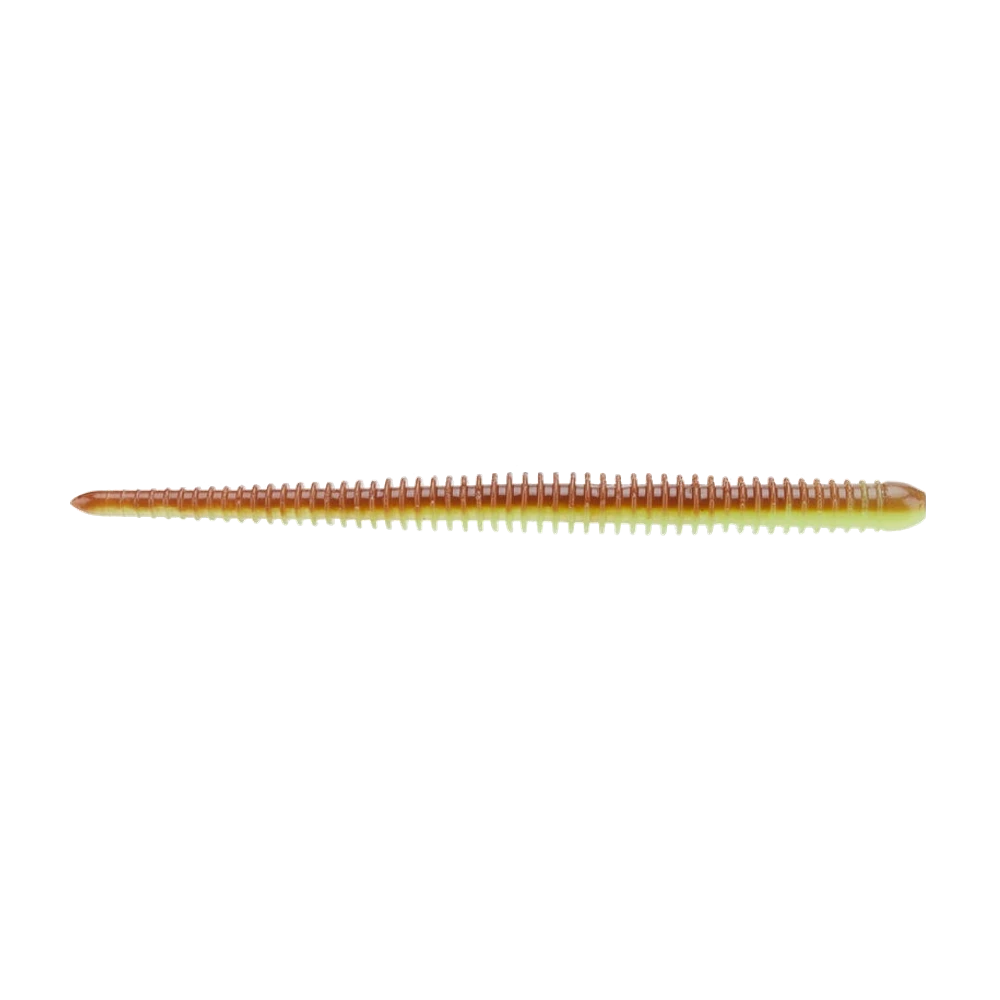
This lure shines under specific conditions. CarnaFish tells you in 10 seconds if today is one of them.
Drop shotting has a flaw nobody admits to: most soft worms end up hanging at an angle under the line, nose up, body on the diagonal. From the fish's point of view that looks like nothing alive. Keitech tackled the problem not through shape but through material, tuning a plastic whose density holds the Easy Shaker horizontal once it is nose-hooked. It is a quiet correction, and it completely changes how credible the presentation is.
Ribbing: bulk without thickness
The Easy Shaker's body is scored with tight rings along its full length, from one tapered end to the other. That ribbing does two things at once, and that is the whole point of the design. First it grows the silhouette: for the same core diameter, a ringed body visibly takes up more room in the water than a smooth one, and it catches light better. Second, it lets the central core stay very thin — so maximum flexibility — without the worm looking skinny for it.
That compromise is what produces the behaviour you are after. A single undulation on the bottom, a tremble at the rod tip, a gust of wind rocking the boat: nothing more is needed to set the body vibrating along its whole length. Keitech describes the effect as the shiver of a struggling baitfish, which is an honest description of what you see when you drop the lure into clear water alongside the boat. The movement is not spectacular, it is permanent — and that is exactly what a fish that has refused three more aggressive lures needs.
Do not try to work an Easy Shaker. Drop it, tension just enough to feel the weight, and watch your rod tip: wind and current are already doing the job. If you can see the tip moving on its own, the worm is moving too. Every pull you add shortens the time the lure spends in the strike zone.
Three lengths, three pack counts
The maker publishes a simple chart, worth reading carefully because the second column is not a weight but a piece count:
- 3.5 in, 8.9 cm: pack of 12. The perch size, and the bass size when the water is very clear or the fish heavily pressured.
- 4.5 in, 11.4 cm: pack of 10. The most useful compromise, as happy on a drop shot as on a shaky head.
- 5.5 in, 14 cm: pack of 10. For better fish and stained water, where you need volume to be found at all.
No per-piece weight is published. That is not a trivial omission: on a drop shot the lure's own weight contributes to how flat it hangs, and on a shaky head it influences the head you pick. In practice, think in terms of the jig head rather than the worm, and start with the lightest that still lets you feel the bottom.
Two rigs, two logics
Drop shot
This is the rig the plastic was tuned for. Pin the hook point through the nose of the worm, right through or just under the skin, and let it hang square to the line. The worm then sits flat at the exact height you tied your knot above the weight, and every micro-tension in the line turns into a shiver through the body. Twenty to forty centimetres of tag is enough in most cases; lengthen it when the sonar shows fish well off the bottom.
Shaky head
The head of the worm is deliberately thicker than the rest, so it accepts an offset worm hook without tearing. That is a genuine design decision, not a moulding accident: on a worm of constant thickness, the hook's entry point is also its failure point. Two slits, one on the back and one on the belly, let you bury the point in the body and get a genuinely weedless rig. You can therefore fish a shaky head through light timber or along a weed edge without spending the session unhooking vegetation.
The classic mistake
Rigging the Easy Shaker wacky through the middle, because that is what you do with a stick bait. It works, but it wastes the lure: the thickened head and the rigging slits become pointless, and a ringed body tears at the hook point faster than a dense stick bait does. If you want to fish wacky, use a lure drawn for it.
Where and when it earns its place
The Easy Shaker is a tough-conditions lure, not a search bait. You reach for it when fish are located but inactive: a shoal of perch glued to a bridge piling in midsummer, bass sitting on a break the day after a cold front, zander marked on the sonar at six metres over flat bottom. In those situations the aim is not to cover ground but to keep the lure within reach of the fish as long as possible.
That is what separates it from a Zman TRD Ned Rig, which trades on a stand-up posture and a specific fall, or from a Keitech Easy Shiner 3, whose paddle tail needs a retrieve to exist at all. The Easy Shaker works while standing still. When fish switch back on and start chasing again, know when to go back to something that moves, for instance a Keitech Flapper Grub fished higher in the column.

Not sure what to tie on?
Photograph your spot: CarnaFish reads the scene, cross-checks the conditions and gives you the zone, the lure and the retrieve. Free on iOS and Android.
Colours for the water
The maker publishes no detailed chart but insists on one point: the range plays on transparency as much as on hue. That is a useful distinction in finesse fishing, where the degree of translucency often matters more than the colour itself.
- Clear water, wary fish: a low-contrast translucent tone that lets light through and gives the fish almost nothing but a silhouette.
- Lightly stained water: the two-tone brown flake over chartreuse belly, the one in the photo. The natural back reassures, the bright belly gives an aiming point on the strike.
- Dark water or low light: a solid dark tone, which stands out by contrast rather than by colour.
A lure that asks for patience
The finesse worm is the family least forgiving of impatience: it produces no feedback in the rod, no reassuring vibration, and you always end up winding it back too fast. Knowing when to slow down that much, and over which ground, is the other half of the job. That is exactly what CarnaFish makes easier: one photo of the spot, and the AI suggests the zone, the depth and the kind of presentation that fit the day's conditions. To frame the structure and tackle side of perch fishing, our guide to lure fishing for perch pairs well with this page.
Key takeaways
- The ribbing grows the silhouette while allowing a thin core: bulk without losing flexibility.
- The plastic is tuned so the worm hangs horizontal under a drop shot instead of sitting at an angle.
- Thickened head plus back and belly slits: the offset-hook shaky head was designed in, not improvised.
- Three lengths — 8.9, 11.4 and 14 cm / 3.5, 4.5 and 5.5 in — in packs of 12, 10 and 10; no per-piece weight is published.
FAQ
Which Easy Shaker size should I start with?
The 4.5 in / 11.4 cm, sold in tens. It is the length that works equally well on a drop shot and a shaky head and interests a good perch as much as a bass. Keep the 3.5 in for very clear water and pressured fish.
Is the Easy Shaker really weedless?
On a shaky head with an offset worm hook, yes: the two slits moulded into the back and belly let you bury the point completely. Nose-hooked on a drop shot the point stays exposed and the rig is not weedless.
How much does an Easy Shaker weigh?
The maker publishes no per-piece weight, only lengths and pack counts. Think in terms of your head or drop shot weight instead, starting with the lightest that still lets you feel the bottom.
Why does my worm hang at an angle on the drop shot?
Usually because the hook is pinned too far back from the nose, or because the hook is too heavy for the worm's size. The Easy Shaker is specifically tuned to stay horizontal, provided you pin it right at the tip.
Is it a good lure for zander?
On a spot marked with sonar, drop shotted at fish level, it is a presentation that works well on an inactive zander. The maker does not name the species, but the register — a slim body shivering without travelling — matches what that fish wants in hard conditions.
Does it need particular tackle?
A finesse rod with a sensitive tip and thin braid to a fluorocarbon leader. All the information comes through the tip: if you cannot see your lure vibrating in the rod tip, you are fishing blind and you will miss most of the soft bites.
The full bass lure guideSeason-by-season strategy: which family of lure, when, and why.Go from theory to fish
CarnaFish reads your spot from a photo and gives you the game plan: zone, lure, retrieve. Free on iOS and Android.