Roboworm Ned Worms: a short ned worm that glides on the fall
The right lure in the wrong spot still catches nothing. CarnaFish spots the zone that works, from a single photo.
The ned rig has an unfair reputation: it gets described as the last-resort presentation, the one you tie on when nothing else works. In reality it is a technique in its own right, built on a short stick threaded onto a very light head, working in the last metre of water where a settled fish is looking for an easy meal. Roboworm's Ned Worm is the house version of that profile, with two features the maker puts forward: a short, fat body and a flat underside.
Why a flat bottom changes the fall
Roboworm explains that the flat underside lets this worm glide as it drops, with a subtle quiver, instead of falling straight down. That is a maker's claim, but it is mechanically sound: a flat surface generates lift against water exactly as a glider's wing does in air. A perfect cylinder drops vertically; a half-cylinder with a flat belly leans on its flat face and drifts sideways.
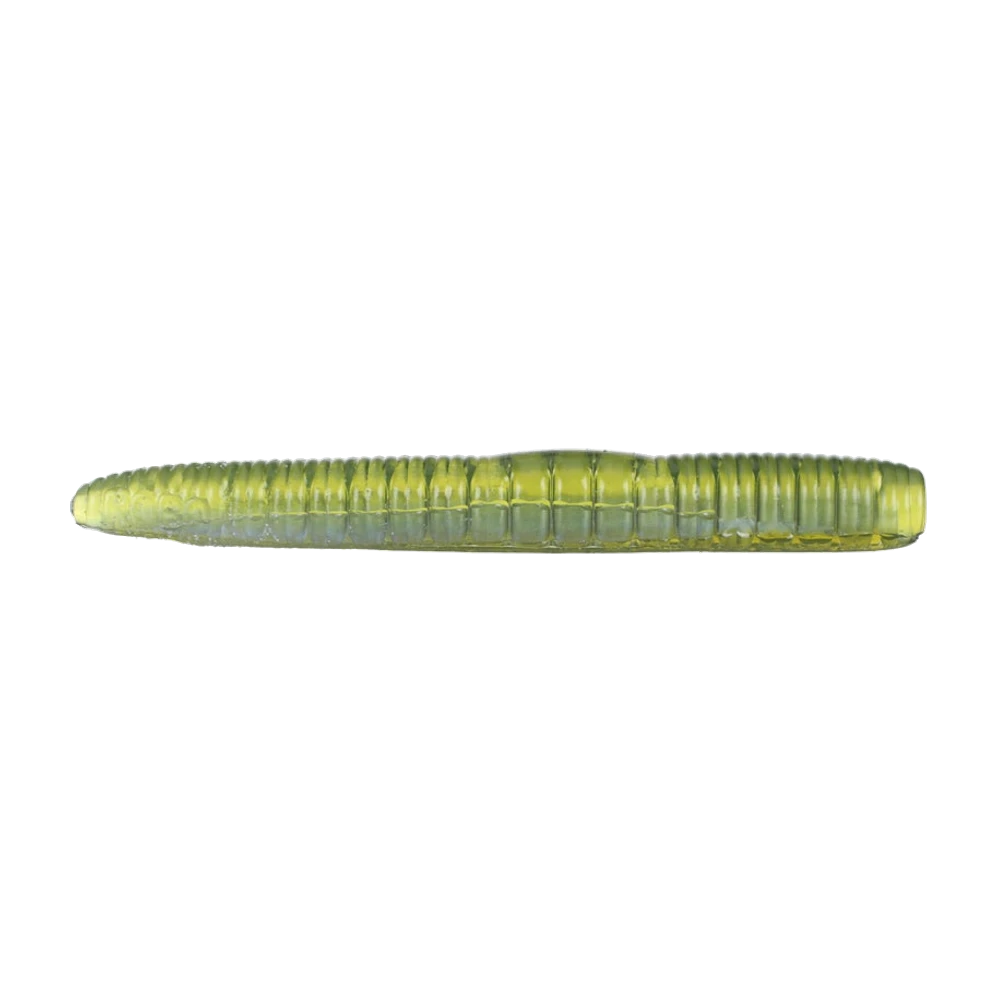
In the photo on this page the body is heavily ribbed along its whole length, with deep, closely spaced rings, and the underside does look straighter than the rounded top. The laminate reads clearly too: a greenish chartreuse top over a translucent bluish belly. Those are observations from a product photo, not specifications, but they match the profile the brand describes.
The rings themselves do two jobs. They trap tiny air bubbles on the cast, which escape during the fall, and they increase the surface in contact with the water, which amplifies the quiver of an otherwise very passive body. This lure does nothing spectacular: everything it offers happens while nothing appears to be happening.
Two lengths, two different pack counts
The maker's table lists two versions, and you have to read the whole header: the two columns are length and pack quantity, not length and weight. The 3 in, 7.6 cm, comes eight to a pack. The 4.5 in, 11.4 cm, comes six to a pack. No weight is published by Roboworm, which matters on a rig where the balance between bait density and head weight is everything: if you need precise numbers, weigh one rather than trusting an estimate.
The 7.6 cm is the classic ned size, matched to a 1.8 to 2.7 g head and a 1/0 hook. The 11.4 cm steps outside the strict ned framework: it becomes a stick worm in its own right, better suited to wacky and Carolina rigs than to a mushroom head, where it would hang well past the shank.
The rigs, from obvious to subtle
Ned rig
A mushroom head of 1.8 to 3.5 g, short shank hook with a wide gap. The worm goes onto the shank dead straight, with no twist — a crooked rigging alone is enough to kill the glide. Cast, let it drop on a tight but unchecked line, then do nothing at all for three to five seconds. Then two short twenty-centimetre pulls, and another pause. Virtually every bite comes during the pause, and it shows up as nothing more than weight.
The mushroom head stands the worm upright on the bottom, tip in the air. That posture is what triggers: it copies a fish rooting head-down in the substrate. If your worm lies flat, your head is too heavy or the plastic too dense — change weight before you change colour.
Wacky
Hooked through the middle with an O-ring, the Ned Worm folds into a V and its two ribbed ends quiver independently. A deadly presentation under an overhanging tree or along a dock, where you simply let it fall without working it.
Drop shot and Carolina
The maker names both as effective, and they answer very different situations. On a drop shot the worm stays at a fixed height above the sinker and the rod tip does the work: excellent on perch in Europe along a rip-rap bank. On a Carolina rig the weight drags the bottom ahead of a long leader and the worm follows, gliding freely — slow search fishing over big featureless flats.
The classic mistake
Rigging a head that is too heavy in order to feel the bottom. A ned rig is fished at the edge of perception: if you feel everything perfectly, you are too heavy, and the flat underside is wasted because the bait falls straight. Go down one step, accept fishing almost blind, and make up for it with thin braid and a sensitive tip.
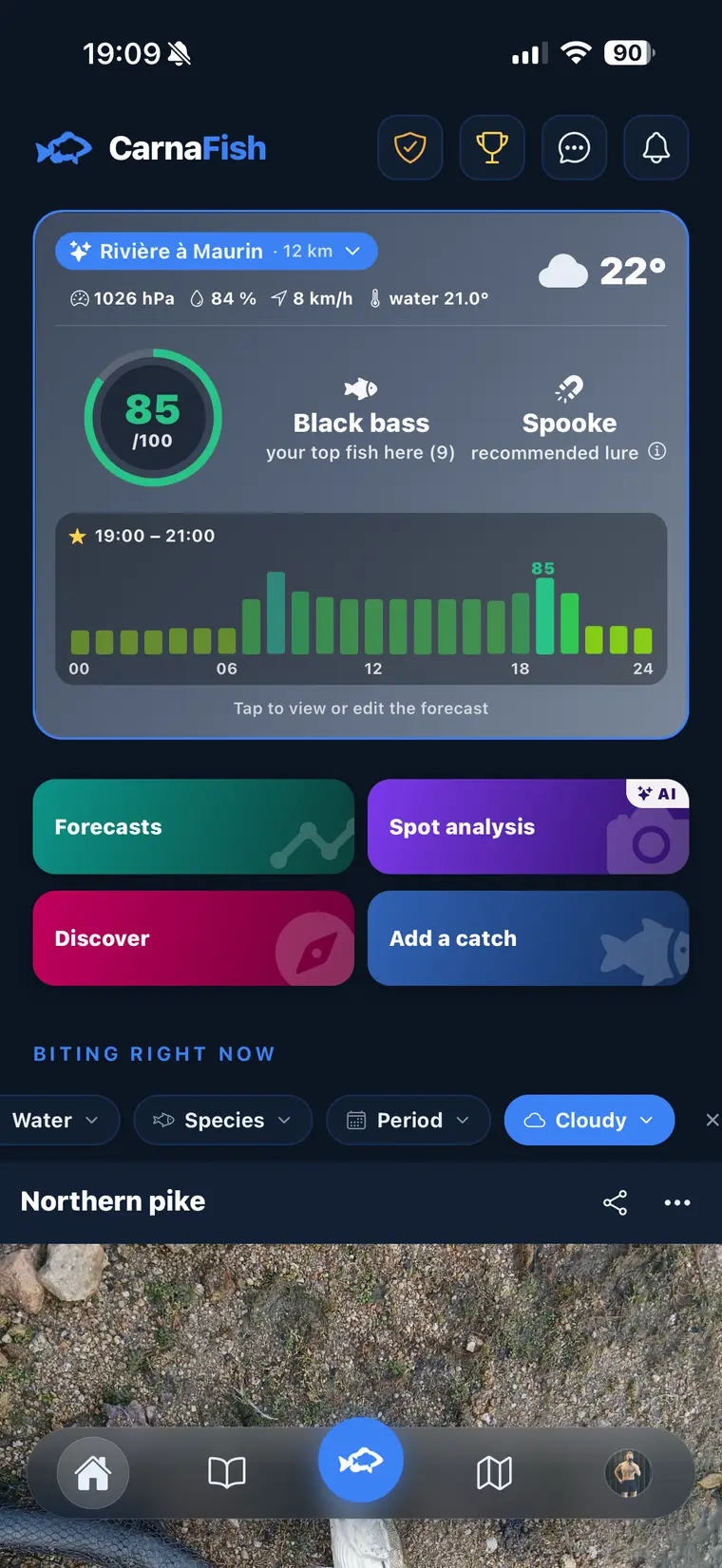
Not sure what to tie on?
Photograph your spot: CarnaFish reads the scene, cross-checks the conditions and gives you the zone, the lure and the retrieve. Free on iOS and Android.
The finish, and what it is worth
Roboworm pours its plastics with a robotic system the brand presents as producing colours as crisp as a hand pour but more consistent from one bait to the next. That too is a maker's argument. What is verifiable is that the laminate is clean, with no smeared gradient between the top and the belly. Every Ned Worm also carries the brand's Salt Release System, which releases salt on the bite so a fish holds the bait longer.
Colours by water clarity
- Clear water: the chartreuse-over-blue laminate from the photo, discreet from below and visible from the side.
- Lightly stained water: green pumpkin, the safe bet in finesse, believable over hard bottom and along weed edges alike.
- Dark water or low light: black and blue, which stops relying on colour and plays a clean silhouette instead.
A ned rig never rescues a bad choice of zone: it is slow fishing, which is exactly why you need to know where to put the bait. CarnaFish is built for that: a photo of the spot, and the AI suggests the zone, the depth and the kind of presentation that fit the day. For tackle and lies, our beginner's guide to bass fishing sets the scene. And if you want to compare profiles, the Zman TRD Ned Rig relies on a floating plastic that stands the stick upright, while our ned rig setup page covers the rig itself.
What to remember
- The flat bottom does one job: making the worm glide on the way down instead of dropping straight.
- The table gives length and quantity, not weight: 7.6 cm eight to a pack, 11.4 cm six to a pack.
- On a ned rig, the lightest head that still reaches the bottom is always the right one.
- The 11.4 cm is not really a ned worm any more: save it for wacky and Carolina rigs.
FAQ
What head weight for this ned worm?
Between 1.8 and 3.5 g for the 7.6 cm, always starting with the lightest that reaches the bottom in the day's conditions. A head that is too heavy lays the worm flat and removes the glide its flat underside allows.
How many baits per pack?
The count differs by size: eight for the 7.6 cm, six for the 11.4 cm. Those are the figures given by the Quantity column of the maker's table.
Is a weight published for this worm?
No. Roboworm's table has only length and pack quantity, with no weight column. Weigh one yourself if you need a precise value to size your jig head.
Can it be fished on anything other than a ned rig?
Yes, the maker explicitly names wacky, drop shot and Carolina rigs. Wacky suits cluttered banks, drop shot suits vertical spots, and Carolina suits big flats where you need to cover ground slowly.
Does it suit perch in Europe?
Yes, especially the 7.6 cm on a drop shot or a very light head. The short profile and the discreet quiver suit a wary perch on rip-rap or a dock wall. For bass, the classic ned rig remains the reference presentation.
How does it differ from an ElaZtech TRD?
The Zman TRD Ned Rig is moulded in a floating plastic, which stands the stick vertically on the bottom. Roboworm's Ned Worm plays a different card: a flat underside that makes it glide during the descent. Two different moments of the same presentation.
The full bass lure guideSeason-by-season strategy: which family of lure, when, and why.Go from theory to fish
CarnaFish reads your spot from a photo and gives you the game plan: zone, lure, retrieve. Free on iOS and Android.