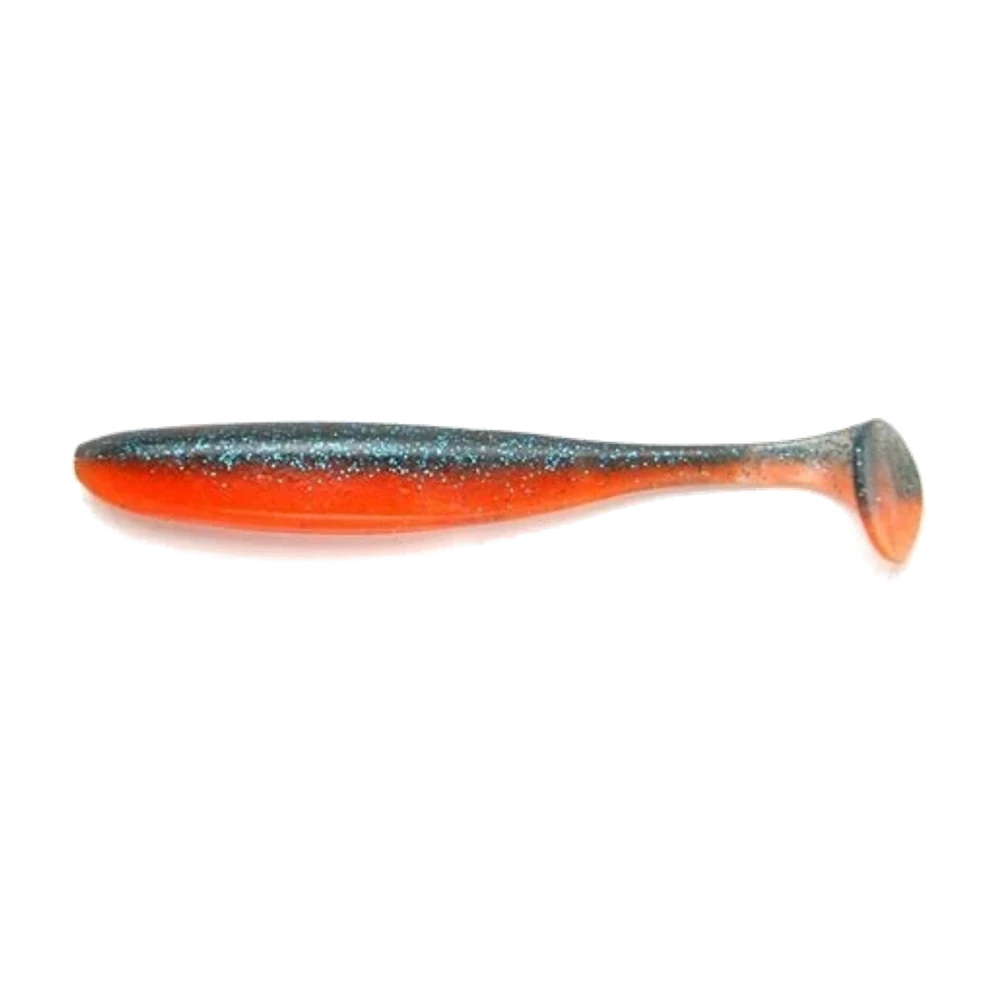
Keitech Easy Shiner 5": when it is actually worth moving up a size
The right lure in the wrong spot still catches nothing. CarnaFish spots the zone that works, from a single photo.
Moving up to a big shad almost always happens for the wrong reasons: because nothing is biting, because you are hoping for a big fish, or because you just bought one. The result is two hours spent with a bait that matches neither the forage present nor the current activity, and you go home concluding that big sizes "don't work round here".
There are objective signs that tell you to go for it, though. The 5-inch is not a bigger 4-inch: it changes the head weight, the rig, the rhythm and the hookset. Size up without adjusting the rest and you lose more than you gain.
The five signals that say to size up
None of them is enough on its own. Two together justify the change.
- The forage is over ten centimetres. Look at what bolts away from your feet, or at what captured fish spit out. If you are seeing hand-sized roach, the 4-inch is under the size that is in place.
- The water is stained. A bulkier body displaces more water and sends a signal the fish picks up from further away. That is the strongest argument of the lot.
- You are after pike, not zander. On pike, bulk works for you. On zander in clear water, it can work against you.
- The water is between 8 and 16 degrees. In autumn and early spring, predators target prey worth the effort. Big sizes are built for those windows.
- The spot is deep or swept by current. You need weight to hold bottom; sizing the bait up stops you hanging a ridiculously small shad off a 21 g head.
Conversely, three signals say stay on the 4-inch: water below 6 degrees, very clear flat water, or a run of missed bites on the bigger size.
A tail that works at very low speed
The characteristic that holds the whole range together, and that shows up most on this size, is the tail's starting threshold. The wrist is thin and the paddle is wide and flat: the kick engages as soon as the bait moves, including at speeds where most twelve-centimetre shads stay inert.
In practice that opens up two uses:
- The dead-slow straight retrieve, just above the bottom, for a zander that refuses anything worked hard. The bait swims, but it does not harass.
- The drop during an active retrieve. On the fall the tail keeps kicking and the body rolls on its flanks. On pike, a large share of the bites comes precisely there.
The trade-off is well known: the material is soft. The bait swims remarkably well, but a pike strike often cuts the body in half. It is a consumable, not an investment — accept that and buy accordingly.
The rig, and why the stinger is not optional
On a twelve-centimetre shad, the jighead hook exits around the front third of the body. A pike attacking from behind — which it often does late in the season — bites into a zone with no steel in it at all.
The stinger rig for pike fixes exactly that. On this size, it is the difference between three fish and one in a day.
The jighead. Round for the straight retrieve, football for bottom contact. A 4/0 to 6/0 hook: below 4/0, the shank is too short to hold a body of this length straight.
The line. 0.16 to 0.20 mm braid, a 0.40 to 0.50 mm fluorocarbon leader for zander, a wire or titanium leader is mandatory as soon as pike are about.
The rod. A fairly firm action, rated 15-50 g. On this size, the hookset has to drive through a thick soft body before it reaches the jaw.
On the water: on a shad this size, set the hook in two stages. A first wide sweep to tighten the line and move the fish, then a second immediately behind it to drive the hook home. The single sharp set that works on a 3-inch often just slides the bait through the mouth without catching anything.
Head weight by spot
| Depth | Current | Jighead | Retrieve |
|---|---|---|---|
| 1 to 3 m | None | 10 to 14 g | Slow straight retrieve, margins |
| 3 to 5 m | Light | 14 to 18 g | Wide pulls, 2 s pauses |
| 5 to 8 m | Moderate | 18 to 25 g | Sawtooth in contact |
| More than 8 m or strong current | Strong | 25 to 28 g | Vertical or short lifts |
The usual benchmark: count the fall. If the bait takes more than eight seconds to touch bottom, you are too light and you lose control. If it drops in less than two seconds over five metres, you are too heavy and you have removed the fall phase that produces bites.
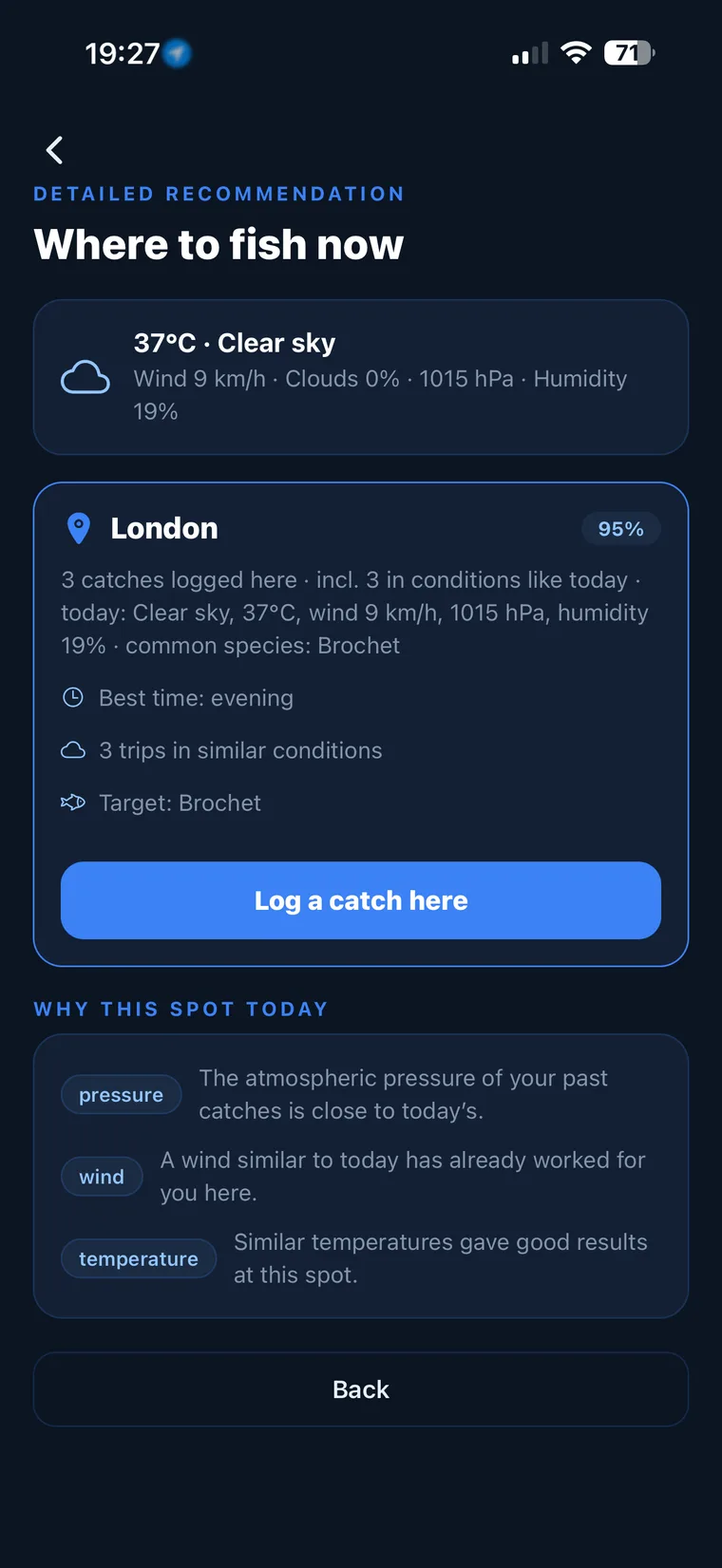
Not sure what to tie on?
Photograph your spot: CarnaFish reads the scene, cross-checks the conditions and gives you the zone, the lure and the retrieve. Free on iOS and Android.
Two retrieves, two species
For zander, a straight bottom retrieve: three or four slow turns, a one-second stop letting the bait touch bottom again, and repeat. Contact must be constant; as soon as you no longer know where your bait is, go up a step in head weight.
For pike, wide pulls: two one-metre rod sweeps, then a two to three second pause on a semi-tight line while the shad falls back rolling. Do not shorten those pauses, that is where it happens.
When it becomes counterproductive
- Water below six degrees. Metabolism drops and a big profile becomes off-putting.
- Heavy fishing pressure in clear water. The fish have seen dozens of big white shads go past; downsizing is usually the right correction.
- Perch. The size is out of proportion, except on big specimens in late autumn.
Five inches or four: what you are trading
The Keitech Easy Shiner 4" is the pivot size of the range, and rightly so: it catches zander, mid-sized pike and big perch, and it rigs from 7 to 20 g without difficulty. If you could only have one, it would be that one.
The 5-inch is not "better". It trades versatility for three specific gains: a stronger signal in stained water, better behaviour on heavy heads, and genuine selection for better fish. In return it costs you missed bites if the rig is not adapted, and baits destroyed faster.
In practice, keep both sizes in the same box: start with the 4-inch to locate fish, then switch to the 5-inch over the zone where the bites came, to try for the bigger fish holding there. Our guide to choosing a pike lure follows the same progression. And if you are torn between the two sizes when you reach the bank, CarnaFish analyses a photo of the spot and answers.
Key takeaways
- Two signals together justify the move to the 5-inch: forage over ten centimetres, stained water, pike targeted, water between 8 and 16 degrees, or a deep spot.
- The stinger is not optional on pike: the back of the bait carries no steel.
- Set the hook in two stages, not with one sharp snap.
- Count the fall: between two and eight seconds validates your head weight.
- Stay on the 4-inch in cold water, in heavily fished clear water, or if you are missing bites.
FAQ
When should I move from the 4-inch to the 5-inch?
When at least two signals stack up: visible forage over ten centimetres, stained water, pike targeted rather than zander, a temperature between 8 and 16 degrees, or a deep spot that needs a heavy head. One criterion alone is usually not enough.
What jighead weight should I use?
10 to 14 g down to three metres, 14 to 18 g down to five metres, 18 to 25 g beyond that, and up to 28 g in strong current. Check by counting the fall: between two and eight seconds to the bottom puts you in the right range.
Is the stinger really necessary?
On pike, yes. The jighead hook exits at the front third of a twelve-centimetre body, and strikes from behind are common, particularly late in the season. Without a stinger you register bites and never hook anything.
Why do my baits tear so quickly?
The material is deliberately soft, which is what gives the tail kick at very low speed. It is a conscious trade-off: the bait swims better but gets used up faster, especially on pike. Budget for spare packs rather than trying to preserve them.
Is it suitable for perch?
Rarely. Twelve centimetres stays out of proportion for an average perch, except on big specimens in late autumn. For that species, the 3- and 4-inch sizes in the same range make far more sense.
Should I set the hook differently than with a small shad?
Yes. On this size, set in two stages: a first wide sweep to tighten the line and move the fish, then a second immediately behind it to drive the hook home. A single sharp set often just slides the bait through the mouth without catching anything.
The full pike lure guideSeason-by-season strategy: which family of lure, when, and why.Go from theory to fish
CarnaFish reads your spot from a photo and gives you the game plan: zone, lure, retrieve. Free on iOS and Android.