Pike stinger hook: the hook that converts the bites you were missing
Not sure this lure fits YOUR spot today? CarnaFish tells you in 10 seconds, from a photo.
You get solid bites on a big shad, you set the hook, and there is nothing on the end. The bait comes back with tooth marks at the rear, sometimes cut in half. That is the signature of a mechanical problem, not of a bad hookset.
Pike do not attack the way zander do. They grab prey across the flank or from behind, often sideways, and a single hook sitting in the front third of the bait simply does not find anything to bite into.
Why the front hook is not enough
On a classic jig head, the point exits around the front third of the body. That position is ideal for zander, which engulf the whole bait head first.
Pike bite in the middle or towards the tail. When you strike, you are pulling a bait the fish is holding by the back end: the only hook available is up front, outside its mouth. The bait comes out, the pike stays.
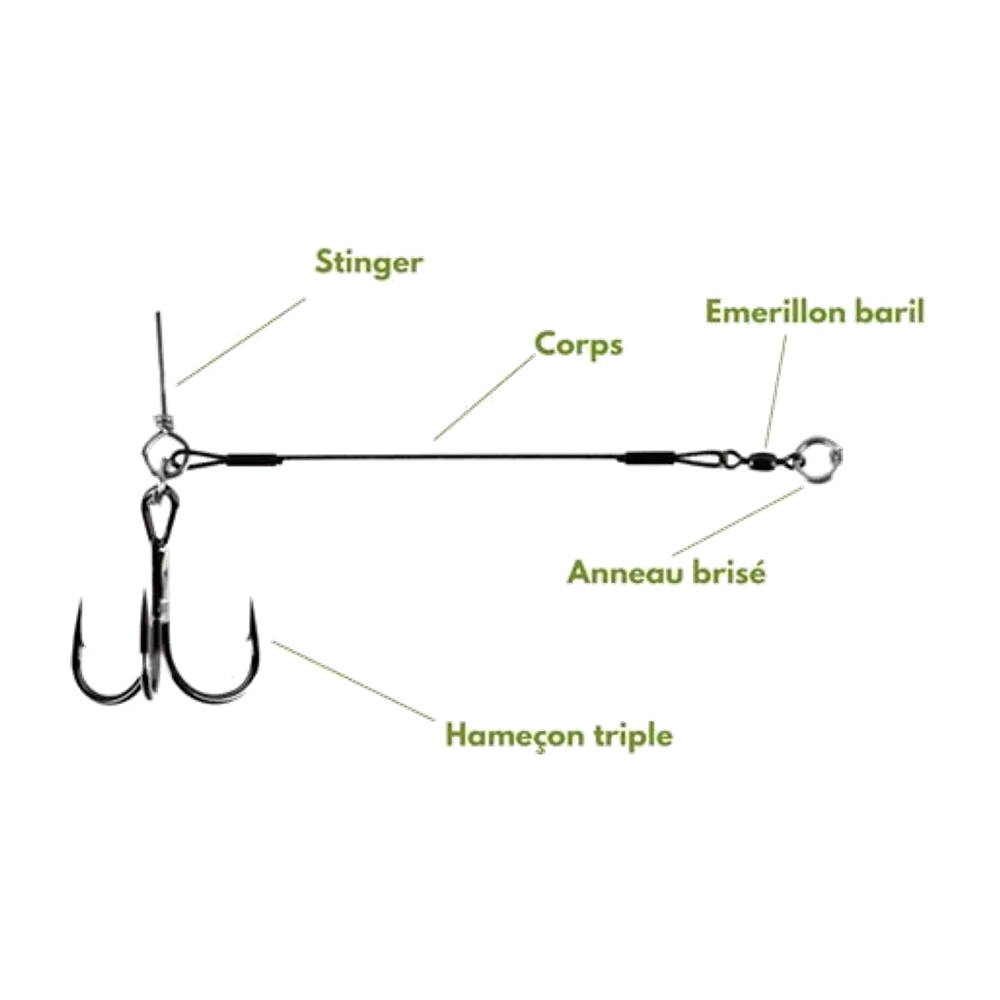
The stinger fixes exactly that: a free treble positioned at the rear, where the fish actually bites.
The rig
There are several variations, but the logic is always the same.
- A fine wire trace or a Dyneema braid link about ten centimetres long, attached to the jig head's eye or to the eye of the main hook.
- A small treble (size 6 to 10 depending on the bait) at the other end.
- The treble is hooked in by one point only, into the flank of the bait, towards the rear, just ahead of the tail.
On the water: a stinger must never be under tension. It has to stay slightly slack, or it bends the bait and destroys the action. Rig it so there is a centimetre or two of slack between the head and the hooking point.
The classic mistakes
A stinger that is too short. It pulls on the bait, bends it, and makes it spin on itself. The action is ruined and the bait stops catching.
A treble that is too big. It weighs down the rear, upsets the attitude of the bait and increases snagging. Stick to a small, fine-wire model.
A treble hooked in by two points. It restricts the movement of the tail. Only one point should go in, and very shallowly.
A trace that is too stiff. Heavy wire transmits movement and disturbs the action. A fine wire or a supple Dyneema braid is better.
When to add it — and when to leave it off
For pike, as a matter of course as soon as you are fishing a shad over 10 cm. The gain in conversion rate is significant and immediately measurable.
For zander, only when you need it. Zander engulf the whole bait and a stinger adds nothing most of the time. What it does add is snagging over cluttered bottoms. Fit one only if you record several unconverted bites in the same session.
For perch, no. The rig becomes too visible and too bulky on a small bait.
In weed, no either. A free treble catches everything. Go for a plain Texas rig instead.
Not sure what to tie on?
Photograph your spot: CarnaFish reads the scene, cross-checks the conditions and gives you the zone, the lure and the retrieve. Free on iOS and Android.
You still need a leader
A stinger does not replace your leader. It protects the bait, not the main line.
For pike, 0.60 to 0.80 mm fluorocarbon or 25 to 40 cm of titanium remain essential. Those teeth reach the line as soon as the fish turns, stinger or no stinger.
The alternatives
Twin-hook factory rigs, offered by some manufacturers on ready-rigged shads, do the same job with a cleaner setup.
A factory-armed shad — such as certain soft swimbaits — already carries a well-placed dorsal hook and generally needs no stinger at all.
Screw-in spine rigs for very large baits, where a shaft runs through the body and carries several attachment points for trebles.
Our guide to choosing a pike lure covers the rigs to use on different spots. And if you cannot work out why your bites are not turning into fish, CarnaFish analyses a photo of the spot and suggests a line of attack.
Key takeaways
- Pike bite across the flank or from behind: the front hook never finds a hold.
- The stinger must stay slightly slack — a tight stinger bends the bait and ruins the action.
- One point of the treble only, hooked in shallowly, just ahead of the tail.
- Standard for pike above 10 cm, optional for zander, pointless for perch.
- It does not replace a wire or heavy fluorocarbon leader.
FAQ
Why do you need a stinger for pike?
Because pike grab prey across the flank or from behind, while the hook on a jig head exits in the front third of the bait. On the strike, the only hook available is outside the mouth and the bait pulls free without finding a hold.
How do you rig a stinger without spoiling the action?
Link a fine treble to the jig head with a fine wire trace or a Dyneema braid link about ten centimetres long, and hook one point in shallowly on the flank, just ahead of the tail. Leave a centimetre or two of slack: a tight stinger bends the bait.
Do you need a stinger for zander?
Not as a rule. Zander engulf the whole bait and a stinger increases snagging over cluttered bottoms. Fit one only if you record several unconverted bites in the same session.
Does a stinger replace a wire leader?
No. The stinger protects your hookup rate, not your line. Fluorocarbon of 0.60 to 0.80 mm or 25 to 40 cm of titanium remain essential for pike, because the fish can reach the line as it turns.
What size of treble should I use?
A small, fine-wire model, size 6 to 10 depending on the size of the bait. Too big a treble weighs down the rear, upsets the attitude of the bait and sharply increases snagging.
Can you use a stinger in weed beds?
No, a free treble catches vegetation constantly. In weed, go for a plain Texas rig with the point buried in the plastic.
The full pike lure guideSeason-by-season strategy: which family of lure, when, and why.Go from theory to fish
CarnaFish reads your spot from a photo and gives you the game plan: zone, lure, retrieve. Free on iOS and Android.