Keitech Glide Camaron: the soft bait that slides backwards under cover
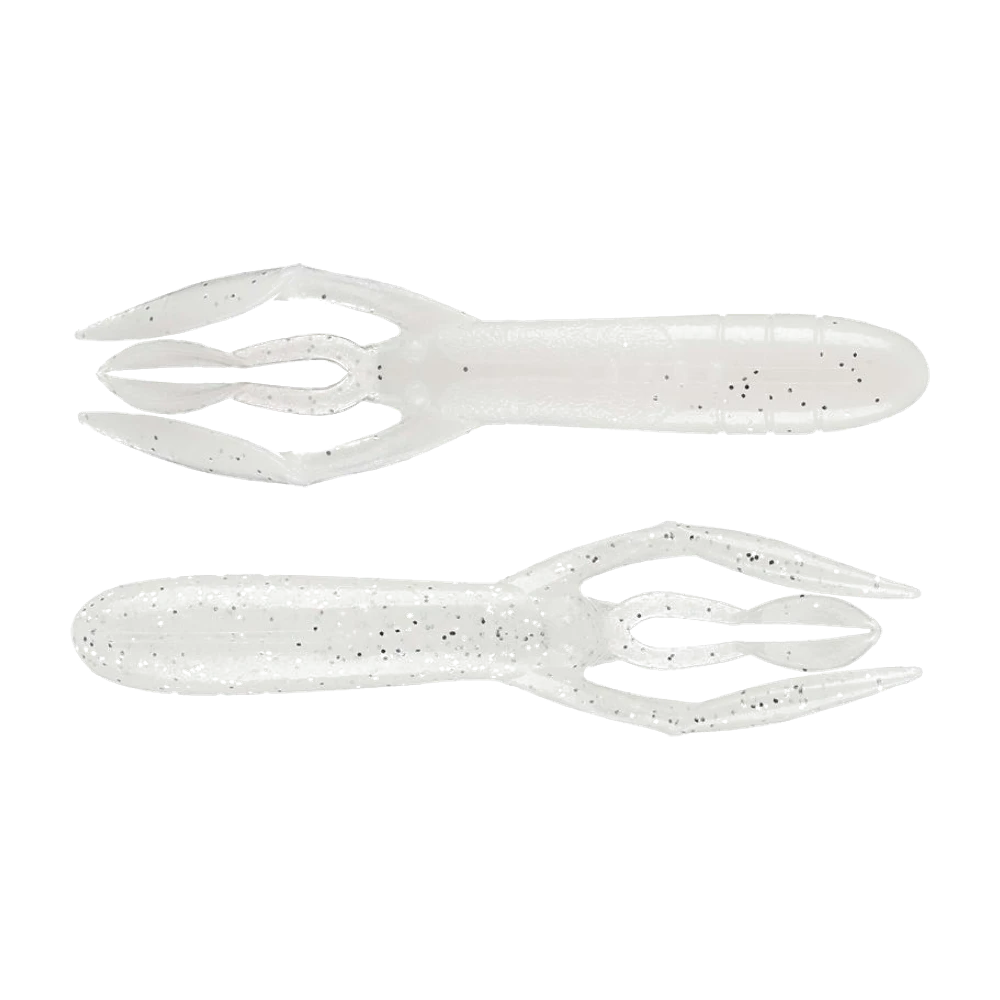
This lure shines under specific conditions. CarnaFish tells you in 10 seconds if today is one of them.
There is always that one dock whose back end stays out of reach. You skip a bait, it stops a metre under the first plank, and the fish you came for is sitting three metres further back in the dark where nothing ever lands. The Keitech Glide Camaron is built for exactly those three metres: instead of dropping straight down under its entry point, it travels backwards while it sinks and finishes its descent deep under the cover, somewhere no cast can reach directly.
The backslide, or the art of sinking in reverse
Two things make it happen, and Keitech states both outright: a high-density plastic that gives the bait real mass for its volume, and a precise salt loading meant to produce the back-sliding action. That combination is why the Glide Camaron casts well with no weight at all — and the absence of mass concentrated in one spot is precisely what lets it plane instead of plummet.
The non-negotiable condition is slack line. Keitech is explicit about it: the slide happens at the end of the cast, on a loose line. As long as the braid or mono stays tight between rod tip and bait, the line works like a pendulum and pulls the bait back towards you, cancelling the one thing you came for. The moment the bait lands, open the bail or feed line by hand, and let it work.
The streamlined body is not styling: it is what generates lateral lift during the descent. Up front, the three-dimensional claws and antennae add relief and movement, but the manufacturer also credits them with stabilising the bait as it glides. That tracks — those appendages trail behind the body during the slide and keep it from spiralling halfway through.
Count the glide, not the fall. On a spot you know, work out how many seconds of slack line it takes for the bait to arrive under the dock, then repeat that exact count on the next cast. It is the only way to fish the same square metre twice with a bait you cannot see.
A rig where every detail was designed in
The dorsal slot and the belly channel
The body is moulded with two rigging aids that few soft creatures offer together: a channel along the belly and a deep slot on the top side, made to swallow the hook point. Bury the point in that slot and you get a genuinely weedless profile, one that slips through laydowns and submerged branches without loading up.
Keitech publishes no length and no weight for this bait, so there is no stated hook size either. The reliable method is the simple one: lay the hook shank alongside the body with the entry point at the nose, and pick the model whose point comes out level with the dorsal slot. A wide-gap worm hook is the logical call, because the body is thick and the iron needs room to find jaw on the hookset.
The nail weight, the only adjustment that matters
The belly carries a small moulded socket sized for a tungsten nail weight. The manufacturer gives it two jobs: tuning the rate of fall and adding casting distance. Both are true, and both are paid for out of the glide.
With no weight at all, the Glide Camaron slides the furthest but sinks very slowly — perfect under a dock in 2 m / 6 ft of water, not enough when you need 4 m / 13 ft before the boat drifts off the spot. Every fraction of a gram you add shortens the backward travel and straightens the path. Always start unweighted and only add lead when depth genuinely demands it. Because the socket sits in the belly, the weight also rolls the bait belly-down on the drop, which steadies its posture but trims the planing further.
Where that reverse travel really earns its place
Keitech names two uses. The first is complex cover: thick vegetation, overhangs, fallen timber, everything big fish hold under and no direct cast can serve. That is where the Glide Camaron has no substitute, and it is the only sound reason to pick it over a conventional creature like the Keitech Crazy Flapper, which works far better dragged across open bottom.
The second stated use is sight fishing bed fish with precision and a tempting profile. Worth saying plainly: in Europe, fishing bass during the spawn is governed by local regulations and open seasons, and that application is a North American one. What carries over is the technical idea — the Glide Camaron lets you place a bait a metre from a visible fish without ever dropping anything on top of it.
The classic mistake
Fishing it like an ordinary Texas rig. Cast, keep the line tight, start pulling the second it lands, and all you have is a big inert chunk of heavy plastic. Everything happens in the three to six seconds of slack line that follow the splash, during which you do nothing at all. After that, yes, you can work it in short pulls like any Texas rig — but the bite usually comes during the slide, spotted on a line that ticks sideways rather than felt through the blank.
The second common error is a lobbed cast. A flat, low, skipping delivery leaves the bait with horizontal speed as it starts to sink, and that residual speed is what feeds the glide.
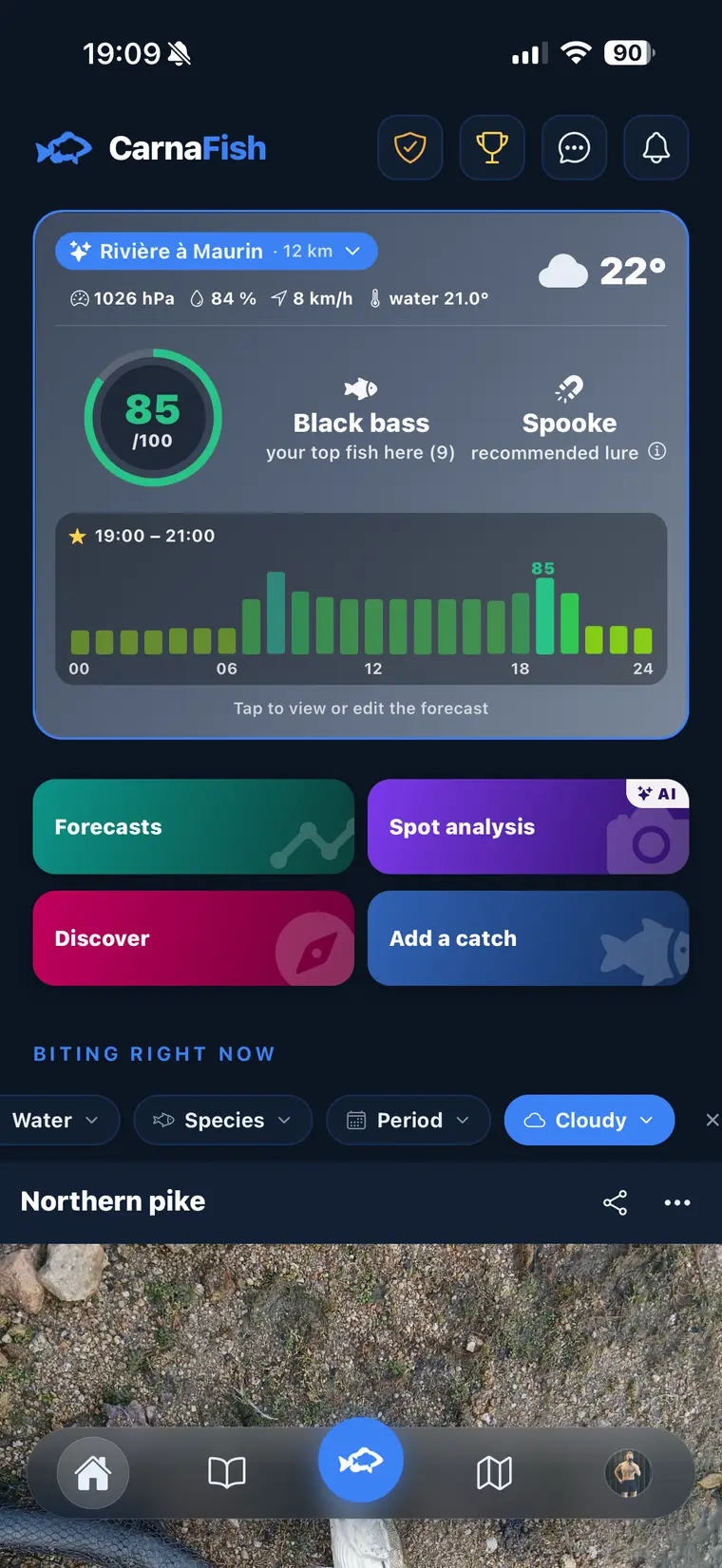
Not sure what to tie on?
Photograph your spot: CarnaFish reads the scene, cross-checks the conditions and gives you the zone, the lure and the retrieve. Free on iOS and Android.
Colours by water clarity
- Clear water: the pearl white with flake shown in the photo, discreet from a distance but bright enough to register in the gloom under a dock.
- Stained water: Green Pumpkin, the safe bet for soft creatures, which reads as a crayfish or a small crustacean without ever looking out of place.
- Dark water or heavy timber: Black Blue, a hard silhouette that stands out viewed from below, which is exactly where the fish is looking from.
Keep in mind that the bait is scent-loaded: under dark cover, where a fish sees very little, smell does part of the job and justifies letting the bait sit a few seconds longer than you would a neutral plastic.
A bait built to go under cover is useless if you cannot tell which cover is worth fishing. That is exactly what CarnaFish does: one photo of the spot, and the AI suggests the zone to attack and the presentation that suits the day's conditions. For the rest — tackle, classic lies, seasonal patterns — our beginner's guide to bass fishing covers the groundwork and the seasons to respect.
What to remember
- The bait travels away from the angler as it sinks, and only on slack line: keep it tight and the effect disappears.
- High-density plastic plus salt loading is what lets you cast it bare, with no added weight.
- The dorsal slot and belly channel give a genuinely clean weedless profile; the belly socket takes a tungsten nail weight to tune fall and distance, at the cost of glide.
- Keitech publishes neither length nor weight for this model: size the hook by holding it against the body, not from a stated spec.
FAQ
What exactly is a backslide bait?
It is a soft bait designed to move away from the angler as it falls, instead of sinking vertically under the entry point. On the Glide Camaron the effect comes from the plastic density, the streamlined body shape and the salt loading, and none of it works unless the line is slack.
Do I need a nail weight?
No, and it is rather the opposite: unweighted is where the glide is longest. The belly socket Keitech moulded in is there to buy casting distance or to reach a deeper spot faster, but every gram you add shortens the backward travel.
What hook size should I use?
The manufacturer publishes no length for this bait, so no size can honestly be quoted. Lay the shank along the body and keep the model whose point falls exactly into the dorsal slot moulded on the back.
How do I detect a bite on a slack line?
By watching the line, not by feeling the rod. Follow the loop floating on the surface: if it moves sideways, stops dead or snaps tight during the glide, reel down the slack and set.
Does the Glide Camaron work for pike or perch?
It is a bass bait, built around a weedless rig under cover. A perch may well hit it, but neither the profile nor the rig is sized for one, and against pike you would need a wire trace that kills the planing action.
How is it different from a normal creature bait?
A conventional creature like the Keitech Hog Impact is dragged along the bottom, where its appendages work on every pause. The Glide Camaron does its job during a phase most baits waste — the fall — and is trying to gain horizontal ground under an obstacle.
The full bass lure guideSeason-by-season strategy: which family of lure, when, and why.Go from theory to fish
CarnaFish reads your spot from a photo and gives you the game plan: zone, lure, retrieve. Free on iOS and Android.