Jackall Counter Back Spoon: the spoon that slides backwards as it falls
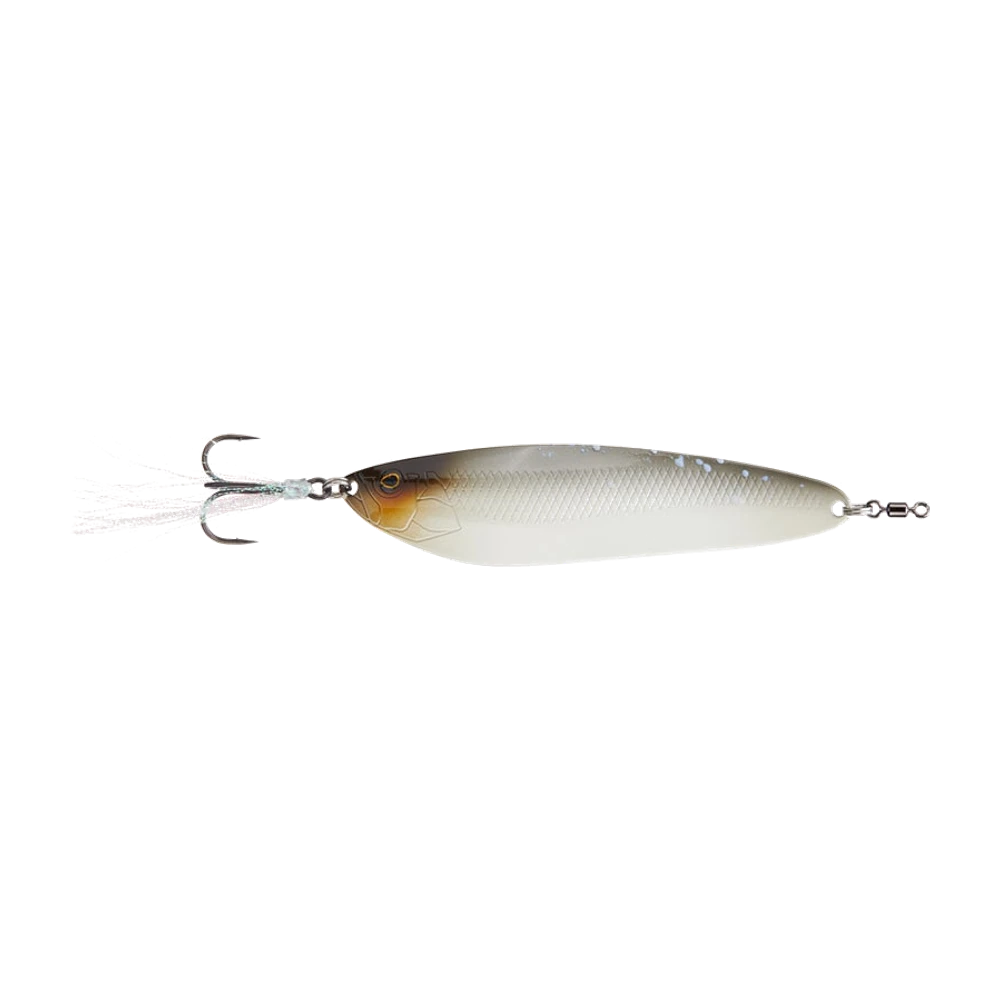
This lure shines under specific conditions. CarnaFish tells you in 10 seconds if today is one of them.
Everyone has a rough picture of what a falling spoon does: it flutters, it spins on itself, and it comes down more or less straight below the point where it hit the water. That is the classic mechanism, it works, and it has one rarely discussed flaw — the lure goes nowhere while it drops. Jackall designed the Counter Back Spoon to break that logic: it moves backwards as it falls, and it does so without fluttering.
A fall that glides backwards
The principle Jackall claims is called "Glide Back". In practice, during the descent the lure travels backwards — towards the angler and under the line — along an angled path, instead of dropping straight below the point of impact. And the maker stresses one point that changes everything: this backslide happens without fluttering, meaning without the disorderly vibration usually associated with a free-falling spoon.
That distinction is worth dwelling on. Flutter means plenty of visual signal and plenty of hydraulic noise, but it also means an unpredictable path: the lure wanders in every direction and ends up spiralling down. A glide without flutter is the opposite: a smooth, quiet descent that nonetheless covers real horizontal distance. On a pressured fish that has already watched three spoons go by today, that is a completely different signature.
Jackall also states that the glide triggers even with no tension on the line. That is an important practical detail: you do not need to hold the fall back to get the movement, so you can leave the line completely slack, which is the only way to let a heavy lure sink on a genuinely straight line.
Where the movement comes from
Two design elements are given as responsible for the behaviour: an asymmetrical body, and the combination of the cup of the blade with the thickness of the body. The asymmetry creates a permanent imbalance that orients the lure in one direction during the fall. The cup acts as a lifting surface: it catches water and turns the descent into an inclined plane rather than a vertical drop.
That is also why body thickness gets a mention. A thin, wide spoon flutters because it lacks the inertia to resist the turbulence it creates; a thicker spoon with better-distributed mass holds its axis. Jackall states the lure took more than three years to develop, alongside tournament angler Kyoya Fujita — hardly surprising for a fall that has to be both directed and stable.
The specs: this is no light spoon
The maker's table runs to a single line: 4.7 in, 1.3 oz. Converted, that comes to 11.9 cm for about 37 g. There is no buoyancy column, and none is needed: a 37 g metal spoon sinks, and the description explicitly talks about a descent to the lake bottom.
Thirty-seven grams is heavy. That has three very concrete consequences. The cast is long, even into the wind. The descent is fast, which lets you reach 6 or 8 m without waiting a minute. And above all the rod has to take it: a medium-heavy to heavy casting outfit is the minimum, with braid that transmits the slack line well enough to detect bites on the drop.
The lure comes fitted with a ball-bearing swivel and a feather-dressed treble. The swivel is not a gimmick: a lure that glides sideways through its entire descent twists line very quickly, and a ball-bearing swivel is the only component that absorbs that without seizing. Do not replace it with an ordinary swivel.
The bite on this kind of lure comes during the fall, and it feels like nothing at all. No thump, no pull: just a line that stops paying out, or that shifts slightly sideways. Watch your line instead of your rod tip and you double the number of bites you detect. Build that habit from the very first drops.
How to fish it
The free-line fall
This is the presentation the lure was built for. Cast, leave the line completely slack, and follow it with your eyes. The lure descends while sliding backwards, covers several metres horizontally, and lands on the bottom — often noticeably closer to you than where it touched down. You can then give a sharp vertical sweep to lift it, and let a fresh fall take over.
That behaviour has one precise application: getting under an obstacle. A dock, a low branch, a rock overhang. Cast beyond it, let the fall do the work, and the lure finishes under the cover without you ever having to cast directly into it.
Yo-yoing along a breakline
On a sharp breakline or a drop-off, chain sweep-fall-sweep-fall while working down the slope. Because the fall glides, each cycle covers more ground than with a conventional spoon, and the lure stays longer in the depth band you care about instead of plunging straight down.
Vertical over a school
At 37 g the lure drops fast and the line stays loaded: it is an efficient vertical presentation over a spot marked on the sonar. One caveat though, the backslide takes you off the vertical on every drop — you will need to reposition the boat or correct the drift more often than with a lure that falls straight.
Not sure what to tie on?
Photograph your spot: CarnaFish reads the scene, cross-checks the conditions and gives you the zone, the lure and the retrieve. Free on iOS and Android.
Colour by conditions
- Clear water: the natural baitfish livery in the photo, bronze back dotted with blue over a silver flank. Jackall paints its spoons on both faces, which deliberately reduces the mirror effect of bare metal: you get a more discreet lure than a traditional spoon, which is exactly what you want on a wary fish.
- Stained water: a pale, high-contrast finish with a marked back that reads under poor visibility without resorting to a garish colour.
- Low light or deep water: a dark or plain tone, working on the silhouette seen in backlight rather than on flash.
Where it sits in the box
Next to a classic flutter spoon such as the 6th Sense Flutter Spoon 120, the Counter Back Spoon does literally the opposite: where the first bets everything on flutter and flash, the second bets on a directed, discreet fall. Both have their day. In a far lighter format for perch, the Molix Nano Spoon covers another end of the register. And if you are fishing the same spot looking for vibration rather than a fall, a Jackall TN 70 rounds out the box nicely.
A falling lure is only worth tying on if you know what depth is under the boat and where the breakline runs. That is exactly the job CarnaFish makes easier: a photo of the spot, and the app suggests the zone and the presentation suited to what the water shows. To build the basics of reading a bass spot, our beginner's guide to bass fishing remains the best way in.
Key takeaways
- 11.9 cm for 37 g: a heavy spoon that demands a medium-heavy casting outfit as a minimum.
- Its distinguishing trait is a fall that glides backwards without fluttering, even on a fully slack line.
- The movement comes from an asymmetrical body combined with the cup of the blade and the body thickness.
- Keep the factory ball-bearing swivel: a gliding fall twists line very fast without it.
FAQ
What does a gliding fall change compared with a classic spoon?
An ordinary spoon flutters and drops roughly straight below its point of impact. This one slides backwards during the descent and covers real horizontal distance, with no disorderly vibration. Among other things, that lets you reach a fish holding under an obstacle.
What exactly does the Counter Back Spoon weigh?
Jackall's table lists 1.3 oz for 4.7 in, which is around 37 g for 11.9 cm. That is a markedly heavier spoon than most all-round models on the market.
Should the factory swivel be kept?
Yes. A lure gliding sideways through its whole descent twists line very quickly, and the ball-bearing swivel fitted at the factory is the only component that handles that over time. A plain swivel seizes and lets the line twist.
How do you detect a bite during the fall?
By watching the line, not the rod tip. A bite on the drop shows up as a line that stops paying out or that drifts slightly sideways. The hookset has to follow immediately, after taking up the slack first.
Is this lure suitable for pike and zander?
Its bulk and weight make sense for both species across Europe, particularly when fishing vertically on a breakline. If pike are present, add a steel or titanium leader: a treble taken sideways puts bare line straight into the mouth.
Can it be retrieved steadily like a wobbling spoon?
That is not its logic. The lure is built around what happens during the fall, not during the retrieve. Chain vertical sweeps followed by free falls rather than a continuous wind.
The full bass lure guideSeason-by-season strategy: which family of lure, when, and why.Go from theory to fish
CarnaFish reads your spot from a photo and gives you the game plan: zone, lure, retrieve. Free on iOS and Android.