Keitech Hog Impact: the trailer that tunes a jig's fall
This lure shines under specific conditions. CarnaFish tells you in 10 seconds if today is one of them.
We spend a lot of time choosing a jig: head weight, skirt density, the shape of the weed guard. And then we thread on whatever bit of plastic is rolling around the box. That is a mistake of priorities: on a jig, the trailer drives the sink rate — which is precisely the parameter that decides whether an apathetic bass moves or not.
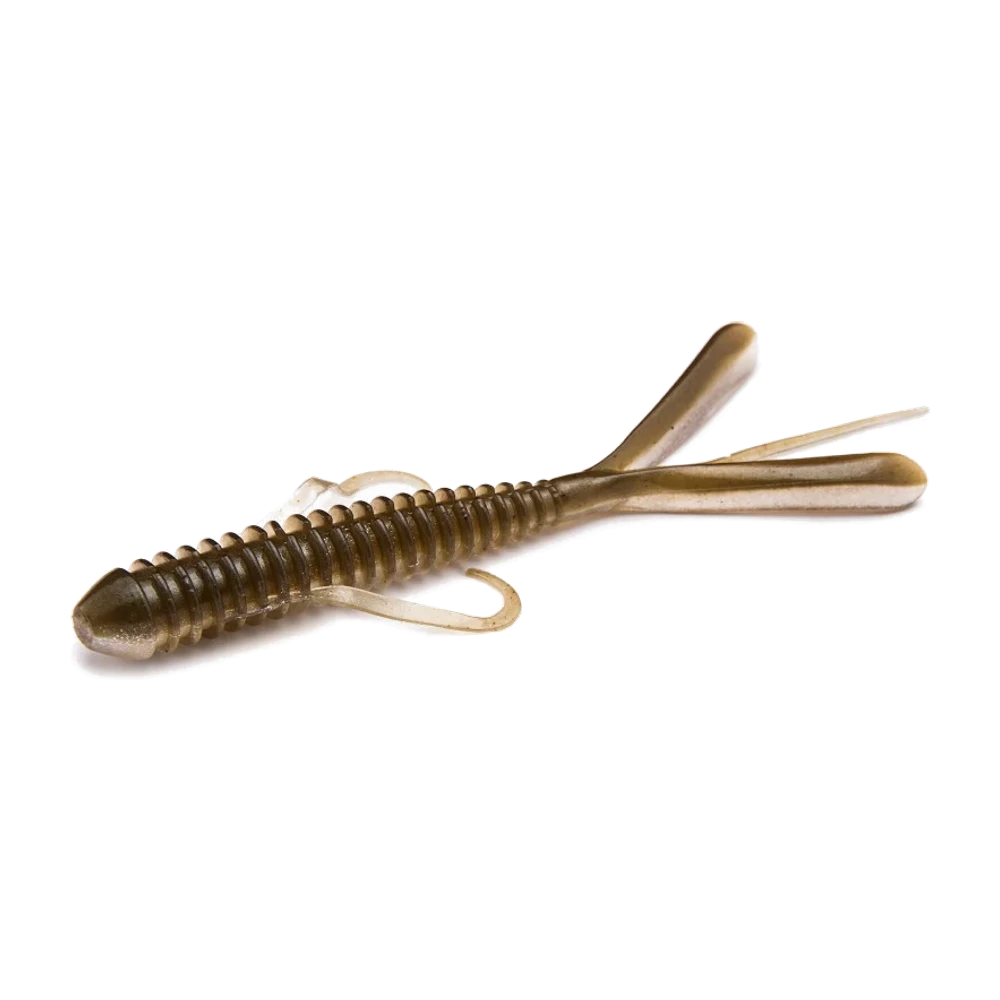
The Hog Impact is built for that job. It is not one more creature bait to fish on its own — it is one that makes full sense hung behind something else.
What it brings behind a jig
Three concrete things, and they stack.
Lift. The flat appendages and the bulky body slow the fall. At equal head weight, a jig rigged with a full-bodied trailer drops noticeably slower than one with a thin twin tail. In practice, you can keep a 14 g head for casting accuracy and feel while getting a fall close to that of a 10 g head.
Movement on the stop. Keitech's material is soft and loaded, and the appendages keep undulating through the pauses, once the jig skirt has already closed up. On a jig sitting on the bottom that you leave alone for ten seconds, it is the only movement still visible.
A scent and sound signature. The ribbed body traps fine bubbles on every lift and releases the built-in attractant. On a fish that takes the lure in its mouth and hesitates, that extra second before it spits is often enough to set the hook.
Which way round: the commonest mistake
A jig swims hook up, weed guard forward. Plenty of anglers thread the trailer on without thinking and end up with the appendages pointing at the bottom, where they are half hidden by the skirt and rub through the debris.
Always rig it appendages up, in the same plane as the hook. Three benefits: the appendages are visible from above, which is almost always where the fish comes from; they stop catching on twigs; and they take the water cleanly on the lift instead of flapping against the skirt.
Second detail: thread it on straight. A trailer rigged crooked spins the whole jig as soon as you speed up, and you spend the day twisting your line without understanding why.
The retrieve: two programmes
- Behind a jig, fished slow. Cast onto the spot, let it sink on a controlled line, wait two seconds on the bottom. Then two short 20 to 30 cm lifts, and a three to five second pause. Repeat three times before recasting.
- Behind a chatterbait, fished fast. Steady straight retrieve, rod low. The trailer stabilises the lure and stops the blade blowing out as soon as you speed up. Add a one-second stop every ten seconds: the chatterbait stalls, the trailer opens out, and that makes up a lot of followers' minds.
- On its own, Texas rigged. A 3/0 to 4/0 hook with a 5 to 10 g bullet, in cover. It is a secondary use but a perfectly valid one on spots with moderate vegetation.
On the water: when a bass follows your jig without taking it, do not change head weight — shorten the trailer. Trim a centimetre off the front of the Hog Impact before threading it on. You cut the bulk, speed the fall up slightly and tighten the profile, without touching what you feel through the rod or your casting accuracy. It is a five-second adjustment that often unlocks a day.
Matching the trailer to the jig
| Type of fishing | Head weight | Trailer size | What you are after |
|---|---|---|---|
| Margins, clear water, wary fish | 7 to 10 g | Small, trimmed | Slow fall and a discreet profile |
| Structure, 2 to 4 m | 10 to 14 g | Standard | Balance between contact and slowness |
| Heavy cover, flipping | 14 to 21 g | Standard | Penetration then braking on the bottom |
| Chatterbait, straight retrieve | 10 to 14 g | Standard | Stability and bulk |
On colours, the rule is simple: match the trailer to the jig skirt rather than looking for contrast. A trailer in a markedly different shade breaks up the single silhouette you are trying to present. Green pumpkin on a natural skirt, black and blue on a dark skirt, and that covers most of the season.
Not sure what to tie on?
Photograph your spot: CarnaFish reads the scene, cross-checks the conditions and gives you the zone, the lure and the retrieve. Free on iOS and Android.
Where it is useless
Two clear limits. On fast searching techniques — crank, spinnerbait, lipless — it obviously has no place, and its bulk would slow everything down. And on ultra-finesse fishing in very clear water, where the fish refuse anything with volume, a full-bodied trailer works against you: better then a thin-skirted jig with a small twin tail, or even a drop shot approach.
Finally, it is a fairly soft plastic: it will not stand up to dozens of fish. Bring several if you are fishing a whole day on the same rig.
Hog Impact or a high-action creature
The Keitech Crazy Flapper, from the same brand, occupies a very different slot. Its ribbed claws flap hard as soon as it moves: it is a bait that emits, happily fished on its own, Texas rigged, on active fish or in less clear water. The Hog Impact is not trying to make noise. It brings bulk and slowness behind a lure that already produces its own signal.
The Zoom Z-Craw plays yet another role: flat body, gliding fall with sideways drift, fished unweighted on pressured fish. Sum it up like this: the Z-Craw glides by itself, the Crazy Flapper flaps by itself, and the Hog Impact tunes the behaviour of another lure.
Our beginner's guide to bass fishing covers when the jig takes over from everything else through the season. And if you are unsure what head weight to use for the cover and the depth, CarnaFish analyses a photo of the spot and answers.
Key takeaways
- It is a trailer first: it tunes a jig's sink rate more finely than head weight does.
- Rig it appendages up, in the plane of the hook, and perfectly straight.
- Its appendages still move once the skirt has closed up: decisive on long pauses.
- Trimming a centimetre off the trailer is the first adjustment to try on a following fish.
- Pointless on fast techniques and in ultra-finesse in very clear water.
FAQ
Is the Keitech Hog Impact fished alone or as a trailer?
Both are possible, but it is at its best as a trailer behind a jig or a chatterbait. Its bulk and its appendages are designed to change the fall and the profile of a carrier lure, more than to produce a signal on their own.
Which way round should the trailer be rigged?
Appendages up, in the same plane as the jig hook. A jig swims hook up: rigged upside down, the trailer is hidden by the skirt, rubs through debris and works far less well.
Does a trailer really change the sink rate?
Yes, markedly. At identical head weight, a bulky trailer slows the fall by an amount comparable to dropping several grams. It is the simplest way to slow a jig down without losing casting accuracy or sensitivity.
What trailer colour should I choose?
Match it to the jig skirt rather than looking for contrast: green pumpkin on a natural skirt, black and blue on a dark skirt. Too different a colour breaks up the single silhouette the rig is trying to present.
Can it be used behind a chatterbait?
Yes, and that is one of its best uses. It stabilises the lure at speed and stops the blade blowing out. Add a one-second stop now and then: the trailer opens out and triggers followers.
What should I do when a bass follows the jig without attacking?
Before changing head weight, trim about a centimetre off the front of the trailer. You cut the bulk and speed the fall up slightly while keeping your head weight, and therefore your casting accuracy and your sensitivity.
The full bass lure guideSeason-by-season strategy: which family of lure, when, and why.Go from theory to fish
CarnaFish reads your spot from a photo and gives you the game plan: zone, lure, retrieve. Free on iOS and Android.