Megabass Yagot: the 8.9 cm dragonfly nymph for pressured bass
Not sure this lure fits YOUR spot today? CarnaFish tells you in 10 seconds, from a photo.
A heavily pressured pond, late June, water at 22 °C and fish that have seen every rubber crawfish on the market. You can keep grinding with one more craw, or change register entirely. Dragonfly nymphs live by the thousand in these waters, bass eat them all season, and almost nobody shows them that silhouette. That is exactly the gap the Megabass Yagot fills.
A silhouette that isn't a crawfish
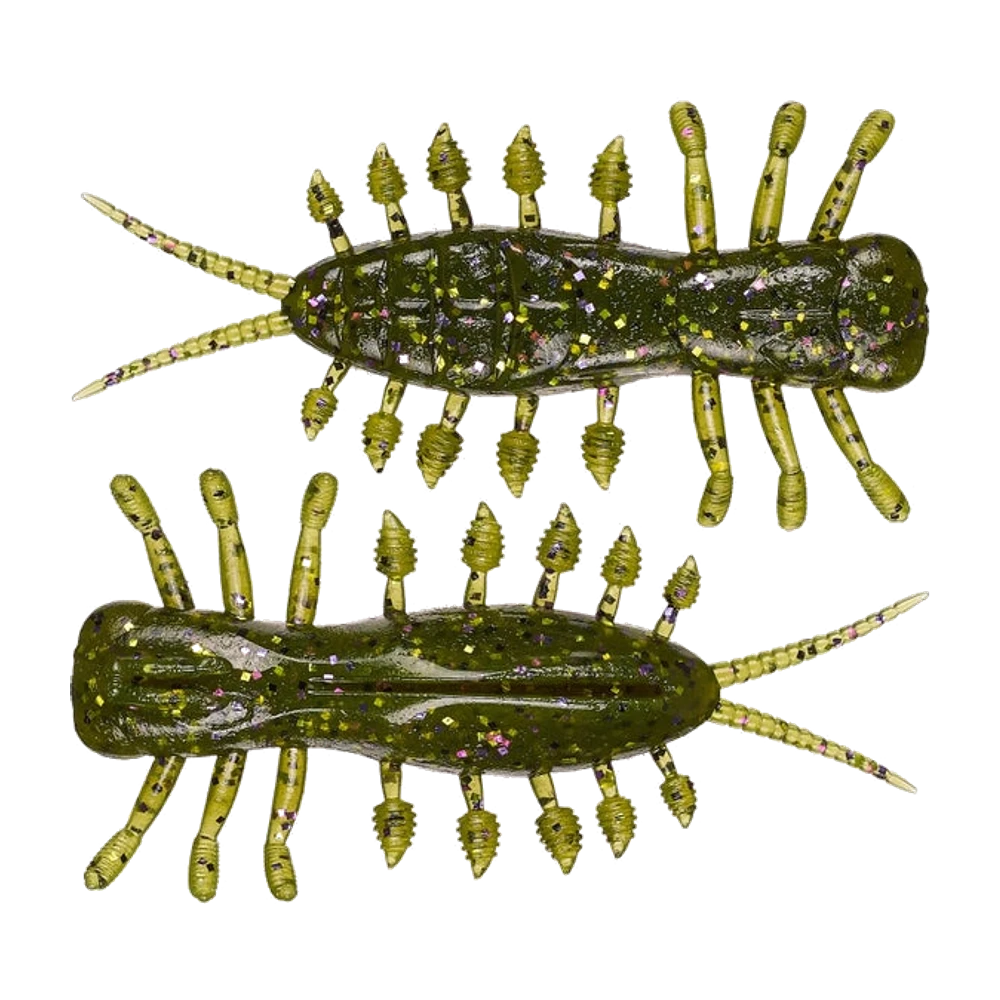
The Yagot comes out of a collaboration between Kenta Kimura, a Japanese angler competing on the Elite Series, and the Megabass workshop, where the shaping follows Yuki Ito's fluid design philosophy. The listed profile is that of a dragonfly nymph: a stocky, flattened body fringed along its whole length with short legs that work independently of the rest.
The maker stresses one point you can verify in the photo: the silhouette reads bulky from one angle and slim from another. From above, the Yagot has width and presence; edge-on, it disappears. That is a rare compromise in a soft plastic, where you normally choose between a body that displaces water and a body that stays discreet.
The listed action is a delicate, precise leg vibration. This is not the clatter of a big-pincered craw: it's a low-amplitude, high-frequency flutter, the sort you don't feel in the rod but can see up close. On a fish that has learned to distrust abrupt movement, that quiet signature is often what makes the difference.
8.9 cm, sold four to a pack: what the sheet says and doesn't
The maker's table has only two columns, and they need reading carefully: Length and Quantity, giving 3.5 in — 8.9 cm — and 4. That 4 is a pack count, the number of baits in the bag. It is not a dimension, not a weight, not a size number.
And that's where the sheet stops. No weight is published, and no density class either. So I'm not going to tell you the Yagot sinks slowly or sits neutral: that would be invented. What we do know is that Megabass presents it as carrying enough volume to cast well, which is consistent with a bait meant to be fished unweighted.
The practical consequence is simple: put one on a kitchen scale before your first session, and above all run a fall test in a bucket or off the bank. Thirty seconds will tell you how long it takes to drop a metre, and you'll be able to count your pauses instead of guessing them. On a bait sold with no published weight, that's the only honest way to know what you're fishing.
The three rigs the maker lists
No-sinker
This is where the Yagot is most itself. Texas hook alone, no weight at all, cast over a margin and let it free fall. The legs vibrate throughout the descent, and the body volume slows the fall enough to give a holding fish time to come up. Keep it for shallow water, one to two metres: beyond that the descent becomes interminable.
Free rig
A teardrop weight slides freely on the line above the hook. The weight falls first, settles, and the bait then drifts down on the slack, keeping its no-sinker attitude. It's the best compromise when you want to reach three or four metres without giving up the slow fall that makes the Yagot worth fishing.
Carolina
Heavy weight, bead, swivel and a 50 cm to 1 m leader. The weight drags bottom and lifts a cloud, the Yagot trails behind it, free. A search rig for flats and large hard-bottom areas, letting you cover ground fast at a depth where no-sinker no longer makes sense.
On the free rig, don't pick the contact back up too early. Let the weight settle, count three more seconds, and only then take up the slack. During those three seconds the Yagot finishes its fall flat, and that's almost always when the line moves sideways — you won't feel a thing in the rod, you'll see it on the line.
The recommended hook, and why it matters
Megabass explicitly recommends a 4/0 offset wide gap worm hook, specifically the Ryugi Infini, for a weedless presentation. Two things follow. First the gauge: 4/0 for 8.9 cm is a generous hook, forced by the thickness of the body. A 2/0 would pass through too little material and leave you swinging at nothing.
Then the type: a wide gap, whose open bend clears the point despite the bait's volume. That's the condition for the rig to stay genuinely weedless while still hooking when it counts.
The classic mistake
Threading the Yagot too far up the shank, until the body touches the eye. The bait ends up compressed, it bows and it spins on the retrieve, which kills the leg vibration outright. Pin it just far enough for the body to stay straight, point out then tucked back under the skin, and check the alignment after every bite.
On the face shown in the photo you can make out a longitudinal groove, the kind of channel that guides a hook point — but the maker documents no such feature, so treat it as an observation and not as a published characteristic.
Not sure what to tie on?
Photograph your spot: CarnaFish reads the scene, cross-checks the conditions and gives you the zone, the lure and the retrieve. Free on iOS and Android.
Colour by water and bottom
- Clear water: a flaked green pumpkin, like the one in the photo, with gold, purple and pink glitter. It's the tone that best matches a real nymph over a vegetated bottom.
- Stained water: a dark, heavily flaked finish, which plays on silhouette contrast rather than on the colour itself.
- Light or sandy bottom: a pale tone, because a dark bait sitting on sand announces itself from a distance and puts a wary fish on alert.
A bait for working a spot, not for covering water
The Yagot doesn't replace a conventional creature bait like the Missile Baits D Bomb or a Missile Baits Baby D Bomb: those displace more water and get fished faster. The Yagot does the opposite job, for when you need to spend ten minutes on two square metres of margin and show a silhouette the fish hasn't seen yet. In Europe, where pressure on bass waters runs high, that kind of mismatch is exactly what pays off late in the day.
Of course a spot-working bait only earns its keep if you work the right spot. That's what CarnaFish is for: a photo of the water, and the app suggests the zone, the depth and the presentation that suit the day. For the rest of the fundamentals, our beginner's guide to bass fishing covers tackle and typical lies.
Key takeaways
- A dragonfly nymph profile, a silhouette very few lures offer, aimed at a fish that genuinely eats them.
- The table lists 3.5 in, or 8.9 cm, and 4 pieces per bag: that 4 is a pack count, not a dimension.
- Neither weight nor density is published: weigh one and run a fall test before you start counting pauses.
- A 4/0 offset wide gap hook is the maker's recommendation, fished no-sinker, free rig or Carolina.
FAQ
How many Yagot come in a pack?
Four. The 4 that appears in the maker's table is indeed a pack count, not a size indication. At that rate, plan on two bags if you intend to fish a full day in standing timber.
How much does a Yagot weigh?
The maker doesn't publish it, and I'd rather tell you that than hand you an invented figure. Weigh one before you leave: it's useful for picking your rod and for calibrating unweighted casts.
Does the Yagot sink or float?
No density class is published by the maker. The description only notes that the bait carries enough volume to cast well, which fits an unweighted use. Run the fall test yourself before building a cadence around it.
What hook should I use?
Megabass recommends a 4/0 offset wide gap, specifically a Ryugi Infini, rigged weedless. The gauge is dictated by the thickness of the body: smaller and you'd miss hooksets, larger and you'd compromise the leg action.
Which rig should I start with?
The free rig, if you only keep one. It preserves the slow, free fall of the no-sinker while letting you reach three or four metres, which covers most bass lies.
Is the Yagot suitable for dense weed?
Partly. Rigged weedless on a wide gap it slips through light to moderate vegetation, but its many legs catch strands in genuinely thick weed. There, a short-appendaged creature bait like the Missile Baits D Bomb travels better.
The full bass lure guideSeason-by-season strategy: which family of lure, when, and why.Go from theory to fish
CarnaFish reads your spot from a photo and gives you the game plan: zone, lure, retrieve. Free on iOS and Android.