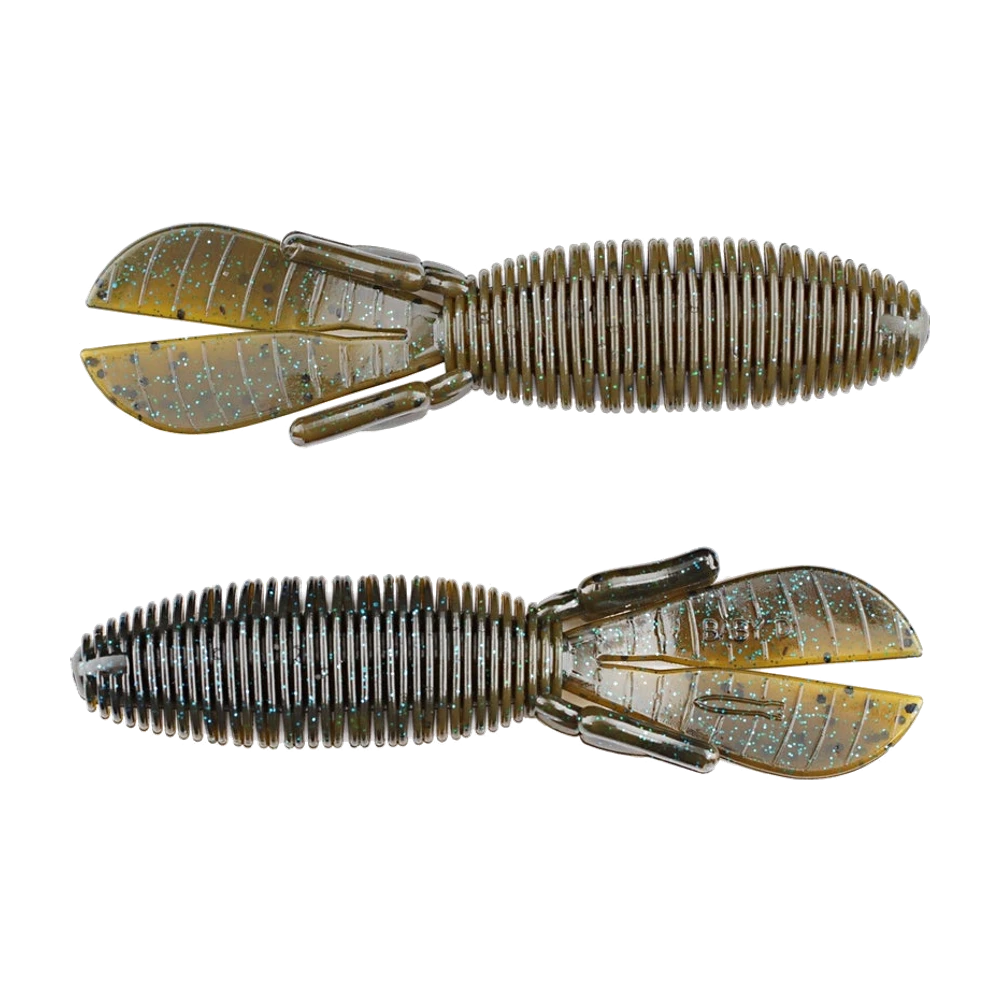
Missile Baits Baby D Bomb: the D Bomb scaled down to 9.3 cm
Not sure this lure fits YOUR spot today? CarnaFish tells you in 10 seconds, from a photo.
A laydown in two metres of water, five or six vertical pitches tight to the trunk, and nothing. You know there's a fish under it, you've watched it refuse twice. That's the classic situation where downsizing changes everything — not changing family, just dropping one notch. The Missile Baits Baby D Bomb exists for exactly that: take a creature bait that already works and bring it back to 9.3 cm.
A scaled-down D Bomb, not a different bait
The maker is clear about the lineage: the Baby D Bomb keeps all the same fish-catching characteristics as the Missile Baits D Bomb, in a smaller and more versatile package. This isn't a new design, it's a rescale, and that's good news: you have nothing to relearn, you simply transpose your rigs onto a profile that sits better with a wary fish.
Behind the brand sits John Crews, a Bassmaster Elite Series competitor. Missile Baits claims each bait is individually designed and thoroughly tested, which shows up concretely in fairly clean moulding: no flash on the claws, consistent material density from one bait to the next.
The smaller format mainly opens up uses the full-size model cannot handle. The maker names the shakey head and the football jig specifically, two rigs where a 12 or 13 cm creature bait would make an unbalanced package. At 9.3 cm, the Baby D Bomb sits properly behind a 10-14 g football head without smothering its action.
9.3 cm, seven to a pack: reading the table properly
The maker's table has only two columns, Length and Quantity: 3.65 in and 7. Translation: 9.3 cm, and seven baits per bag. That 7 is a pack count, not a dimension and not a size number.
It's also worth stating what the table doesn't contain: no weight, no density class. So I won't tell you the Baby D Bomb sinks fast or slow. What the description does say is that the body displaces a significant amount of water on the drop — that's information about displaced volume, not about sink rate.
The consequence is the same as on any soft plastic sold with no published weight: run your own fall test with your usual sinker before you start counting pauses. Two minutes at the water's edge beats a guess.
What the ribbed body actually does
Look at the photo: the body isn't smooth, it's covered in deep rings along nearly its whole length. Those ribs do two things. The first is mechanical: they increase the surface in contact with the water, and so the volume of water pushed around with every movement. The second is practical: they hold attractant and release it gradually, instead of dumping it on the first cast.
The two flat claws are described by the maker as thin and lively. They're broad but not thick, which lets them flap at the slightest water movement — including during a pause, when the bait is sitting still and only current or a ripple is working them. That is exactly what tips the balance with a fish that stares for a long while before committing.
After every missed bite, pull the bait in and check how the claws line up. A creature bait that has taken a set of jaws shifts a millimetre or two on the shank, and from then on it spins on the retrieve. Two seconds of checking beats half an hour fishing a bait that rolls.
The rigs that suit it
Texas or flipping
The description notes that the Baby D Bomb still accommodates a 3/0 flipping hook despite the reduced size. That's the base rig: point tucked under the skin, a 7-14 g bullet weight pegged or free depending on how thick the cover is. Pitch vertically tight to the object, let it drop on slack line, two short hops on the bottom, then move on.
Football jig trailer
The maker names this use explicitly. Behind a football head, the ribbed body and the claws offset the very plain silhouette of a jig head and add volume to the package without slowing it. This is the search rig for hard bottom, gravel and rocky breaks.
Shakey head
The other named use. On a light 5-9 g shakey head, the Baby D Bomb stands up on the bottom with its claws in the water column, and shaking the rod tip works them without moving the bait at all. A pure insistence presentation on a located fish.
The classic mistake
Rigging the Baby D Bomb on too small a hook in search of discretion. A 1/0 or 2/0 doesn't pass through enough material on a body this thick, and you'll swing at nothing half the time. The 3/0 the maker names is not a theoretical maximum, it's the gauge that matches the real thickness of the body.
Not sure what to tie on?
Photograph your spot: CarnaFish reads the scene, cross-checks the conditions and gives you the zone, the lure and the retrieve. Free on iOS and Android.
Colour by water and season
- Clear water: a green pumpkin with blue-green flake, like the one in the photo, which stays credible over weed and over gravel alike.
- Stained water: a dark, dense finish, playing on silhouette contrast seen from below rather than on colour.
- Spring, when crawfish are active: an orange or red tone, matching what bass naturally target at that time of year.
Small format, serious brief
The Baby D Bomb isn't the bait you tie on to cover water fast. It belongs to the insistence family, alongside a Missile Baits Ned Bomb for pure finesse and a Megabass Yagot when you need an unfamiliar silhouette. Between the three, you cover just about every case where a fish refuses a fast presentation.
You still have to know which laydown is worth fishing. That's exactly what CarnaFish makes easier: a photo of the spot, and the app suggests the zone, the depth and the presentation that suit the day's conditions. To sharpen your water reading, our guide to reading a fishing spot lists the clues to look for before casting.
Key takeaways
- A rescaling of the D Bomb to 9.3 cm, keeping the same characteristics in a more discreet format.
- The table lists 3.65 in and 7 pieces: that 7 is a pack count, not a dimension.
- Neither weight nor density is published: run your own fall test with your usual sinker.
- A 3/0 flipping hook is stated as compatible despite the reduced size — don't go below it.
FAQ
How many Baby D Bombs come in a pack?
Seven. The 7 in the maker's table is a pack count. That's generous for a creature bait of this size, which helps when you're fishing standing timber and leaving a few behind.
How much does this bait weigh?
The maker doesn't publish it. Rather than invent a figure, note that the description only mentions a significant volume of water displaced on the drop. Run a test with your usual sinker to learn your real sink rate.
What hook size should I use?
A 3/0 flipping hook, the size the maker states as compatible. Go smaller and the hook won't pass through enough material on a body this thick, and you'll multiply swing-and-miss hooksets.
Can it be used as a jig trailer?
Yes, that's one of the uses the maker names, particularly behind a football jig. The ribbed body adds volume and the claws keep the back of the package alive even when the head is dragging slowly over hard bottom.
How does it differ from the original D Bomb?
Only in size, according to the maker: the Baby keeps the same characteristics in a reduced profile. The Missile Baits D Bomb stays the choice in stained water or for bigger fish, the Baby takes over when pressure forces you down a notch.
Is it suitable for dense weed?
Rigged Texas with the point properly tucked, it travels through moderate vegetation. Its two flat claws catch more than slim appendages do in genuinely thick weed, where a slimmer body stays easier to work.
The full bass lure guideSeason-by-season strategy: which family of lure, when, and why.Go from theory to fish
CarnaFish reads your spot from a photo and gives you the game plan: zone, lure, retrieve. Free on iOS and Android.