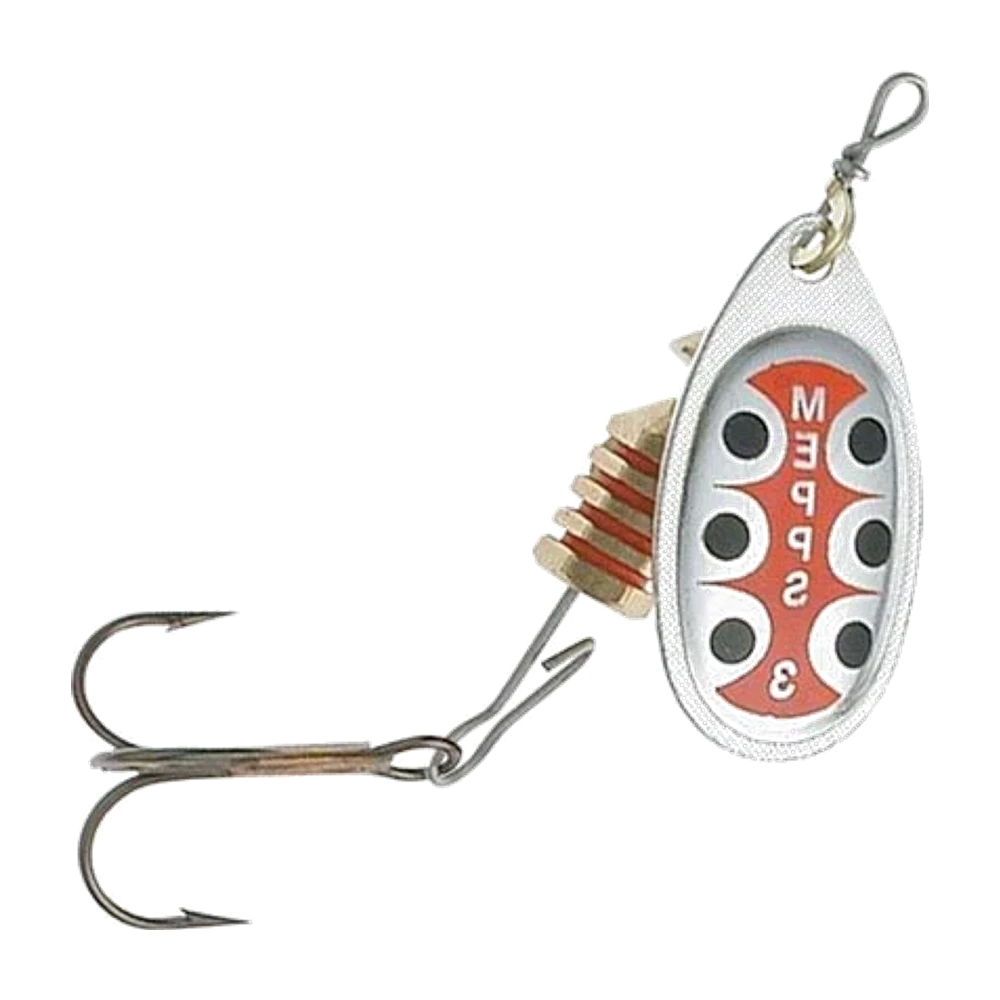
Mepps Aglia TW: the inline spinner you reconfigure at the water's edge
Not sure this lure fits YOUR spot today? CarnaFish tells you in 10 seconds, from a photo.
The problem with a classic inline spinner is that it is not up for discussion. It comes out of the packet with a blade, a body and a treble, and that is what it will be all day. If the fish wants more signal, you change spinner. If it wants less, you change again. Three hours in, you have pulled out six models and half a dozen of them are tangled in the bottom of the box.
The Aglia TW attacks that problem mechanically: its hook comes off. That detail, which sounds trivial, turns a fixed spinner into a platform you can build on however you like — a single, a treble, a soft plastic, an extra blade — without ever cutting your line.
The result: you go from a discreet setup to a heavily vibrating one in thirty seconds, on the same spot, with the same lure on the end of the line.
A hook system that frees up the rear of the lure
On a classic spinner, the hook is trapped in a crimped ring. On the TW, the rear of the rig opens. Three options open with it.
- Change the type of hook. A treble for maximum contacts, a single to limit snags and make unhooking easier on fish you are releasing.
- Add an extra blade. The second rotating element doubles the flash points and thickens the vibration signature. That is the option for stained water and active fish.
- Add a soft plastic on the rear shaft. The soft body slows the whole thing down, adds a silhouette and lets you run deeper at the same speed.
The blade itself keeps the characteristic that made the Aglia name: it fires up on contact with the water, with no run-up. You do not need to accelerate to start it, which allows very slow retrieves and dead time during which it keeps fluttering.
The three setups and their uses
| Setup | Signal | When to fit it |
|---|---|---|
| Blade alone + stock treble | Standard | Clear water, neutral fish, ordinary searching |
| Blade alone + single hook | Discreet | Cluttered bottoms, catch and release, plenty of small trout |
| Double blade | Strong | Stained water, cloud cover, active fish, current |
| Blade + soft plastic at the rear | Heavy and slow | Apathetic fish, cold water, need to get down |
The table reads in a precise order: always start with the simplest version. Going straight to the double blade in clear water amounts to announcing your arrival to every fish on the spot.
A useful reference for deciding without hesitating: look at how far out you can still see your blade as you bring it in near the bank. If you lose sight of it within a metre, the water is dirty enough to justify a second blade. If you can still track it at three metres, stay on the simple version and work on your retrieve speed instead. That test takes five seconds and beats guessing about turbidity.
How to work each version
- Standard version: straight retrieve at constant speed, just fast enough to feel the blade turning in the rod tip. If you feel nothing, speed up a notch.
- Double blade version: slow down. Water resistance rises noticeably, and a brisk retrieve brings the lure up to fifteen centimetres under the surface.
- Version with a soft plastic: alternate five turns of the handle and a one-second pause. During the pause, the whole rig tips slightly and the soft plastic keeps living.
- In every case, do the first three metres of the retrieve before the spinner is even below you: that is where following perch make up their minds.
On the water: when you add a second blade, drop the main blade one size. Two blades of the same size interfere with each other and create an unstable rig that twists the line. A large blade followed by a smaller one turns cleanly and produces two distinct vibration frequencies, which is exactly the effect you are after.
Where the modularity really pays
It pays when conditions change during the day: a clear morning turning overcast, water rising after a storm, a school of perch going from active to apathetic in an hour. You adapt without taking your rig apart.
It also pays when you are roving, working spots of different character over a few kilometres of river or canal: a slow flat, a riffle, a deep undercut bank, each calls for its own setup.
It is useless in two cases. On a stocked trout fishery, where the rules often impose a single hook and where finesse matters more than modularity. And when you have already worked out what is working: on that day, fit the right setup and leave it alone — changing for the sake of changing costs bites.
Not sure what to tie on?
Photograph your spot: CarnaFish reads the scene, cross-checks the conditions and gives you the zone, the lure and the retrieve. Free on iOS and Android.
The rig you should not neglect
A spinner twists the line, and a double-bladed spinner twists it more. A rolling swivel is compulsory, set fifty centimetres from the lure, and not a cheap one: a swivel that does not turn freely under load is useless.
On line, count on 0.16-0.20 mm for trout in the light setup, and 0.22-0.24 mm as soon as you go to a double blade or when canal perch share the water with jack pike. Check your knot every twenty minutes: residual twist fatigues the line just above the swivel.
Aglia TW or classic Aglia
The Mepps Aglia No. 3 remains the benchmark in plain spinners: one round blade, a perfectly calibrated signal, nothing to adjust. It is the lure you tie on when you know what you want and want to do it without thinking.
The Aglia TW targets the other need: uncertainty. It does not swim better, it does not catch more fish in absolute terms — it simply lets you test three hypotheses with one lure. On a day spent exploring, that is a real time saver.
Against a Mepps Black Fury, the logic differs again: the Black Fury plays on a dark spotted blade and a fixed dressing, designed for a precise contrast. Our guide to perch fishing with lures covers the situations where adding vibration changes everything. And if you are unsure which setup to fit when you reach the bank, CarnaFish analyses a photo of the spot and answers.
Key takeaways
- The removable hook lets you change hooks, add a blade or a soft plastic without cutting the line.
- The blade fires up on contact with the water: very slow retrieves are possible.
- Two blades: drop the main one a size, otherwise the whole rig twists.
- Always start with the most discreet setup and add signal only if you need it.
- A quality rolling swivel is compulsory, especially with a double blade.
FAQ
What is the Aglia TW's removable hook for?
It lets you modify the rear of the lure without changing spinner: go from treble to single, add a second blade for more vibration, or fit a small soft plastic. You match the signal to conditions without cutting your line.
Should you always fit two blades?
No. The double blade is a strong-signal setup, reserved for stained water, cloud cover or active fish. In clear water on wary fish, it produces the opposite of the effect you want.
What size blade should you add as the second one?
One size below the main blade. Two identical blades disturb each other and twist the whole rig, whereas a large-small pair turns cleanly and puts out two different frequencies.
Can you fit a soft plastic on it?
Yes, it is one of the setups the hook system is designed for. The soft plastic slows the whole thing down, adds a silhouette and helps it get deeper. Count on a slower retrieve and short pauses to use it properly.
What line and what swivel should you use?
0.16-0.20 mm in the light version, 0.22-0.24 mm with a double blade or where there are jack pike. A rolling swivel set fifty centimetres from the lure is essential, and it must turn freely under load.
Is it more effective than a classic Aglia?
Not intrinsically. It swims on the same principle. Its advantage is the speed of adaptation: on a day when conditions shift, or over a varied stretch, it saves you changing lures at every spot.
The full trout lure guideSeason-by-season strategy: which family of lure, when, and why.Go from theory to fish
CarnaFish reads your spot from a photo and gives you the game plan: zone, lure, retrieve. Free on iOS and Android.