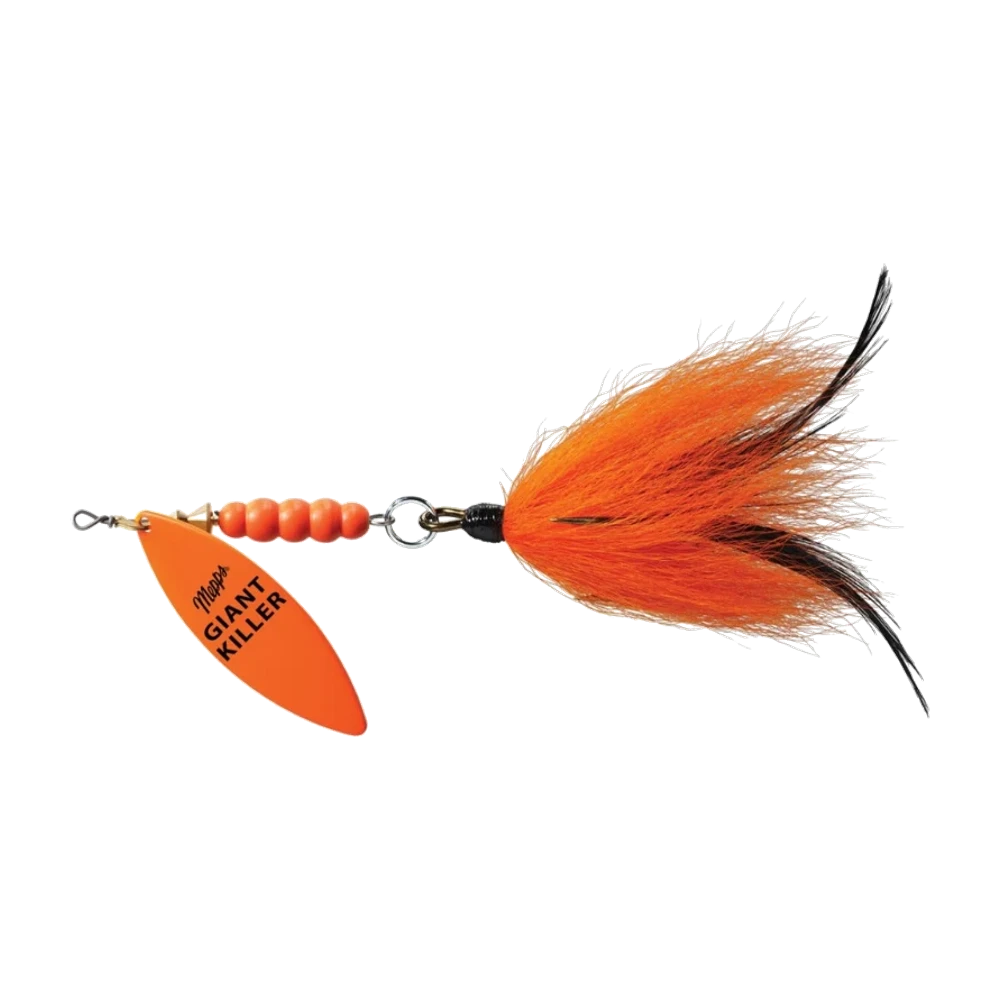
Mepps Giant Killer: thirty-five grams that have to fish at one metre
Before tying this one on, it helps to know if the spot actually calls for it. CarnaFish reads the scene from a photo.
Late summer on a big reservoir. The pike are not in the deep holes: they are spread over flats two metres deep, along the weed edge, and they are feeding. The problem is not getting down — it is covering three hundred metres of bank in an evening with a lure that can be heard from a distance.
The Giant Killer is built for that, and it immediately poses a paradox: it is a 35 g lure that has to fish at one metre down. Its solid brass body gives it the casting distance you need, but that same weight takes it to the bottom if you fish it badly. The whole art is keeping it high while physics pulls it down.
Once you have that setting, it does something few pike lures do as well: it calls a fish that never saw the lure go past.
Holding the top layer with a heavy lure
Three parameters decide the running depth, and none of them can be bought: you control them.
- When you start. If you wait for the spinner to touch the water before closing the bail, it has already begun its descent. Close and start retrieving a fraction of a second before impact: the blade fires up instantly and the lure sets off level.
- Speed. A big blade needs a minimum speed to turn, and that same speed creates lift. Go too slow and you lose both at once: the rotation and the depth.
- Rod angle. Rod tip high at 45 degrees and you fish a metre higher than with the tip pointed at the water, at identical speed. That is your fine adjustment mid-retrieve, particularly as you pass over a shallow hump.
The bucktail makes volume, not weight
The hair mounted on the rear treble is not decoration. It does a precise job: adding visible volume without adding mass or water resistance.
In motion, the fibres lie flat and the lure stays compact. The moment you slow down or mark a stop, they open out like a flower and the silhouette doubles in size in a tenth of a second. That sudden swelling is a powerful trigger on a pike following without committing.
Two maintenance points that change how well it works:
- Do not trim it to "freshen it up". A shortened bucktail loses its opening and becomes a stiff tuft.
- Rinse it and let it dry open after a session. Hair that dries stuck in a clump never opens properly again.
The retrieve, spot by spot
- Fan your casts from a fixed point, covering a 180-degree sector cast after cast, shifting about ten degrees each time.
- Close the bail just before impact and start with no dead time.
- Retrieve at a constant, brisk speed, rod at 45 degrees. You should feel the blade thumping continuously in the rod.
- Mark a half-second slowdown every five or six turns of the handle, without ever stopping completely. The bucktail opens, the lure drops twenty centimetres, then sets off again.
- Slow down noticeably over the last three metres, rod raised, and make a figure-of-eight with the tip before lifting the lure out.
On the water: the mid-retrieve slowdown must never become a stop. On a spinner of this weight, a dead stop kills the rotation, the lure noses down, and a following pike loses contact with the target it was tracking. Half a beat is enough to open the bucktail without breaking the signal.
Speed, depth and angle: the dashboard
| What you want | Speed | Rod tip angle | Result |
|---|---|---|---|
| Passing over weed | Brisk | High, 60° | 0.5 to 1 m |
| Standard margin searching | Steady medium | 45° | 1 to 1.5 m |
| Running a drop-off | Medium, start delayed 1 s | Low, 20° | 2 to 2.5 m |
| Fish following without biting | Medium + regular half-beats | 45° | A profile that swells and closes |
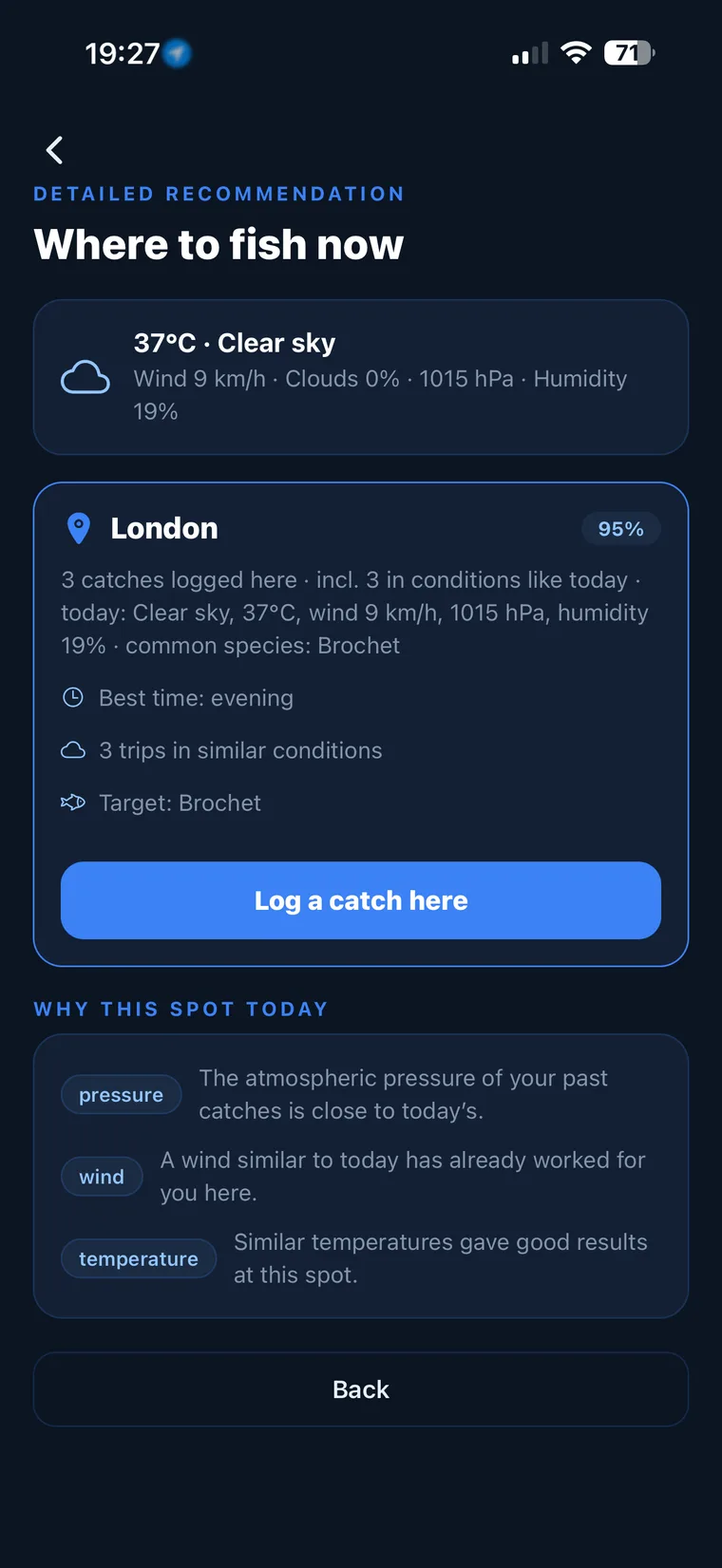
Not sure what to tie on?
Photograph your spot: CarnaFish reads the scene, cross-checks the conditions and gives you the zone, the lure and the retrieve. Free on iOS and Android.
Its season, its waters, and what it will not do
It is at its best from late spring to early autumn, on waters where pike are active and mobile: big reservoirs, gravel pit lakes, wide canals, river backwaters. It also gives good results in lightly stained water, where the combination of a heavy blade and a bulky bucktail makes up for the loss of visibility.
It should be left dry in three situations, though. Cold water, where pike no longer move enough to come and take a fast lure. Tight, cluttered spots, where a lure this size snags everything. And days when you fish more than six hours straight from the bank without the right gear: 35 g plus a 6 cm blade is a constant pull that wears out your wrist and the bail arm of a light reel. A 2.40 to 2.70 m rod rated 30-80 g, a size 4000 reel minimum, 0.30-0.40 mm braid.
Giant Killer, Vibrax size 6 or Lusox
Three big inline spinners, three uses that do not overlap.
The Blue Fox Vibrax size 6 relies on a sound-producing body that puts out a distinctive low-frequency vibration, and it is often used in tandem rigs by catfish anglers. The Giant Killer plays the card of visible volume and the flash of a big blade, with a bucktail as its signature. On pike over a big expanse, the choice mostly comes down to "being heard" versus "being seen".
The Mepps Lusox frames the question differently: it is a bottom spinner, slow, with interchangeable weights, for settled fish in cold water. It takes over from the Giant Killer exactly when the season turns and pike stop coming up.
Our guide to choosing a pike lure places these three options within a full annual cycle. And if you are unsure which layer to search when you reach the bank, CarnaFish analyses a photo of the spot and answers.
Key takeaways
- The lure weighs 35 g but has to fish high: start the retrieve before impact.
- Constant, brisk speed; a dead stop kills the rotation and loses the follower.
- The rod tip sets the depth mid-retrieve, at identical speed.
- The bucktail doubles the apparent volume when it opens: do not trim it, dry it open.
- A warm-season, big-water lure, to be put away in cold water and on cluttered spots.
FAQ
Does the Giant Killer fish at the surface or on the bottom?
Between 0.5 and 2.5 m depending on how you handle it. With an immediate start and the rod tip high, it stays in the first metre despite its 35 g; by delaying the start and dropping the rod, you make it work two metres lower.
Why should you never stop it completely?
Because a blade this size stops turning the moment the pull is interrupted. The lure noses down, the signal disappears, and a following pike loses the target. A simple half-second slowdown produces the effect you want without breaking the rotation.
What is the bucktail for?
To add visible volume without adding weight or resistance. The fibres lie flat on the retrieve and open out like a flower at the slightest slowdown, which doubles the silhouette instantly. It is an effective trigger on following fish.
What gear do you need to fish it?
A 2.40 to 2.70 m rod rated 30-80 g, a size 4000 reel minimum and 0.30-0.40 mm braid. A steel or titanium leader is essential: this lure is fished exactly where pike sit.
Does it work in winter?
Hardly. Cold-water pike no longer move enough to intercept a fast lure in the top layer. A weighted spinner worked slowly on the bottom, or a soft plastic, covers that period far better.
Does it twist the line much?
Yes, like any big inline spinner. A heavy-duty rolling swivel, replaced as soon as it becomes stiff to turn, is the minimum. Also check your knot regularly: the twist fatigues the line just above the connection.
The full pike lure guideSeason-by-season strategy: which family of lure, when, and why.Go from theory to fish
CarnaFish reads your spot from a photo and gives you the game plan: zone, lure, retrieve. Free on iOS and Android.