Baitsanity Chimera Shad: the glide bait that weights itself as you fish
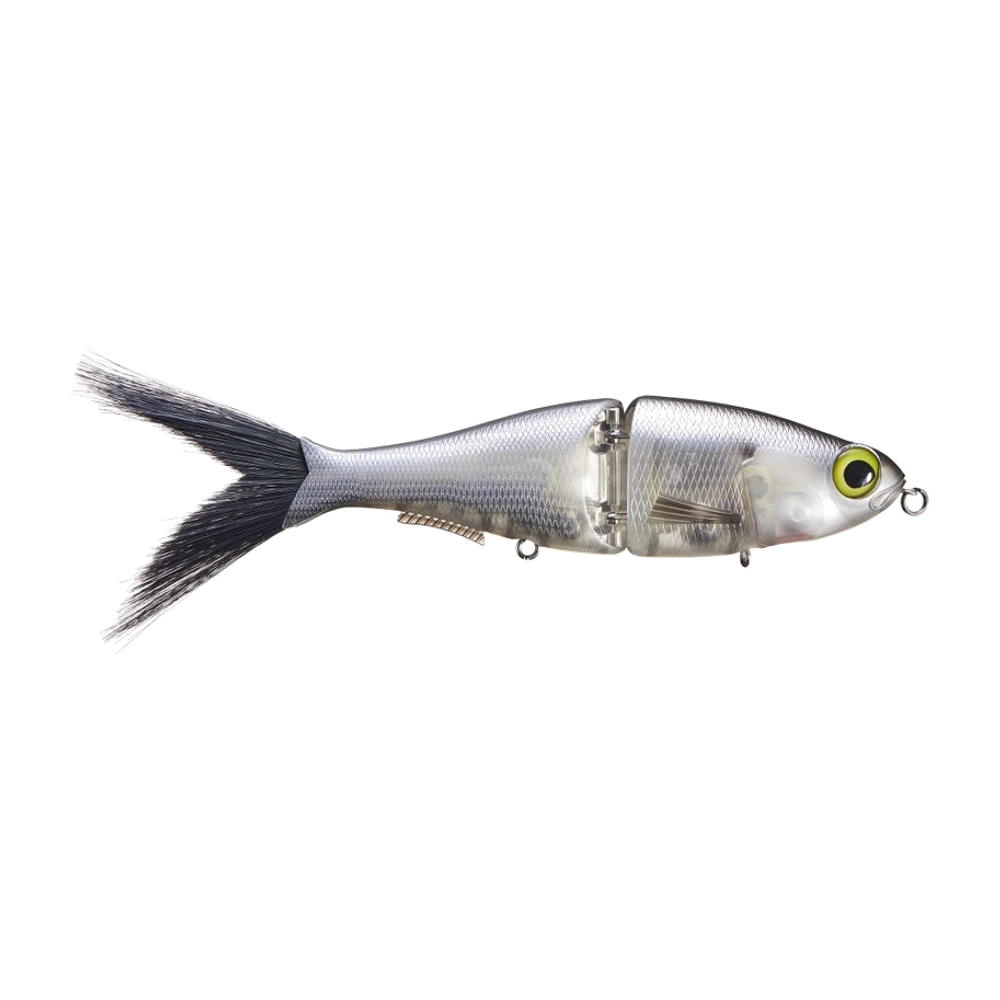
The right lure in the wrong spot still catches nothing. CarnaFish spots the zone that works, from a single photo.
You cannot judge a glide bait on the first cast. For the first three or four, the Chimera Shad sinks faster than you expect and you get the feeling you bought a badly tuned lure. Then it changes behaviour: it settles, slows its descent and ends up hanging almost between two layers of water. That is not a fault, that is how the bait is designed to work.
The STS system, or a lure that tunes itself in the water
Baitsanity calls it STS, for Submerge-to-Sink. The idea is simple: water enters through the hook hanger housings and gradually fills part of the body. As it fills, the bait gains internal mass, its descent slows, and it tends towards near neutral buoyancy.
The practical consequence is that the first few minutes of fishing are a running-in phase. The maker's spec table lists the Chimera Shad as a slow sink, and that is the reference behaviour — but once the body has taken on water, the sink rate drops noticeably and the bait stays longer in whatever layer you put it.
There is a less pleasant consequence too. If you put it away wet in a sealed box, it stays wet. Shake it hooks down at the end of a session to drain it, otherwise you start the next trip with a lure that is already weighted, and you lose the slow sinking phase that is useful for reaching your starting depth.
Two retrieves, and you need to mix them
The Chimera Shad was drawn to answer two very different retrieves. That is unusual on a glide bait, which often excels at only one.
The first is the wide glide. A smooth, continuous retrieve with the rod pointed down: the bait swings alternately left and right in long S shapes. This is the searching retrieve, the one that covers a flat or a long point and gives a fish time to come from a distance.
The second is walking in place. Short, sharp chops of the reel handle with the rod tip still: the bait flips from side to side almost without moving forward. This is the precision retrieve — an isolated stump, the corner of a dock, a rock head — where you want to keep the lure inside one square metre for ten seconds.
The real gain is not choosing between the two, it is stringing them together inside the same retrieve. Two long S shapes to bring the bait onto the spot, then three sharp chops in place, then a long glide to pull away. Most bites come at the transition, when the bait stops gliding and starts flipping.
Setting the hook on a 79 gram lure
A glide bait this heavy does not forgive slack line. The hangers are swiveling, which limits the leverage the bait has during the fight, and the hooks are #2 round bends — fine enough to penetrate, not strong enough to carry a badly managed scrap on their own.
Keep the line tight at all times, set to the side and pump slowly. A fish shaking its head with 79 g hanging from its jaw throws the bait quickly if you give it any play.
The classic mistake
Fishing the Chimera Shad with the rod, like a jerkbait. Both retrieves are driven from the reel, rod tip low and still. The moment you start pulling with the rod you impose jolts the joint cannot absorb, the bait turns sideways, and the glide becomes a tail slide.
Where this bait has a real edge
The Chimera Shad belongs on big open water: shallow flats, long points that taper away gently, the edges of shallow humps, and isolated targets you can work in place. That is typically boat or float tube fishing, where you can position yourself to send the bait through on the right line.
In Europe it is also a very good pike bait on big lakes, with the same protocol as a Gan Craft Jointed Claw or a Deps Slide Swimmer 175: a heavy leader is compulsory, and pay close attention to the split rings, which take the whole load.
Its limit is vegetation. With two trebles slung under a rigid jointed body, the Chimera Shad is in no way weedless. Over a weedy flat a Westin Swim Glidebait will do no better, and you need to switch to a weedless rigged soft bait.
Not sure what to tie on?
Photograph your spot: CarnaFish reads the scene, cross-checks the conditions and gives you the zone, the lure and the retrieve. Free on iOS and Android.
Colors by water clarity
- Clear water: the pearl silver with a dark back shown in the photo. That is the all-round livery of an open-water baitfish, and the one most consistent with the hybrid profile of the lure.
- Weedy bottom, slightly green water: a green or brown back, which avoids an over-contrasted silhouette above a light bottom.
- Stained water: a solid pearl white, still readable at two or three metres where a detailed pattern disappears completely.
Knowing whether the spot deserves a glide bait
A 79 g glide bait is fished slowly, and an hour spent on the wrong flat is expensive. That is exactly the call CarnaFish helps you make: one photo of the spot, and the AI suggests the zone to work, the depth and the lure family that match the conditions — enough to tell whether you are on a glide setup or a bottom-bait setup. To organise the session itself, our guide to float tube and boat fishing covers positioning and drifting.
Key takeaways
- The STS system lets water in through the hook hangers: the bait starts as a slow sink and tends towards neutral buoyancy as you fish.
- Two retrieves, the wide glide and walking in place, to be strung together in the same cast.
- Everything is driven from the reel, rod tip low: pulling with the rod turns the bait sideways.
- No weedless capability at all, so keep it for open water.
FAQ
Does the Chimera Shad sink or float?
The maker rates it a slow sink. As you fish, water entering through the hook hangers increases its internal mass and it tends towards near neutral buoyancy: the sink rate drops noticeably after a few minutes.
What are its exact dimensions?
22.4 cm / 8.8 in overall including the tail, 17.1 cm / 6.75 in for the body alone, and 79 g / 2.8 oz. This is a lure that calls for a swimbait rod, not an all-round pike outfit.
How do you work it?
Two retrieves, both driven from the reel. A smooth, continuous retrieve gives the long searching S shapes; short sharp chops of the handle with a still rod tip make it flip in place above a precise target.
Should the factory hooks be changed?
Not necessarily. It comes with #2 round bend trebles on swiveling hangers, which is consistent for bass. For pike, watch the split rings above all: they are the real failure point on a lure of this weight.
Is it suitable for pike?
Yes, on big lakes and over open water, with a heavy fluorocarbon or titanium leader. The size and the wide glide match what a pike sitting on a flat is looking for.
Why does my glide bait keep spinning out?
Either you are working it with the rod instead of the reel, or your chops are too heavy. Reduce the amplitude until you get a clean flip again, and check that the knot leaves the nose eye free to pivot.
The full bass lure guideSeason-by-season strategy: which family of lure, when, and why.Go from theory to fish
CarnaFish reads your spot from a photo and gives you the game plan: zone, lure, retrieve. Free on iOS and Android.