Mepps Lusox: the inline spinner whose weight you swap to match the hole
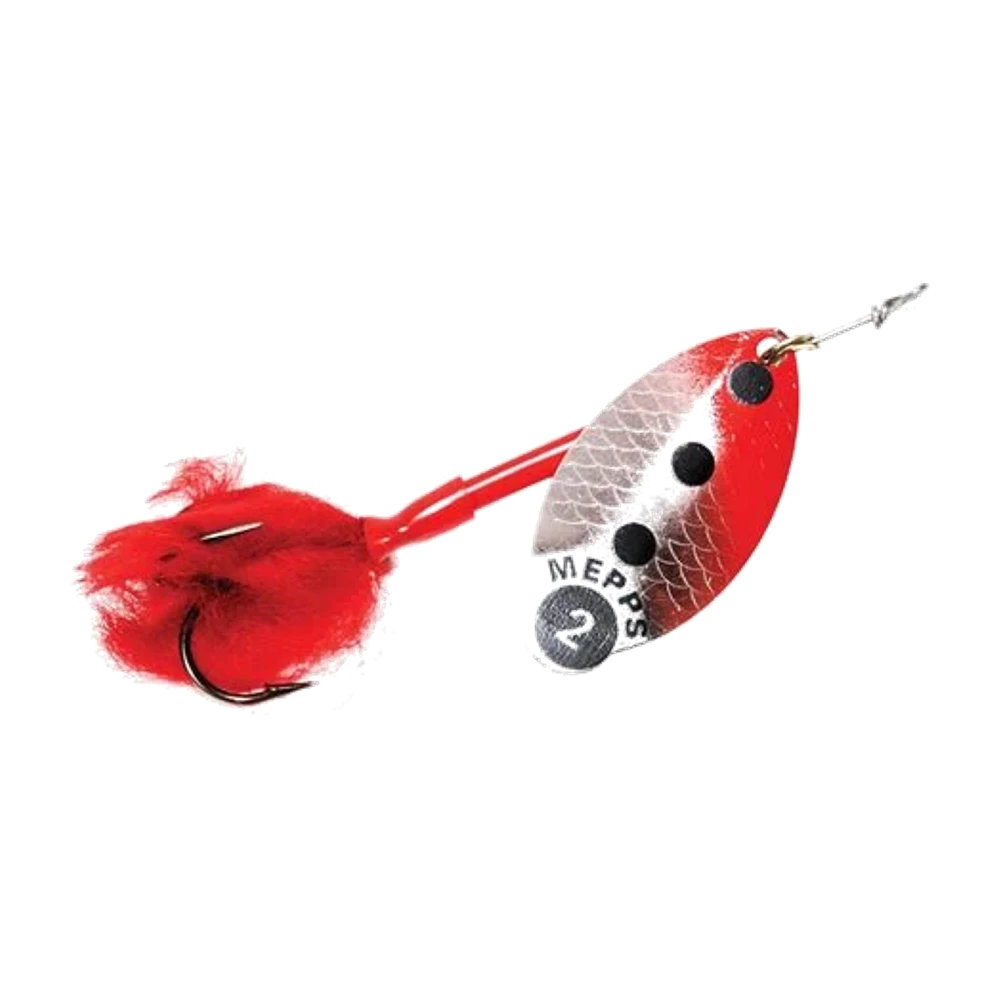
One lure, endless conditions. CarnaFish reads your spot from a photo so you are not just guessing.
An ordinary inline spinner has a built-in flaw when you want to fish deep: as soon as you retrieve fast enough to turn the blade, the drag of that same blade lifts the lure. You meant to fish at four metres, you are fishing at one and a half. And the November pike lying at the foot of a drop-off is not going to rise two and a half metres for a look.
The Lusox solves that conflict by splitting the two jobs. The signal stays in the blade. The weight moves out front, onto a weighted shaft you change the way you would change a jig head. The spinner is no longer fighting itself: the lead holds it down, the blade turns in slow motion, and you can finally work the deep layer with an inline spinner.
It is an old lure, still in production, and its modular logic remains more modern than that of many recent spinners.
Weight up front, not in the body
The difference with a body-weighted spinner matters. On those, the weight is built into the body behind the blade, and it is fixed: one size, one weight, one depth.
On the Lusox, the lead sits ahead of the blade, on a metal shaft you clip on. Three direct consequences:
- The same lure covers the whole water column. A light shaft for a two-metre flat, a heavy one for a five-metre hole. You keep the same blade, the same silhouette, the same behaviour.
- The lure dives head first on every stop instead of gliding flat. That nose-down fall is the main bite moment on an inactive pike.
- The pulling point sits well ahead of the blade, which gives it a freedom of rotation it would never have with lead stuck behind it.
The blade itself is three-faced: its three panels break the rotation into three distinct flashes per turn and produce a low-frequency vibration, heavier than that of a classic round blade. That is what lets it stay noticeable at speeds where an ordinary spinner simply stops turning.
The sawtooth retrieve
This is the retrieve the lure was designed for. It has nothing to do with a straight wind.
- Cast and let it sink on a free line until it hits bottom. Count the drop and you will know whether you are over three metres or six.
- Lift the rod slowly from the 9 o'clock position to 11 o'clock, over a good second. The blade starts turning during that lift.
- Drop the rod tip back down with the lure, picking up just the slack. The lure dives head first, blade still turning.
- Wait for bottom contact, or count one to two seconds depending on the depth.
- Repeat all the way to the bank, holding the same rhythm. You are drawing sawteeth eighty centimetres to a metre high.
On pike, the bite almost always registers as a sensation of weight during the falling phase — not as a knock. If the lure does not drop back the way you expected, set the hook.
On the water: during the falling phase, never give completely slack line. Keep light contact, rod at 45 degrees. A Lusox dropping on a totally slack line falls straighter, but you feel nothing and you miss half the bites, which happen precisely there. The exact compromise is a line just tight enough to transmit, not tight enough to slow the fall.
Which shaft for which depth
| Depth | Shaft | Rhythm |
|---|---|---|
| 1 to 2 m, slow flat | Lightest in the range | Short sawteeth, without touching bottom |
| 2 to 4 m, margins and drop-offs | Intermediate | Bottom contact every other cycle |
| 4 to 6 m, holes and moorings | Heaviest | Systematic bottom contact |
| Strong current | One size above the theoretical depth | Cast upstream, let it swing |
The classic bad reflex: staying on a light weight "so as not to snag". A lure that never touches bottom is not fishing the zone you were aiming at, and it snags on the first obstacle anyway. Better the right weight and a controlled rhythm.
Pike, zander, and what it cannot do
On pike, it peaks between autumn and early spring, over holes, deep margins, the foot of dykes and mooring areas. The low vibration carries a long way in cold, murky water.
On zander, it works but needs adjusting: an even slower rhythm, amplitude cut to fifty centimetres, and bottom contact on every cycle. A zander follows the lure more than it hits it.
It is, on the other hand, unsuited to dense weed beds — the blade collects everything — to fast searching over large areas, and to fishing very clear water for educated pike, where a quieter, more discreet lure gets through better.
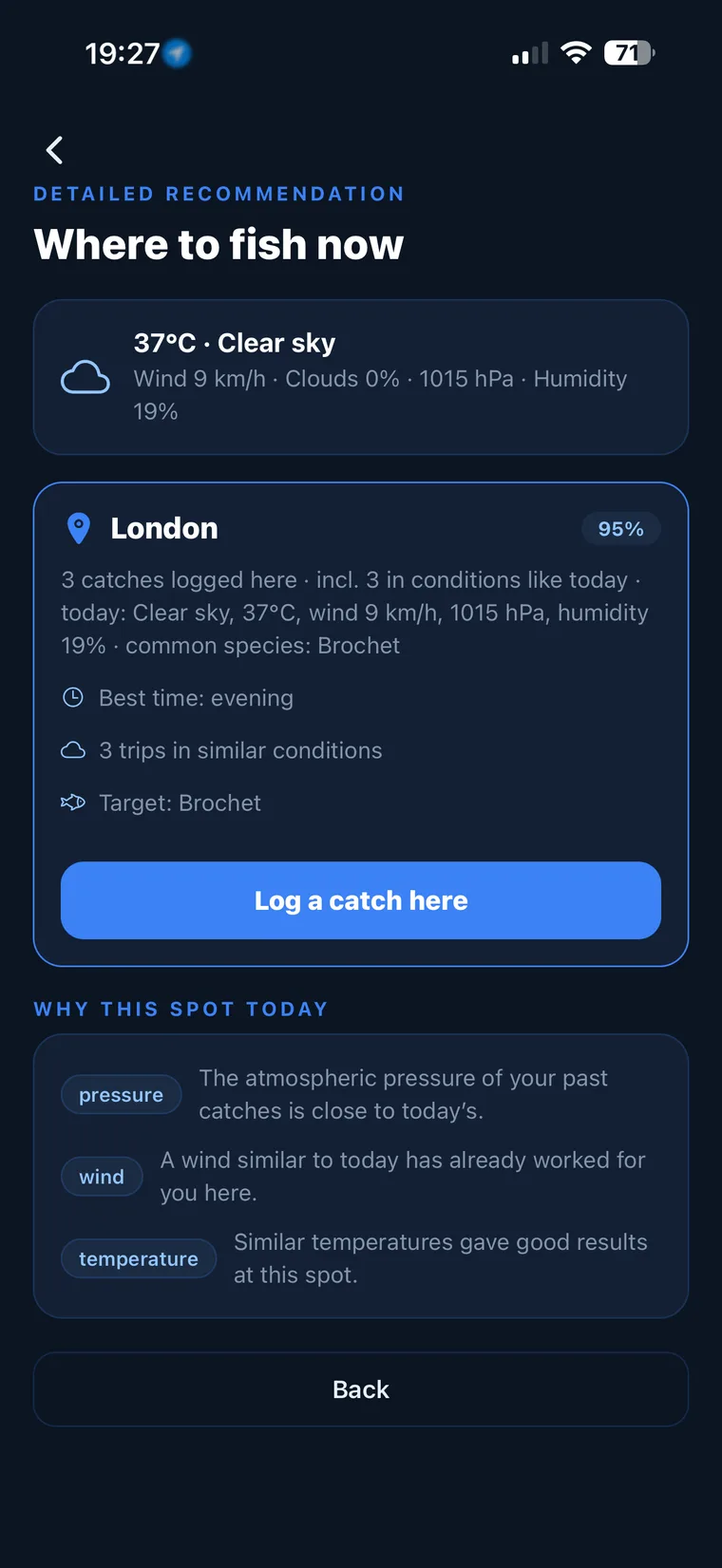
Not sure what to tie on?
Photograph your spot: CarnaFish reads the scene, cross-checks the conditions and gives you the zone, the lure and the retrieve. Free on iOS and Android.
The rig: the part many people rush
A 30 g weighted spinner generates considerable torque. A decent rolling swivel is mandatory, and it needs replacing as soon as it starts grating.
Count on a 2.40 m rod rated 20-60 g, 0.20 to 0.30 mm braid, and a wire or titanium leader wherever pike are present: the Lusox is fished exactly where they sit, and the take is often swallowed. For pure zander work, 0.45 to 0.50 mm fluorocarbon is enough.
Lusox or Giant Killer: two Mepps pike spinners, two jobs
This is the commonest confusion in the range, and it deserves settling.
The Mepps Giant Killer is a mid-water searching spinner: big blade, solid brass body, bulky bucktail, sustained straight retrieve. You cover distance and call an active fish in the first two or three metres.
The Lusox is a bottom spinner, slow, vertical in its movements, going to find a fish that is settled and barely moving. It is not trying to call from a distance, it is trying to pass under the nose.
In practice: Giant Killer in summer and early autumn on hunting fish, Lusox in cold water on fish glued to the bottom. The Mepps Comet fills the gap, in moving water and at mid-depth. Our guide to choosing a pike lure puts those three families back in context. And if you are unsure which shaft weight to fit when you reach the bank, CarnaFish analyses a photo of the spot and answers.
Key takeaways
- The lead sits up front on an interchangeable shaft: one lure covers 1 to 6 m.
- The three-faced blade keeps turning at speeds where a round blade stalls.
- Sawtooth retrieve of roughly a metre in amplitude, bottom contact depending on depth.
- The bite comes during the fall: keep light contact, never a slack line.
- Unsuited to weed beds, fast searching and very clear water.
FAQ
What is the Lusox weighted shaft for?
It shifts the weight ahead of the blade and can be swapped at will. You adjust fishing depth by changing the lead rather than the lure, and the rig dives head first on every stop, which triggers inactive pike.
How do you work a Lusox?
In a sawtooth: a slow rod lift from 9 to 11 o'clock, then a controlled drop while picking up slack, and a pause on bottom contact. Roughly a metre of amplitude for pike, fifty centimetres for zander.
What depth can it reach?
One to six metres depending on the shaft fitted and the sink time you allow. That is exactly the point of the system: the same blade works over a two-metre flat and in a five-metre hole, provided you change the weight.
Do you need a wire leader?
Yes, wherever pike are present, which is the case on almost every spot this lure is used on. The take is often deep and fluorocarbon, even at 0.50 mm, does not survive a set of teeth on a swallowed bite.
What is the difference with the Mepps Giant Killer?
The Giant Killer is a mid-water searching spinner, fished on a straight retrieve, for active fish. The Lusox is a bottom spinner, slow and vertical, for settled fish. They do not cover the same season or the same water layer.
Does it catch zander?
Yes, provided you slow down further and cut the amplitude to around fifty centimetres, with bottom contact on every cycle. Zander escort the lure more than they attack it: the bite often reads as a simple halt in the fall.
The full pike lure guideSeason-by-season strategy: which family of lure, when, and why.Go from theory to fish
CarnaFish reads your spot from a photo and gives you the game plan: zone, lure, retrieve. Free on iOS and Android.