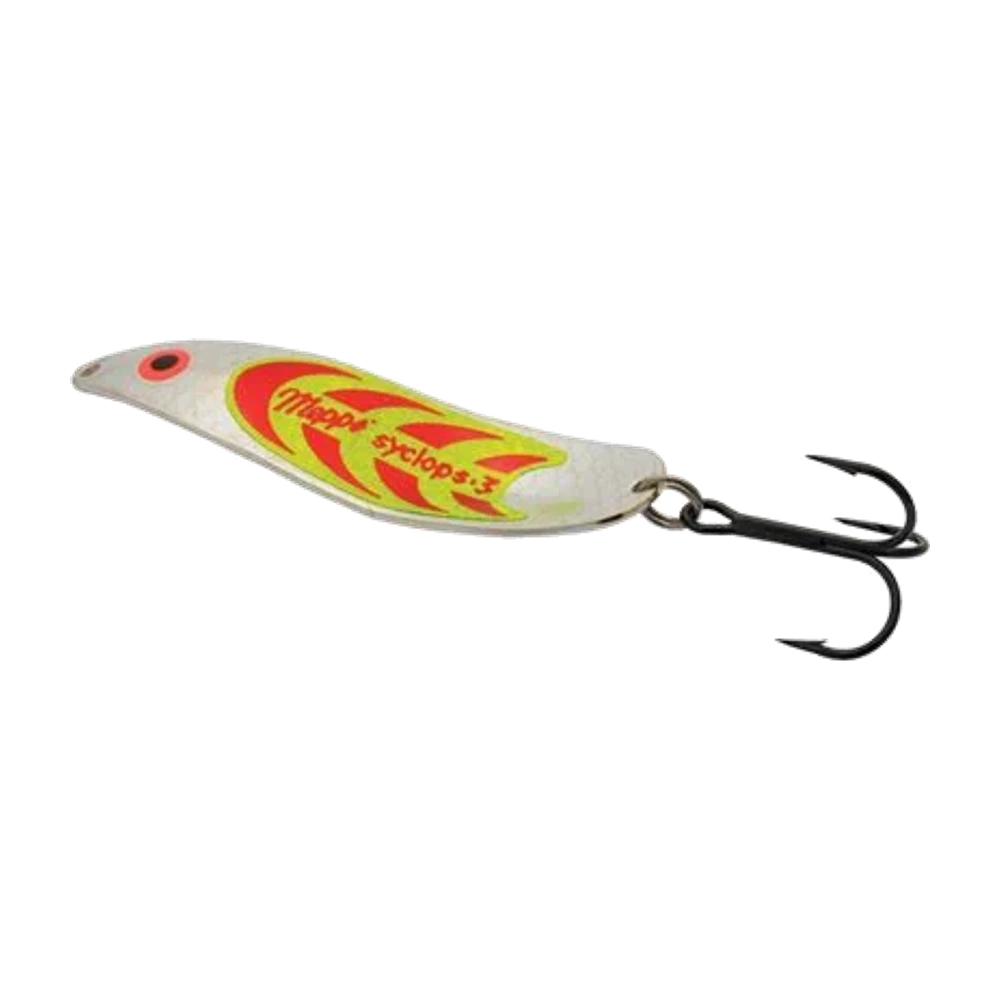
Mepps Syclops: the spoon that doesn't twist your line
One lure, endless conditions. CarnaFish reads your spot from a photo so you are not just guessing.
The spoon is the oldest artificial lure still in use, and the most badly fished. The standard complaint — "it twists the line" — is not a curse on the whole family: it is a design fault on poorly balanced models, and a speed error on the rest.
The Syclops was drawn to eliminate that problem. Its asymmetric shape and offset centre of gravity let it wobble hard without ever breaking into rotation, even at high speed.
Spoon or inline spinner: two different signals
The confusion is common, even though the two families do not do the same job.
An inline spinner like the Aglia has a blade turning around a shaft. It produces a continuous, steady vibration at a constant frequency. It excels in rivers and on active fish.
A spoon is simply a metal plate rocking from one edge to the other. It produces a powerful, alternating flash, a slower and more irregular vibration, and above all it sinks: it fishes the whole water column, which an inline spinner does not.
On pike, the spoon almost always takes the lead: the wide, slow flash matches the way that predator picks out its prey.
The three retrieves
The straight wind. Cast, let it sink a few seconds, retrieve at a constant speed. That is the baseline. Set the speed at the minimum that keeps the wobble alive: too slow and the spoon drags without working; too fast and it planes and rises.
The drop-back. This is the retrieve that makes the difference on pike. Wind normally, then stop everything for two seconds. The spoon flutters down, spinning on itself with a disordered flash. Start again. A large share of the bites come exactly as you restart the retrieve.
The river swing. Cast up and across, let the spoon swing down while keeping just enough contact. It works on its own in the flow. Very effective on trout in medium to strong water.
On the water: if your line still twists, it is almost never the spoon. Either you are retrieving too fast, or you are missing a quality swivel at the top of the leader. Add one before you change lure.
Choosing the weight
| Context | Weight |
|---|---|
| Trout stream, shallow | 5 to 8 g |
| Medium river, 1 to 2 m | 10 to 12 g |
| Lake, searching 2 to 4 m | 15 to 20 g |
| Big lake, deep or windy | 25 to 30 g |
Weight determines both casting distance and sink rate. On a lake, a slightly heavy model you can slow down beats a light one that rises the moment you turn the handle.
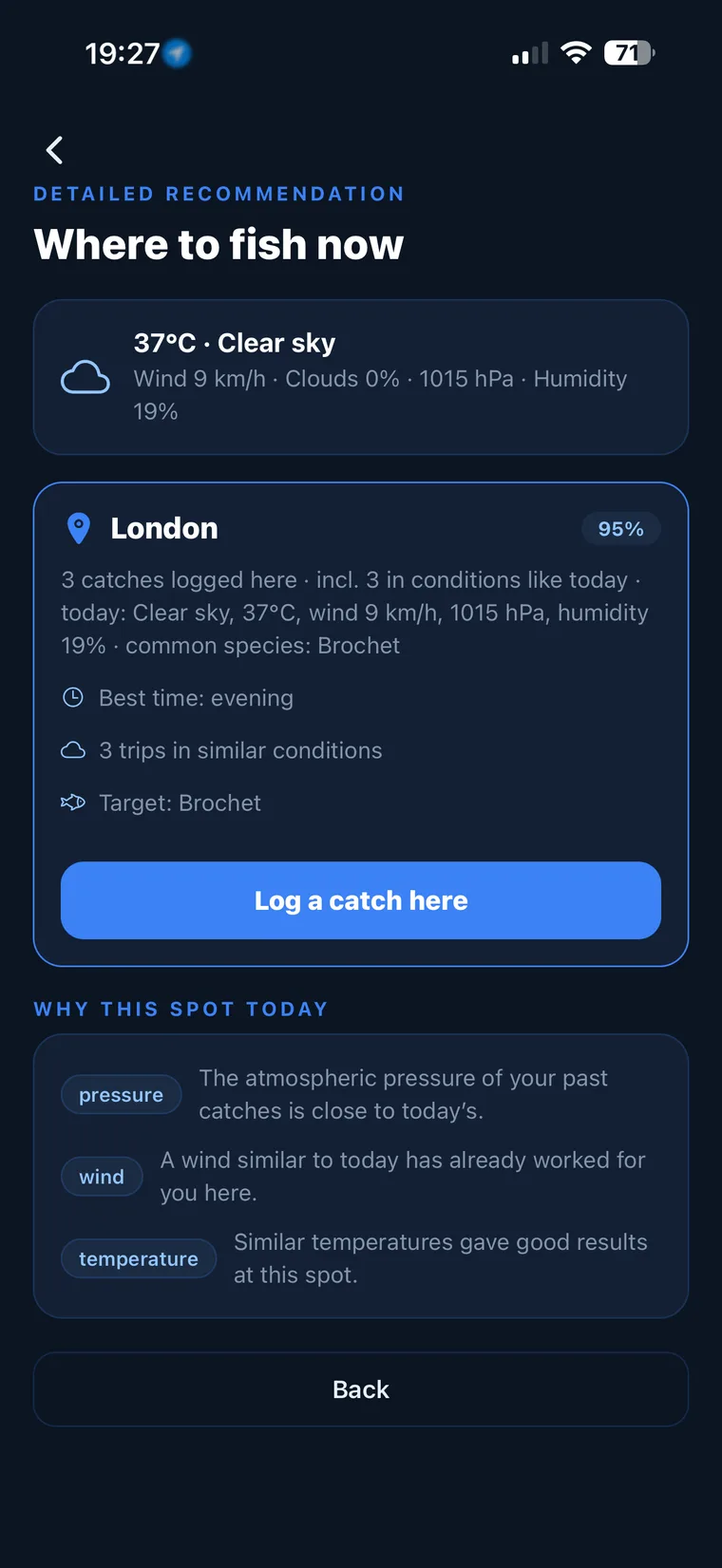
Not sure what to tie on?
Photograph your spot: CarnaFish reads the scene, cross-checks the conditions and gives you the zone, the lure and the retrieve. Free on iOS and Android.
Colours, kept simple
Three finishes cover almost every situation:
- Silver in clear water and bright light. It is the sharpest flash.
- Gold in stained water or under cloud. Warm light shows up better in loaded water.
- Copper in very dark water, at the end of the day or over peaty bottoms. A quieter signal with more contrast against a dark background.
Painted versions have their place in heavily coloured water, but bare metal stays more consistent across a whole season.
The rig, not to be neglected
Two items matter more than everything else.
The swivel at the top of the leader. Even on a spoon that does not twist, it clears the residual twist built up over hundreds of casts. Three euros that save a spool of braid.
The leader for pike. A spoon gets swallowed deeply, far more than a lure carrying several trebles. Fluorocarbon of 0.50 mm minimum, or better, 25 cm of titanium. Plenty of spoon break-offs come from an undersized leader.
Our guide to choosing a pike lure places the spoon among the other families. And if you are torn between an inline spinner and a spoon on a given spot, CarnaFish analyses a photo and answers.
Key takeaways
- Asymmetric shape and offset balance: it wobbles hard without breaking into rotation.
- A spoon sinks and fishes the whole column, unlike an inline spinner.
- The two-second drop-back mid-retrieve triggers most of the pike bites.
- Silver in clear water, gold in stained water, copper in dark water.
- Always a swivel, and a 0.50 mm or titanium leader for pike.
FAQ
Does the Syclops twist the line?
No, its asymmetric shape prevents it under normal retrieve conditions. If twist does appear, the cause is almost always a retrieve that is too fast or a missing swivel at the top of the leader.
What is the difference between a spoon and an inline spinner?
The inline spinner has a blade turning around a shaft and produces a continuous, steady vibration; it barely sinks. The spoon rocks from edge to edge, produces a stronger alternating flash, and sinks — so it fishes the whole water column.
Which retrieve for pike?
A straight wind broken up with two-second drop-backs. During the stop, the spoon flutters down with a disordered flash; the bite very often comes as you restart the retrieve.
Which weight should I choose?
5 to 8 g in a stream, 10 to 12 g in a medium river, 15 to 20 g on a lake down to 4 m, 25 to 30 g beyond that or in wind. On a lake, favour a slightly heavy model you can slow down.
Silver or gold?
Silver in clear water and bright light, gold in stained water or under cloud. Copper completes the range for very dark water and peaty bottoms.
Do you need a wire leader for pike?
Strongly recommended. A spoon is often swallowed deeply, far more than a lure with several trebles. Fluorocarbon at 0.50 mm is a minimum, 25 cm of titanium is safer.
The full pike lure guideSeason-by-season strategy: which family of lure, when, and why.Go from theory to fish
CarnaFish reads your spot from a photo and gives you the game plan: zone, lure, retrieve. Free on iOS and Android.