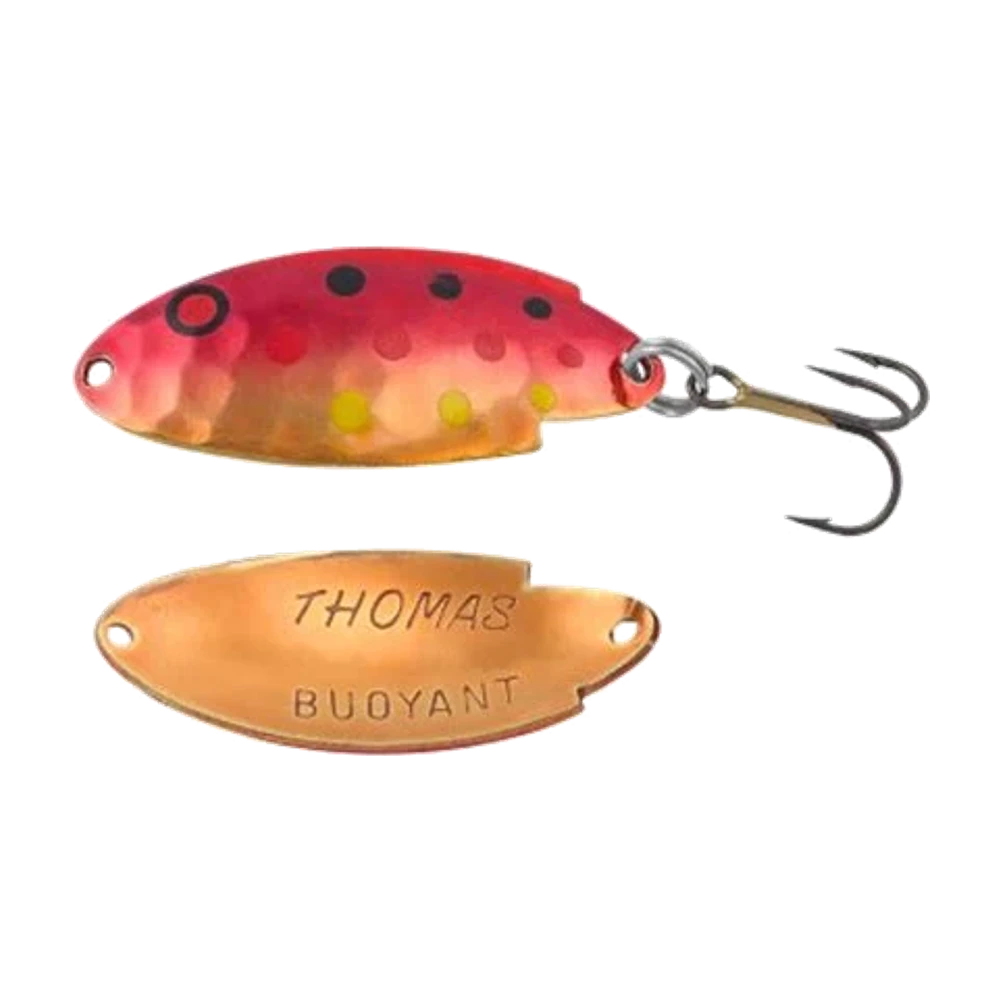
Thomas Buoyant: the spoon that fishes thirty centimetres off the bottom
Before tying this one on, it helps to know if the spot actually calls for it. CarnaFish reads the scene from a photo.
Late July, the river is low. The riffles are down to forty centimetres, you can count the pools on one hand, and every slightly dense spoon you cast ends up in the stones before it has covered three metres. You spend more time freeing it than fishing, and in the end you wind it back too fast to stay off the bottom — which means too fast to interest anything.
This is exactly the Thomas Buoyant's ground. Its name says what it does: for the same volume, it weighs less than a classic casting spoon, so it sinks more slowly and holds its layer of water with minimal pull. Where a dense spoon forces you to choose between snagging and fishing too fast, this one leaves you a usable range.
It is not a long-casting spoon, nor a deep one. It is a spoon for low rivers and margins, and it is deadly in that precise role.
Weight to volume, the only number that matters on a spoon
On a spoon, two parameters decide everything: the surface that grips the water and the mass that drags it down. The ratio between the two determines sink rate, minimum working speed and running depth.
A thick, compact spoon has high mass for little surface: it sinks fast, casts far, and demands a quick retrieve to avoid scraping bottom. The Buoyant is built the other way round — relatively thin metal in a generous outline, so plenty of surface for very little mass.
The practical consequences are direct:
- The sink rate is low. Over a metre-deep riffle, you have time to start winding before the spoon touches down.
- The minimum working speed is low. The wobble starts almost as soon as the line comes tight, which allows a very slow retrieve without the lure flattening out.
- The spoon planes. As soon as you lift the rod slightly, it climbs in the water column instead of continuing to sink.
In exchange, it catches the wind on the cast and gets carried away by strong current. Those are the two limits to accept from the outset.
The wobble: fast and tight, not wide
Not every casting spoon beats at the same rhythm. A long, deeply cupped spoon gives a wide, slow roll with dead spots in it. The Buoyant does something else: its moderate curve and compact outline give a fast, tight beat, closer to a shiver than to a big roll.
That detail has consequences for the species you target. A wide roll sends out a low-frequency signal that carries far and suits big predators. A tight beat produces a high-frequency flash, very visible at short range, which matches what a trout intercepts in current: something small, fast, cutting across.
It is also why the Buoyant does not need to be worked. Adding twitches usually breaks its rhythm rather than improving it.
The retrieve: it is the angle, not the handle
On a light spoon in a river, retrieve speed is only one of the two settings. The other, more important one, is the angle you give your line relative to the current.
- Cast across or slightly upstream, never straight downstream.
- Tighten the line immediately, before you even start winding. The spoon has to be under tension as it sinks, otherwise it falls flat and snags.
- Let the current do half the work. Your handle mostly keeps contact; it is the flow that puts pressure on the metal.
- Control the depth with the rod tip. Rod high, the spoon rises. Rod low, it drops. You correct continuously, spot by spot.
- Slow down at the end of the swing, as the spoon comes back into line under your bank. That is when it moves slowest and when plenty of bites arrive.
So the most useful adjustment is not "faster or slower", it is "more upstream or more downstream". A cast further upstream takes you deeper; a cast further downstream brings you up.
On the water: in a low river, do not try to fish the bottom. Aim for a pass twenty or thirty centimetres above the stones. A trout holding behind a rock will happily rise to a lure passing over it, but it almost never drops down to look for something crawling below its level.
Which weight for which spot
| Setup | Indicative weight | How to work it |
|---|---|---|
| Brook, under 40 cm of water | 2 to 3 g | Short cast, rod high, almost continuous retrieve |
| River riffle, 40 cm to 1 m | 3.5 to 5 g | Cast across, controlled swing, rod at half height |
| Pushy current or a 1.5 m pool | 6 to 9 g | Cast upstream, let it sink 1 to 2 seconds before tightening |
| Headwind on stillwater | 6 to 9 g | A firmer retrieve to keep the wobble going |
Two rigging points that change the outcome. A rolling swivel is mandatory: a casting spoon always ends up putting some twist into the line, and without a swivel you will ruin your line in one session. And stay fine on the nylon, 0.16 to 0.22 mm depending on spoon size — heavy line slows the descent, which sounds good on paper, but it also drags in the current and loses you contact.
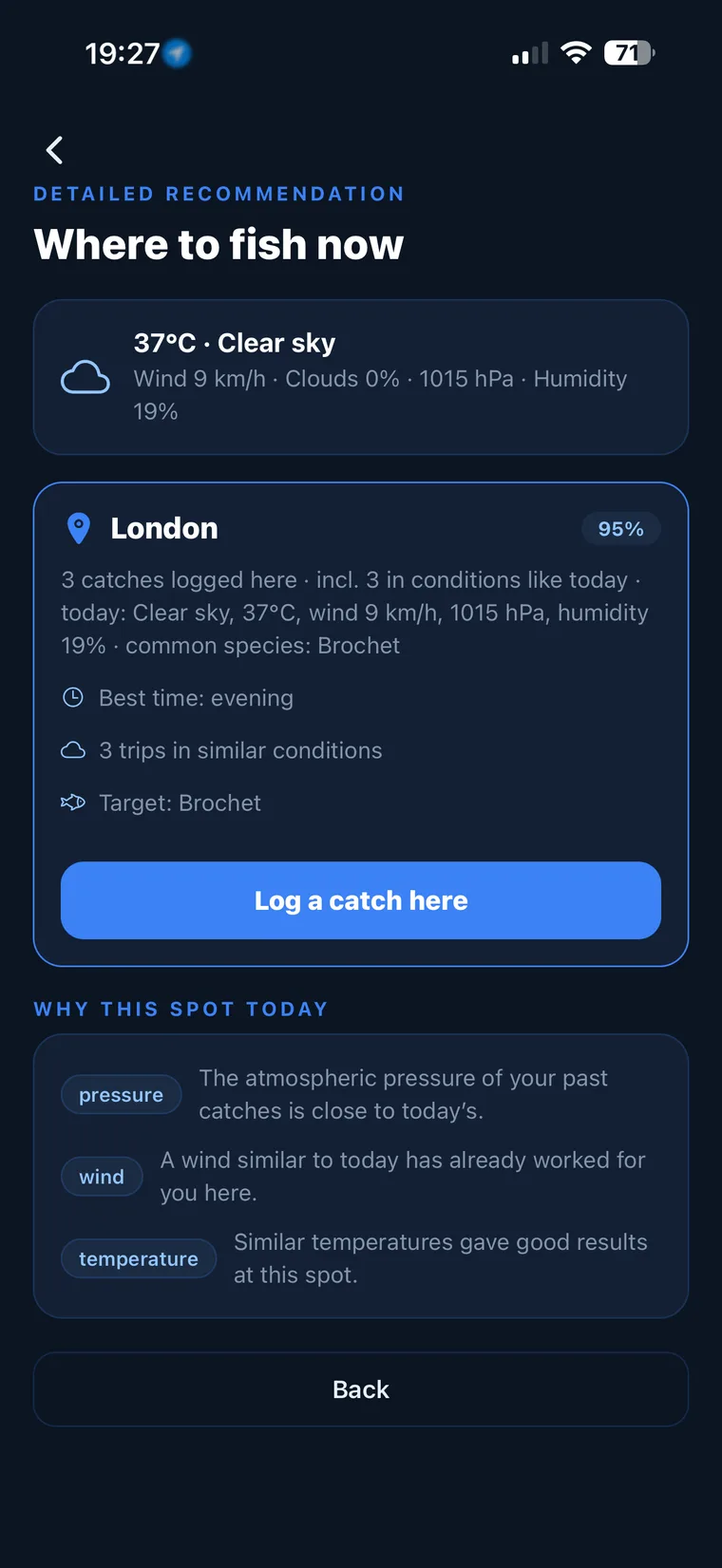
Not sure what to tie on?
Photograph your spot: CarnaFish reads the scene, cross-checks the conditions and gives you the zone, the lure and the retrieve. Free on iOS and Android.
Where it is the wrong choice
You have to be honest about its range. The Buoyant is unsuited the moment you need to:
- Cast far, on a big stillwater or off a beach. Being light for its volume penalises it heavily.
- Fish deep, beyond two metres. It planes too much to go down efficiently, and you will spend your time waiting.
- Cut across powerful current. In a fast run it turns side-on and rises to the surface.
- Fish in a strong headwind. Casting becomes imprecise, which is fatal on tight spots.
In those four cases, a dense casting spoon does everything better.
Buoyant, Little Cleo or Toby: three geometries, three uses
The difference between casting spoons is not about the brand but about the shape of the metal.
The Acme Little Cleo is channelled into a gutter along its whole length. That concavity steadies it in strong current and stops it spinning where a flat spoon would blow out. It is the right choice on a fast river or a dam outflow — precisely where the Buoyant cannot hold.
The Abu Garcia Toby plays a different game: long, narrow and dense, it sinks fast and casts a very long way. It takes the lead whenever you need to reach a distant spot or drop quickly into a pool, but it scrapes the bottom in a low river.
The Buoyant slots in between the two, in a window neither of them covers well: low water, moderate current, slow retrieves, spots within casting range. Our guide to river trout fishing works through that division spot by spot. And if you are unsure which weight to tie on in front of a riffle, CarnaFish analyses a photo of the spot and answers.
Key takeaways
- Plenty of surface for little mass: slow sink, works at very low speed, tends to plane.
- Depth is set with the casting angle and rod height, not with the speed of the handle.
- Aim for a pass 20 to 30 cm above the bottom, not the bottom itself.
- Always a rolling swivel, and fine nylon of 0.16 to 0.22 mm.
- The wrong choice as soon as you need to cast far, go deep or cut across powerful current.
FAQ
Why is the Thomas Buoyant called that?
The name refers to its behaviour in the water: for its volume it is light, so it sinks slowly and rises easily as soon as you lift the rod. It is not a floating spoon, but a spoon that planes.
Which weight should I choose for river trout?
Between 3.5 and 5 g for a standard riffle of 40 cm to 1 m, 2 to 3 g on a very low brook, and 6 to 9 g as soon as the current pushes or you need to get down into a pool.
Do I need a swivel with this spoon?
Yes, always. Like any casting spoon, it puts a slight twist into the line over time. Without a rolling swivel your nylon kinks and breaks prematurely on the hookset.
How do I avoid snagging the bottom in low water?
Tighten the line as soon as the spoon touches down, cast across rather than downstream, and lift the rod to make it plane. The goal is a pass slightly above the stones, not in contact with them.
What colour in a river coloured after rain?
Gold or copper, which keep a visible signal in stained water. In clear, bright water, silver or a classic red-and-white gives a more discreet flash, better suited to trout that have already been fished for.
Can it be fished on a stillwater?
Yes, but along the margins and in calm weather. With no current to supply the pressure, you have to make up for it on the handle, and its low weight limits casting distance the moment there is any wind.
The full trout lure guideSeason-by-season strategy: which family of lure, when, and why.Go from theory to fish
CarnaFish reads your spot from a photo and gives you the game plan: zone, lure, retrieve. Free on iOS and Android.