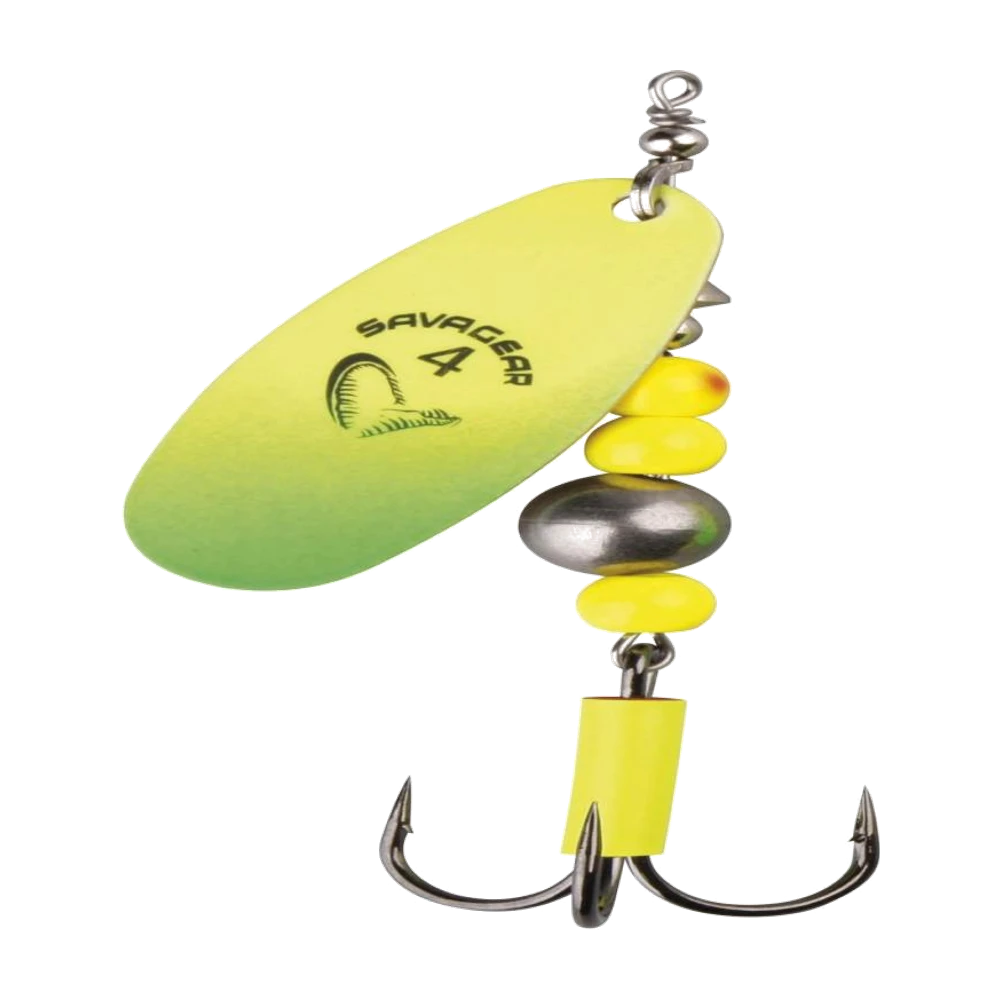
Savage Gear Caviar Spinner: the compact spinner that won't twist your line
The right lure in the wrong spot still catches nothing. CarnaFish spots the zone that works, from a single photo.
The most mundane problem in spinner fishing has nothing to do with the fish: it's the line twisting after ten casts, forcing you to stop and untangle it. Savage Gear built the entire case for the Caviar Spinner around that one technical detail, by embedding a tungsten ball directly into the lure's body.
The detail that changes things: an off-centre tungsten ball
On a classic inline spinner, the body mostly serves as casting weight; the "anti-twist" function relies almost entirely on the swivel tied at the line end. The Caviar Spinner flips that logic: a tungsten ball sits inside the body, positioned slightly off the rotation axis. That offset mass counteracts part of the rotational torque transferred to the line, resulting in noticeably less line twist by the end of a session, even on thin braid that's especially prone to it.
The second benefit of this design: a denser body in a more compact volume means better casting distance for the same weight compared with a standard inline spinner. On a big lake or a wide river, that extra density packed into a smaller body makes a real difference to range.
Three sizes and their uses
- #2 (6 g): the slimmest size, for perch in canals or small lakes, and trout in calm rivers. A subtle swim, suited to clear, shallow water.
- #3 (9.5 g): the versatile size, the one to default to when you don't yet know what size fish holds the spot. Casts comfortably even in wind.
- #4 (14 g): reserved for deep spots, long casting distances, or river fishing with strong current where extra weight is needed to hold the line.
How to work it
Rotation starts the instant it hits the water thanks to the body's concentrated mass, letting you begin the retrieve with no delay — a real edge fishing margins where every inch of swim counts. For perch, a medium retrieve with one or two short pauses works well: the compact body keeps sinking slightly during the pause without tipping off-axis, unlike some longer spinners that tip over. For river trout, a steady retrieve across the current, with light speed bursts to maintain rotation in the slower stretches, gives the best results.
A spinner that spins the instant it's pulled through the water on the retrieve doesn't have a hidden manufacturing flaw — check instead that the treble hook hasn't tangled in the blade after a snagged cast.
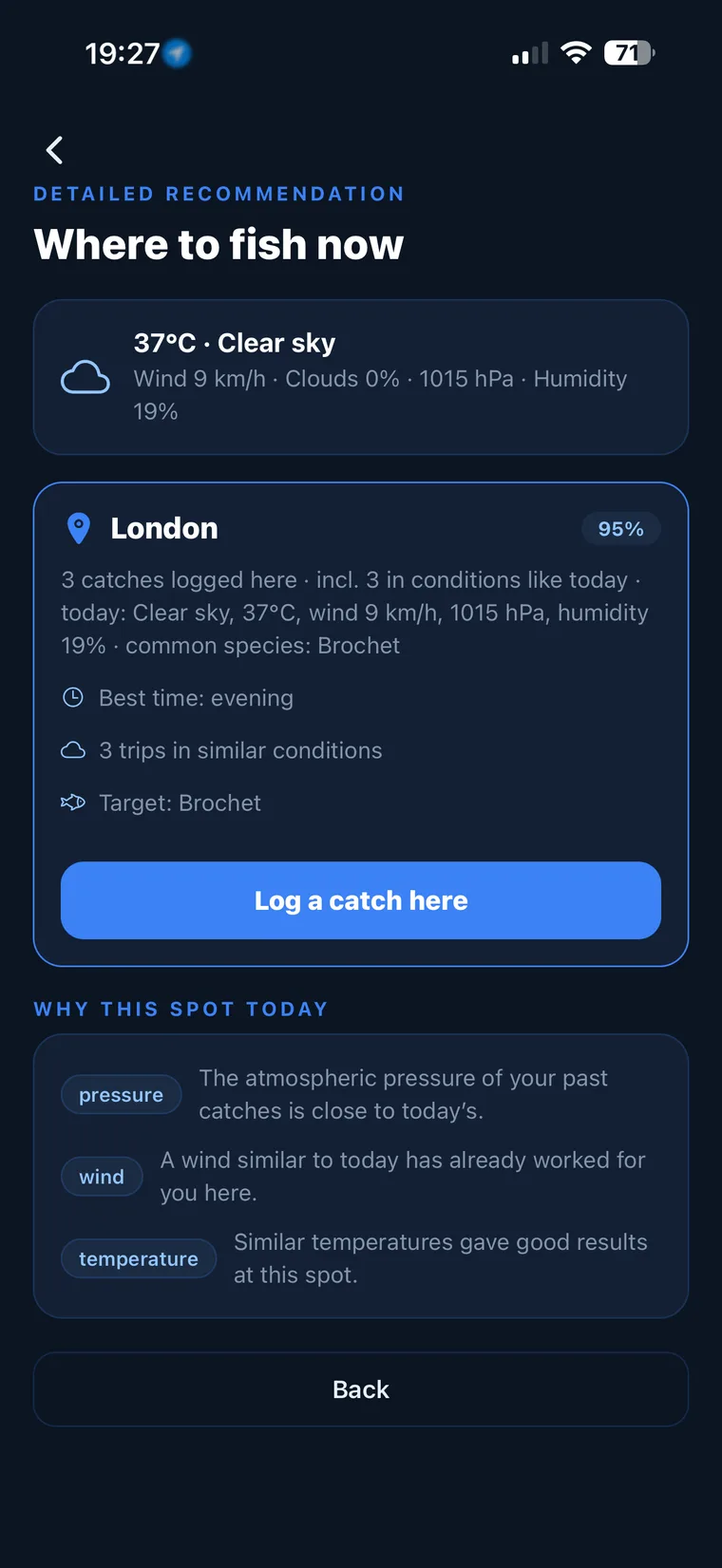
Not sure what to tie on?
Photograph your spot: CarnaFish reads the scene, cross-checks the conditions and gives you the zone, the lure and the retrieve. Free on iOS and Android.
Finishes and colour choice
The Caviar Spinner comes mostly in classic copper and silver finishes, built for clear water where the metal's natural reflection is enough to draw attention. In more stained water, higher-contrast versions (darker back, colour accents) keep good visibility without sacrificing rotation quality — a point where some cheaper spinners lose consistency once the blade is repainted.
Up against older market staples
Compared with a Mepps Aglia, the Caviar Spinner relies less on blade amplitude and more on consistency and casting distance. It's not a direct replacement: on a very wary trout in low water, the Aglia and its wide flash can still have the edge. The Caviar Spinner finds its niche when you need to cover distance fast, or when line twist becomes a genuine practical problem over a long session.
Picking the right spinner for the spot and the day's conditions is exactly what CarnaFish helps with: one photo is enough for the AI to read the scene and point you to the right lure type and the zone to fish. To go further on perch beyond spinners, our guide to lure fishing for perch pairs well with this one.
The technical takeaway
- Built-in tungsten ball: less line twist and increased casting distance.
- #2 (6 g) for finesse, #3 (9.5 g) as the all-rounder, #4 (14 g) for depth or strong current.
- Instant rotation on contact with the water, useful fishing margins.
- Classic finishes in clear water, higher-contrast ones in stained water.
FAQ
Does the Savage Gear Caviar Spinner really prevent line twist?
It reduces it noticeably thanks to the tungsten ball built into the body, but doesn't eliminate it entirely on very long sessions. A quality ball-bearing swivel as a backup is still a good precaution.
What Caviar Spinner size should I prioritise?
The #3 (9.5 g) is the most versatile size, suited to both perch and trout in most situations. Save the #2 for very clear, shallow spots, and the #4 for deep spots or long casting distances.
Does this spinner work as well as a Mepps Aglia for trout?
It works differently rather than worse: the Aglia relies on a wider flash, the Caviar Spinner on rotational consistency and casting distance. On a very wary trout in low water, the Aglia often still has the edge.
Can you fish perch in a lake with the Caviar Spinner?
Yes, that's one of its strongest uses, especially with the #2 or #3 on a medium retrieve with short pauses.
Why isn't my Caviar Spinner rotating properly?
Check first that the treble hook hasn't tangled in the blade after a cast into cover. That's by far the most common cause of irregular rotation on this type of spinner.
Is the Caviar Spinner good for long-distance casting?
Yes, that's one of its strengths: the compact, dense body casts further than a standard inline spinner of equal weight, a real advantage on big lakes.
The full perch lure guideSeason-by-season strategy: which family of lure, when, and why.Go from theory to fish
CarnaFish reads your spot from a photo and gives you the game plan: zone, lure, retrieve. Free on iOS and Android.