Picasso Hog Snatcher Buzzbait: the blade that clacks, or just whispers
Not sure this lure fits YOUR spot today? CarnaFish tells you in 10 seconds, from a photo.
Half past six in July, a lake edge carpeted with lily pads and a surface barely rippled. You have not seen a fish yet, but you know they are tucked under the leaves and that they will not stay active for three hours. A buzzbait is the tool that lets you ask two hundred metres of bank the same question in twenty minutes. What makes the Hog Snatcher different is that it lets you choose the tone of voice.
A keeled head that lifts on its own
Picasso describes the Hog Snatcher head as a keeled planer head, built to bring the bait to the surface instantly while tracking straight. That is exactly what separates a usable buzzbait from an annoying one. A buzzbait that only planes above a certain speed dictates your rhythm and forbids you from slowing down over a precise spot. With a head that lifts from the off, you keep control of the speed, and in calm water it is usually the slowest speed that draws the strike.
The keel does a second job: it stops the bait rolling onto its side when you speed up or swing it across current. A buzzbait that rolls tracks off line and comes back two metres from where you aimed. On a pad edge you want to shave without entering, that stability matters as much as the noise.
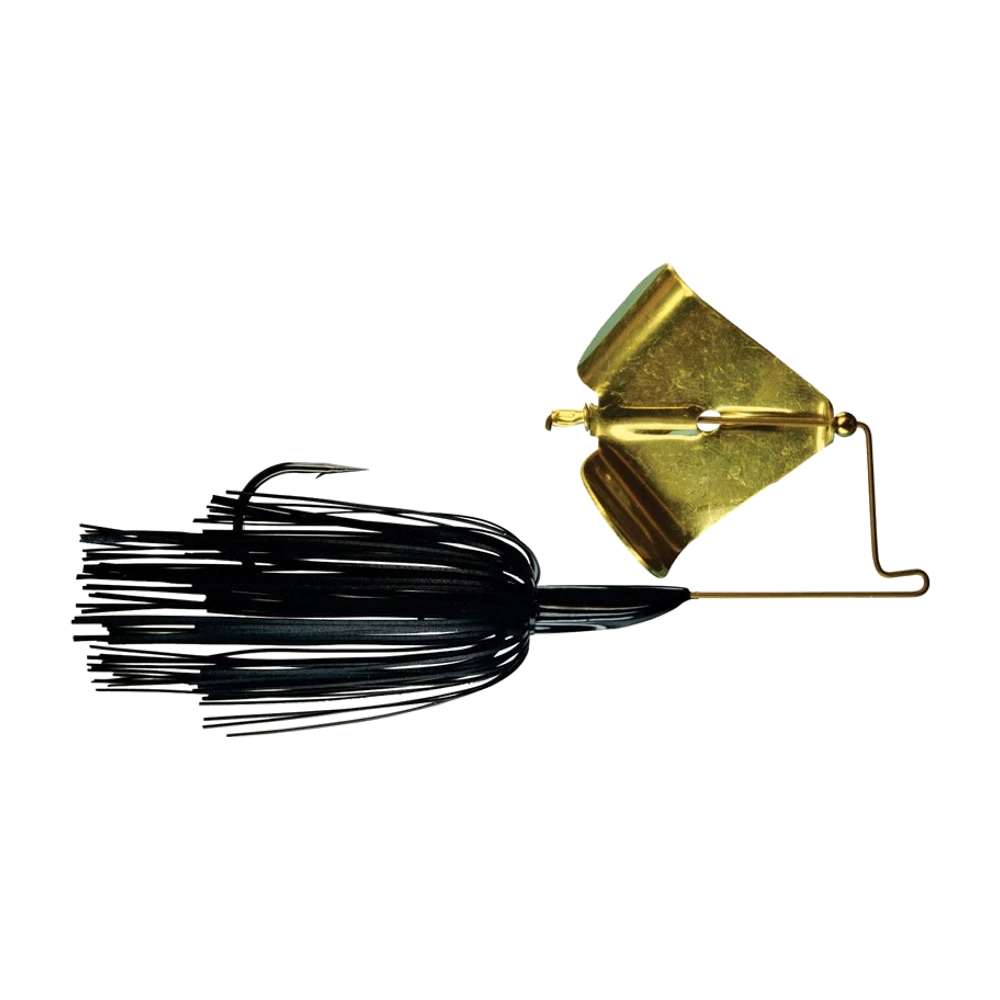
In the product photo the head is completely hidden by the skirt. What you can see is the black skirt, the gold two-winged buzz blade, the contact bead and the gold wire arm with its squared bend. That is an observation from a product photo, not a specification.
Clack or churn, one tweak and two baits
The real argument for the Hog Snatcher lies elsewhere. Out of the packet, the rotating blade is set to strike the head on every rotation, which produces a sharp, repeated, very audible clack that Picasso presents as a trigger for violent strikes. The upper wire arm can instead be bent clear so that blade and head never touch. All that is left is the churn of the blade working the surface, a far quieter sound the maker links to fish feeding on top. That reading is the manufacturer's claim, not an acoustic measurement.
What you can check on the water is that the two settings are not interchangeable. The clack carries a long way and earns its place in wind, chop or stained water, where the fish has to locate the lure before it can see it. The quiet setting comes into its own in clear, calm water, or right after a missed strike in the same spot: coming back silent over a fish that has just swiped and missed often buys a second chance.
Making the tweak without wrecking the bait
The adjustment is nothing more than the angle of the upper arm, the one carrying the blade, relative to the head. A very slight lift is enough to kill the contact, so there is no need to force anything. Test it at your feet, at the speed you intend to fish, and listen. Two precautions: do not bend the arm so far that the blade stops spinning cleanly, and check the setting after every fish and every trip through a branch. A tweaked wire changes both the sound and the tracking, and you can fish a quarter of an hour with a bait running sideways without noticing.
Thick wire, a big hook, and what that implies
Picasso lists a heat-treated Inviz Wire frame in .051 inch gauge, roughly 1.3 mm. For a buzzbait that is a heavy frame. The benefit works twice over: the setting you just made holds, and the bait shrugs off pad stems, branches and teeth without folding on the first serious hit. The trade-off is that thicker wire flexes less on the strike, which asks for a rod that forgives a little. If you want a softer frame, the same brand's Picasso Rusty Squeaker Buzzbait drops to .040 inch, around 1 mm.
For the hardware, the maker gives a two-column table, weight and hook size: 1/4 oz with a 5/0, 3/8 oz and 1/2 oz with a 6/0, all Mustad Ultra Point. Converted, the three versions run about 7, 10.5 and 14 g. A 6/0 on a 10 g lure is huge, and deliberately so: on a buzzbait the strike comes from above and behind, and a wide gape rescues badly framed takes. A wire keeper is fitted to hold a soft trailer. No overall length is published, and no trailer hook is listed as standard, so if you want one it is your own addition.
Start the retrieve before the lure touches down. One or two turns of the handle at the end of the cast and the buzzbait planes the instant it lands, with none of the dead second in which it sinks and picks up a strand of weed. On a cast tucked against a laydown, that second is the difference between an immediate strike and a lure you have to pick out of the branches.
Not sure what to tie on?
Photograph your spot: CarnaFish reads the scene, cross-checks the conditions and gives you the zone, the lure and the retrieve. Free on iOS and Android.
Where and when it really works
A buzzbait is a window lure. Warm water, from late spring to autumn, and above all the low-light slots: dawn, dusk, night, overcast skies, shaded banks. It still works in broad daylight when wind ruffles the surface, far less in clear water under a flat calm and full sun.
The spots are those of every skirted topwater: lily and reed edges, laydowns, submerged weed a few dozen centimetres under the surface, rocky points taking the wind. Cast past the target and run the lure along the structure rather than dropping it on top. Keep the rod tip high as the retrieve starts and lower it as the bait gets closer, so the blade stays up without having to speed up.
The classic mistake
Striking at the noise. You hear the blow-up, you see the boil, and the reflex is to pull: nine times out of ten you rip the lure away before the fish has properly taken it. The rule is to keep reeling at the same pace until you feel the weight in the rod, and only then set. A slightly progressive tip helps hold that beat; a very fast rod makes it nearly impossible.
In Europe, pike regularly turn up on this kind of lure in summer over weed. If the spot holds them, a steel or heavy fluorocarbon leader is compulsory: the thick frame of the lure is no substitute for a leader.
Colours by light level
- Low light, dark water, night fishing: black skirt and gold blade, the combination in the photo. The silhouette reads from below against the sky.
- Clear water with silver baitfish: silver white with a nickel blade, consistent with what the fish is actually eating.
- Stained water, after rain: chartreuse and white, the classic compromise when visibility drops.
A perfectly tuned buzzbait is worth nothing on an empty bank. That is what CarnaFish saves you: one photo of the spot, and the AI suggests the zone, the depth and the lure type that suit the day's conditions. For the rest of the method, our guide to getting started with bass fishing covers the spots and the lure families worth knowing.
What to remember
- The blade can be set to hit the head (sharp clack) or to miss it (plain churn): two baits in one, picked by water clarity and fishing pressure.
- The keeled head planes immediately, which lets you retrieve slowly instead of being forced into a minimum speed.
- A .051 inch frame, around 1.3 mm, with Mustad 5/0 or 6/0 hooks by weight: heavy wire that holds its tune but flexes little.
- Never strike at the noise, strike at the weight. It is the first cause of missed buzzbait takes.
FAQ
Should the blade hit the head or be set clear of it?
Both have their place. Contact gives a sharp clack that carries, useful in wind, chop or stained water. Set clear, only the churn remains, which suits clear calm water and pressured fish far better.
Which weight should I pick between 1/4, 3/8 and 1/2 oz?
The 3/8 oz, about 10.5 g, is the most versatile and still casts well into wind. The 1/4 oz, about 7 g, lets you crawl the bait on small waters. The 1/2 oz, about 14 g, is for reaching a distant bank.
Why do I miss so many buzzbait strikes?
Because you are striking at the noise. Keep reeling at the same pace until you feel the fish's weight, then set. A rod with a slightly progressive tip helps a lot; a very fast rod tears the lure free before the take.
Can I add a soft plastic trailer?
Yes, the bait comes with a wire keeper made to hold a soft trailer in place. A trailer adds bulk, slows the bait slightly and lengthens the silhouette, which helps when fish are hitting short.
Does the Hog Snatcher catch pike?
In Europe, yes, it is a common summer catch over weed beds. Fit a steel or heavy fluorocarbon leader if the spot holds them: the lure's frame, thick as it is, does not protect your line.
How is it different from a spinnerbait?
A buzzbait works purely on the surface and makes noise by churning air and water; something like the Picasso Titanium HP Double Willow Spinnerbaits swims under the surface and trades on flash and vibration. The buzzbait covers a bank fast, the spinnerbait covers the water column beneath it.
The full bass lure guideSeason-by-season strategy: which family of lure, when, and why.Go from theory to fish
CarnaFish reads your spot from a photo and gives you the game plan: zone, lure, retrieve. Free on iOS and Android.