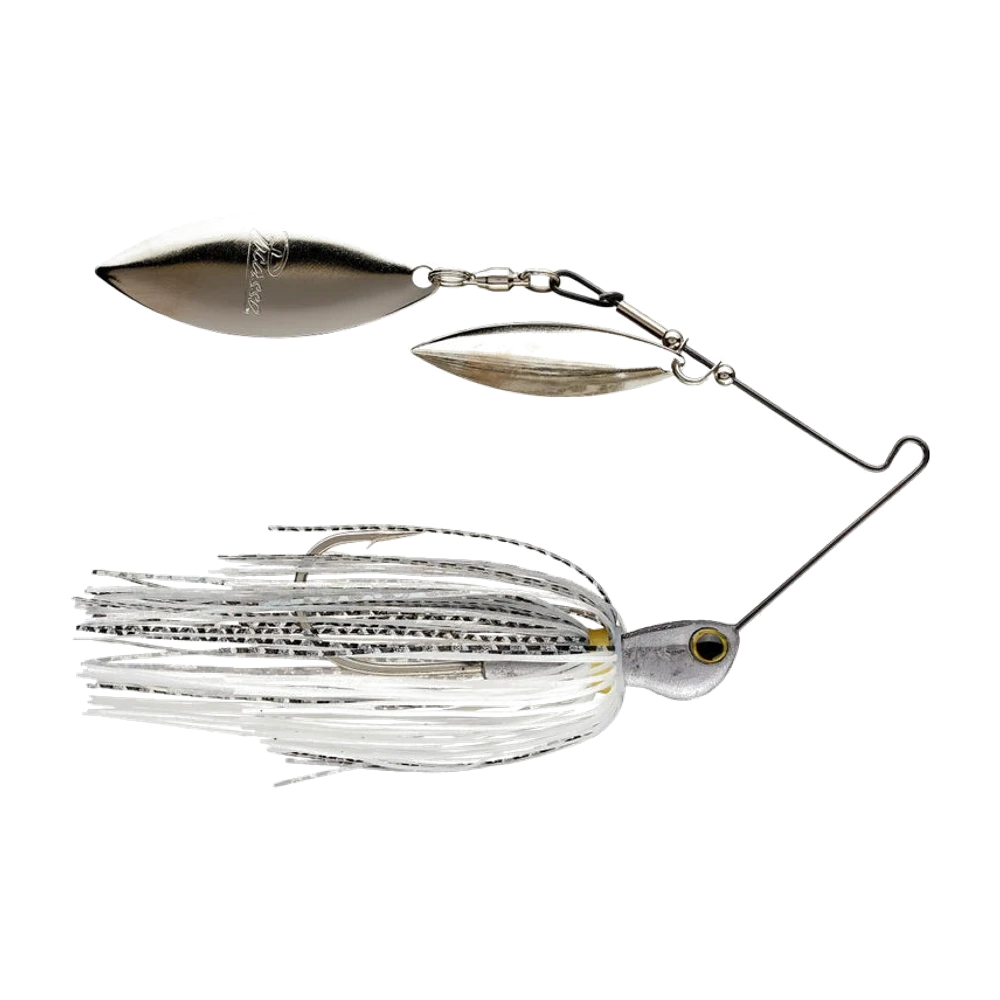
Picasso Titanium HP Double Willow: the titanium frame that flexes on the strike
Before tying this one on, it helps to know if the spot actually calls for it. CarnaFish reads the scene from a photo.
Everyone has had a spinnerbait fold up after three pike: the upper arm creeps towards the hook, the blades brush the skirt, and the bait no longer tracks straight. Picasso attacks the problem through the material and builds this model on a titanium frame. Titanium springs back to its shape where ordinary steel keeps the bend, and that is the whole point of the HP version.
What titanium actually changes
The description lists a titanium wire frame over a traditional wire known for its durability, the combination intended to extend the bait's working life. The titanium wire diameter is given as .040 inch, about 1 mm. Picasso adds that the frame flexes on the strike to improve the hook-up ratio, which is the manufacturer's claim rather than an independent measurement, but the reasoning holds: an arm that gives under pressure lets the hook travel back instead of levering against the fish's jaw.
Titanium's other effect, the one you notice on any lure built this way, is shape memory. A steel spinnerbait a pike has chewed stays bent and has to be straightened by hand, usually by eye. A titanium frame returns to its own geometry and keeps its original tune, which matters a great deal on a bait whose tracking depends entirely on the angle between the two arms.
Two willow blades, and a precise grid
The maker's table pairs weight with blade sizes, and the three versions are not simple scalings of each other. In 3/8 oz, about 10.5 g, the blades are a 3.5 at the front and a 4.5 at the rear. In 1/2 oz, about 14 g, you move to a 4 front and a 5 rear. In 3/4 oz, about 21 g, the front stays a 4 and only the rear grows, to a 6.
That detail has a practical consequence. Going from 1/2 oz to 3/4 oz does not only buy you weight: you keep the same front blade and add a noticeably bigger rear one. The heavy model therefore generates more lift on the retrieve, which paradoxically lets it fish higher in the column than its weight suggests. It is the one to pick for slow rolling a wind-blown break, not necessarily for dropping vertically.
Willow blades are a specialist's choice. They spin fast and tight, throw a lot of flash and create little drag: the profile made for clear water and long, slim forage. If you want low-frequency vibration in coloured water, a colorado blade like the one on the Luck E Strike Redman Colorado Spinnerbait does the job better. For a comparison with another well known double willow, the Booyah Blade Double Willow Spinnerbaits works on the same flash-led logic.
Why the ball bearing swivel matters
The description specifies a ball bearing swivel, whose stated benefit is that the blade keeps spinning on the fall. This is not catalogue filler: a spinnerbait whose blades stall the moment the tension drops goes dead on the drop, and you lose half your bites, the ones that come as the bait sinks past a laydown or a vertical wall. With a swivel that turns freely, the pause and the fall become fishing phases in their own right.
The best moment to hook a big fish on a spinnerbait is the stop. Retrieve normally along a structure, and as you come level with an obstacle, kill the retrieve dead and let the bait fall for two or three seconds on a slightly tight line. The take almost always comes during that drop, and you only feel it as a weight settling on the rod.
Working it, and above all slowing it down
Picasso states the bait is built to produce maximum vibration and skirt undulation even at reduced speed. That is the real key to using it. A spinnerbait retrieved fast merely crosses the water; retrieved at the minimum speed that keeps the blades turning, it becomes a formidable search bait because it stays in the fish's field of view far longer.
Three ways to fish it. A slow straight retrieve just under the surface when fish are high: you should feel the vibration constantly in the rod, and if it disappears you are either too slow or a weed has jammed a blade. Slow rolling, where you let the bait sink close to the bottom then retrieve at exactly the speed needed to keep it off. And deliberate contact with cover, running the bait into a stump or a branch to create an abrupt change of direction, the deflection that converts followers.
The classic mistake
Adding a snap. A spinnerbait is tied straight onto the bend of the upper arm, and a snap fitted there changes the angle of pull, tips the bait onto its side and ruins the straight tracking. If you want to change lures quickly, change leaders, not the attachment. The second common mistake is ignoring the head. It is described as stationary, which means the bait's balance comes from the frame and not from a joint. If the tracking goes off, it is the arm angle you should correct, not the head.
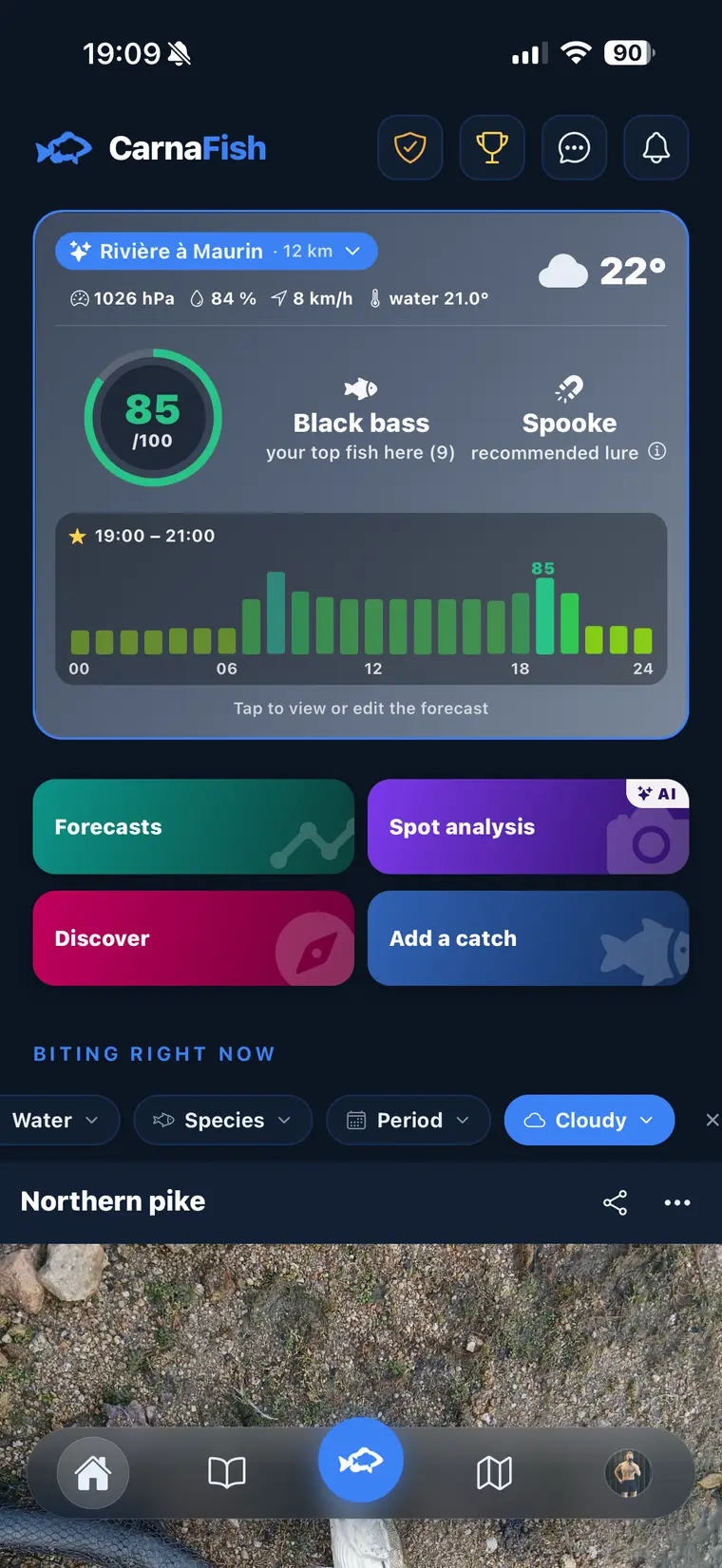
Not sure what to tie on?
Photograph your spot: CarnaFish reads the scene, cross-checks the conditions and gives you the zone, the lure and the retrieve. Free on iOS and Android.
Colours by water clarity
- Clear water, silver forage: white skirt with silver flecks and nickel blades, the combination in the photo. It is the most logical set-up for a double willow, which trades on flash rather than silhouette.
- Stained water: chartreuse and white, with at least one gold blade to keep a warm reflection when light stops getting through.
- Low light or dark water: black or dark brown, where the mass is what registers, not the colour.
The right spinnerbait on the wrong break will give you nothing. That is exactly what CarnaFish narrows down: one photo of the spot, and the AI suggests the zone, the depth and the lure type that fit the day's conditions. If you expect to meet pike with this model, our guide to choosing a pike lure places the spinnerbait among the available families.
What to remember
- A .040 inch titanium frame, about 1 mm, claimed to flex on the strike and to spring back to shape after a fish.
- Three weights, three blade pairings: 3.5/4.5 in 3/8 oz, 4/5 in 1/2 oz, 4/6 in 3/4 oz — only the rear blade grows on the heavy model.
- The ball bearing swivel keeps the blades turning on the drop, so the pause becomes a fishing phase.
- Tie straight onto the wire bend, never a snap, or you will skew the tracking.
FAQ
Which weight should I start with?
The 1/2 oz, about 14 g, with its 4 front and 5 rear blades, covers most situations and casts well. The 3/8 oz, about 10.5 g, suits small waters and wary fish better; the 3/4 oz, about 21 g, is mainly for fishing far and deep in wind.
Does titanium really make a difference?
Over time, yes: the frame returns to its shape instead of staying bent after a fish or a trip through a branch, and the bait holds its tune. The claimed gain in hook-up ratio is the manufacturer's statement and should be taken as such.
Why two willow blades rather than a colorado?
Willows spin fast and tight, throw plenty of flash and create little drag, which is the clear-water profile for medium to fast retrieves. A colorado produces more low-frequency vibration, useful in coloured water, but it also slows the bait down considerably.
Should I add a soft trailer?
It is not compulsory. A shad or craw on the hook adds bulk, slows the fall slightly and lengthens the silhouette, which helps when fish are hitting short. Without a trailer the bait stays more compact and casts better into wind.
Is this spinnerbait suitable for pike?
Yes, this family regularly takes pike in Europe, especially in 1/2 and 3/4 oz over weed beds. Fit a steel or heavy fluorocarbon leader: the lure's frame does not protect your line.
Can it be fished very slowly?
It is actually recommended. The maker claims the vibration and skirt undulation hold up at low speed, and it is at the minimum speed that keeps the blades turning that the bait stays visible to the fish for longest.
The full bass lure guideSeason-by-season strategy: which family of lure, when, and why.Go from theory to fish
CarnaFish reads your spot from a photo and gives you the game plan: zone, lure, retrieve. Free on iOS and Android.