Rapala Crush City The Mayor: the flat-sided shad that goes anywhere
Before tying this one on, it helps to know if the spot actually calls for it. CarnaFish reads the scene from a photo.
A shad that snags is a shad you do not cast where you should. You see the stump two metres off the bank, you know the fish is under it, and you go past because the rig is not clean enough. The answer rarely lies in the bait itself, but in how the hook beds into it. The Mayor is moulded with two channels, one along the back and one under the belly, and that changes what you can realistically fish.
Two channels, and a hook point that stays put
Rapala states a body moulded with top and bottom hook slot channels, so it can be rigged perfectly weedless. The manufacturer puts forward that ability to work through the nastiest cover, where the bigger fish sit.
In practice the dorsal channel is what you use with a standard Texas hook, point tucked into the back. The belly channel comes into its own with a belly-weighted swimbait hook, where the point lies in the groove instead of standing proud. Both grooves are recessed into the material: the point beds down without raising a bump, the bait keeps its line, and the hookset asks no more force than usual.
That is precisely what separates a shad genuinely designed for weedless rigging from one you rig weedless by default. On a Rapala CrushCity Freeloader or a standard shad, a point buried in the back eventually distorts the swimming action; here it disappears.
A flat body, a tail that does not overact
The second technical point stated is the pairing of a flat-sided body with a boot tail, described by the manufacturer as producing a subtle kicking action.
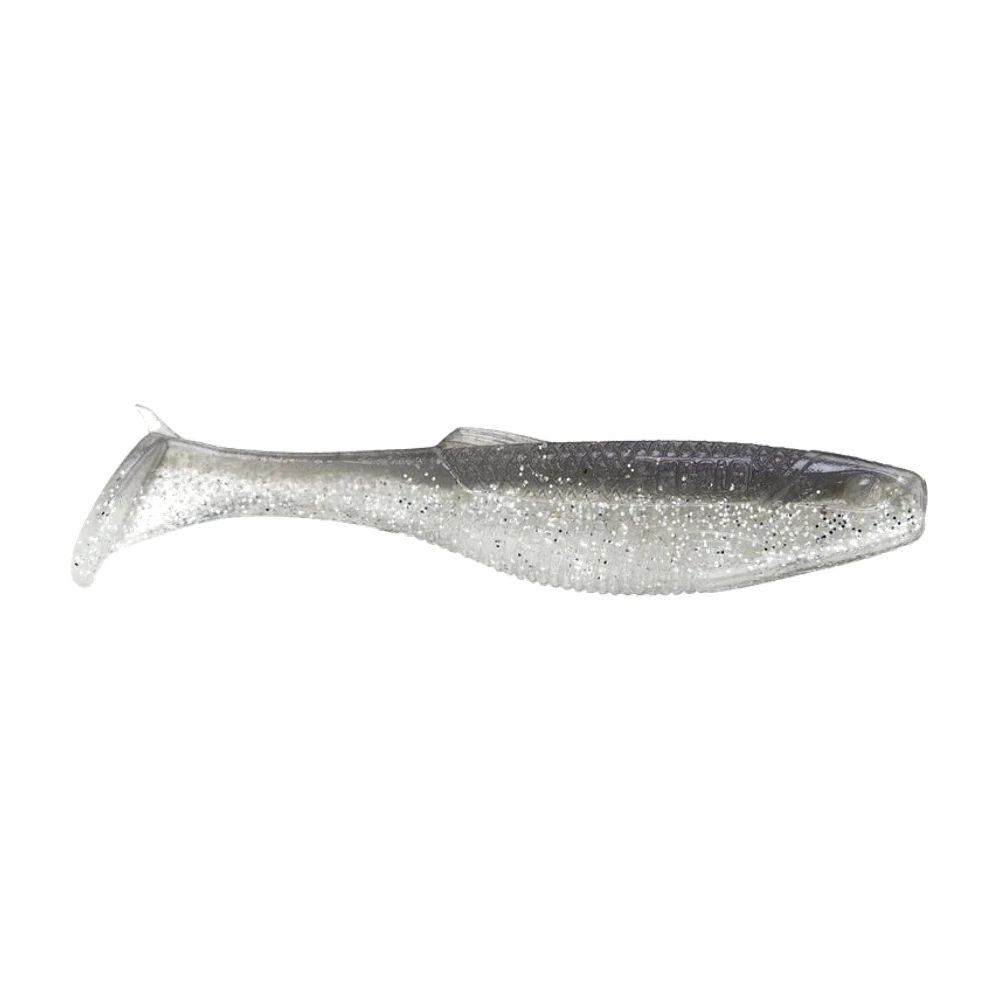
Take that word seriously: subtle means subtle. This is not a shad that thumps in the rod and that you can feel working ten metres out. The flat sides contain the roll instead of amplifying it, and the tail — slim, on a narrow caudal stem in the product photo — kicks without shaking the whole body. The result is a bait that looks like a fish swimming calmly, not like a lure announcing its arrival.
That is a clear advantage on wary fish and a handicap in very dirty water, where a noisier shad gives the fish more to lock onto. Worth knowing before you buy.
In the photo the moulding shows a scaled back, a small translucent dorsal fin, a belly covered in tight transverse ribs and the brand lettering embossed in the flank. The visible finish is translucent silver, loaded with silver flake and a few black specks. Those are observations from a product photo, not specifications, but they state the intent clearly: a baitfish imitation, not a provocation lure.
Four sizes, no weight given
The manufacturer offers four lengths: about 6.4 cm, 7.6 cm, 8.9 cm and 10.2 cm. The size chart carries a header that reads length and quantity, and the figures next to the sizes — eight, eight, six, six — are pieces per bag, not weights. The weight of the bare lure is not published, and no density is mentioned either: there is no way to say whether it sinks faster or slower than a comparable shad. Without that figure, test the drop at your feet before building a retrieve around a count.
The two smaller sizes are trailer and finesse formats. The 8.9 cm is the all-rounder, the one you put on a jig head to cover water. The 10.2 cm becomes a search bait in its own right, and the one that interests zander and bigger bass most.
The four stated rigs, and what each gives
Rapala lists four uses: jig head, belly-weighted swimbait hook, umbrella rig, and trailer on a jig or spinnerbait.
The jig head stays the baseline: 5 to 14 g depending on depth, a steady retrieve at moderate speed, with a one second pause every five or six turns of the handle. It is during that pause, as the tail slows and the bait tips slightly, that the fish commits.
The belly-weighted hook is the rig to favour over weed and timber. The weight under the body keeps the bait upright even at low speed, and the belly channel takes the point without letting it stand proud.
The trailer is the most underrated use. Behind a jig or a spinnerbait, the flat body adds volume and a tail that works without interfering with the host lure — where a shad with a big paddle often makes the whole rig spin.
If you use it as a trailer, go one size down from your usual instinct. An oversized trailer slows the fall of the jig, and the fall is exactly what triggers the bite.
Not sure what to tie on?
Photograph your spot: CarnaFish reads the scene, cross-checks the conditions and gives you the zone, the lure and the retrieve. Free on iOS and Android.
Colors by clarity
- Clear water: the translucent silver flake from the photo, imitating a baitfish without ever creating an opaque silhouette.
- Weed or lightly stained water: green pumpkin, which blends into the vegetation while staying readable up close.
- Coloured water or low light: opaque white, or a touch of chartreuse on the tail, to offset how naturally discreet this shad is.
A weedless shad is no use if you do not know where the cover holding the fish is. That is exactly what CarnaFish does: one photo of the spot, and the AI suggests the zone to work, the likely depth and the type of presentation. To build the method around it, our guide to getting started with bass fishing covers tackle and reading a spot.
What to remember
- Two moulded hook channels, back and belly, for a genuinely clean Texas or belly-weighted rig.
- Flat sides and boot tail: a deliberately subtle kick, excellent on wary fish, less relevant in very dirty water.
- Four sizes from 6.4 to 10.2 cm; the figures next to them in the chart are pack counts, not weights.
- Neither weight nor density published: nothing supports any claim about how fast this shad sinks.
FAQ
What are the two moulded channels for?
They bed the hook point, along the back for a standard Texas rig and under the belly for a weighted swimbait hook. The point disappears into the groove, which makes the rig weedless without distorting the body of the bait.
Which size should I start with?
The 8.9 cm covers the most situations, from a jig head to a Texas rig. The 6.4 and 7.6 cm are mainly trailer formats, the 10.2 cm a search bait for bigger fish.
Does this shad sink fast?
Impossible to say: neither the bare lure weight nor its density is published, and the manufacturer mentions no floating or sinking behaviour. The only reliable method is to test it at your feet before building a retrieve around a count.
Can it be used as a spinnerbait trailer?
Yes, it is one of the uses listed by the manufacturer. The flat sides and contained kick add volume without disturbing the blades, unlike a wide paddle shad that often makes the whole rig spin.
Is it a good lure for zander?
In 10.2 cm on a jig head, yes: the quiet action and baitfish silhouette suit what a zander looks for in clear water. For a stronger action in stained water, a shad such as the Keitech Easy Shiner 4 sends out more signal.
Do I need a special hook for the weedless rig?
A wide gap Texas hook is enough for the dorsal channel. The belly channel calls for a belly-weighted swimbait hook, whose lead sits under the body and keeps the bait upright at low speed.
The full bass lure guideSeason-by-season strategy: which family of lure, when, and why.Go from theory to fish
CarnaFish reads your spot from a photo and gives you the game plan: zone, lure, retrieve. Free on iOS and Android.