Rapala Crush City Bronco Bug: the creature bait that actually swims
Rather not fish it blind? Photograph your spot — CarnaFish cross-checks the conditions and points you the right way.
A creature bait in the packet looks like every other one: a body, some appendages, some flake. In the water, though, the gap is enormous between a bait that merely quivers when you pull on it and a bait whose appendages generate enough thrust to move the whole body. The Bronco Bug belongs in the second category, and that is just about the only thing that matters when you pick one.
Two large appendages doing all the work
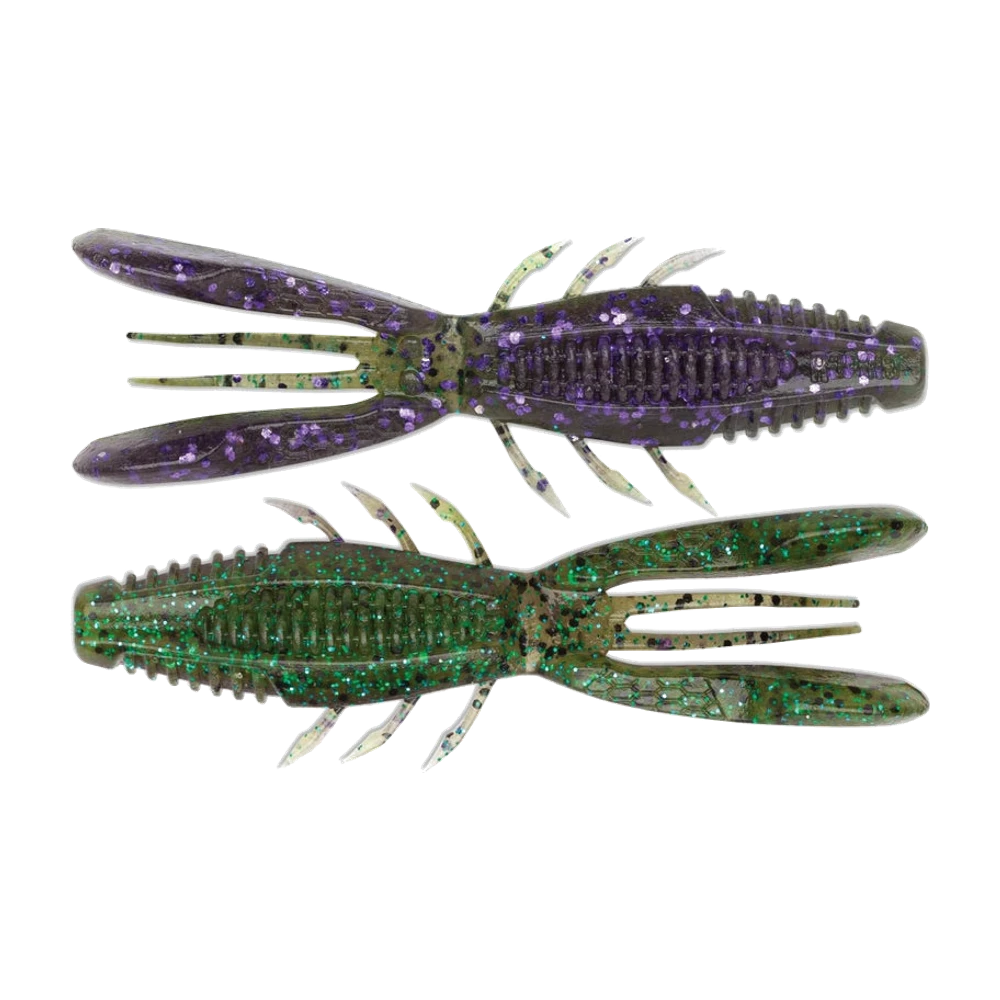
At the back of the body, Rapala has placed two large flat appendages, wide and oval, which the brand compares to a set of chaps — hence the name. They look nothing like crawfish claws or worm tails: they are lifting surfaces, and once the bait is rigged they sit vertically.
The consequence is described by Rapala as a dolphin-like swimming action: instead of simply folding back under the pull, the two paddles push down and then up, and transmit that movement to the body. That is a maker's claim rather than something to swallow whole, but it is consistent with the geometry visible in the photo: paddles of that surface area, hinged on a narrow soft joint, cannot stay inert once the bait is moving.
Between the two paddles, two thin straight antennae extend the body backwards. And along the flanks, three pairs of small flattened legs quiver continuously. Rapala talks about a subtle secondary action: that is exactly what it is, a permanent flutter that stays visible even when you are doing nothing at all.
Reading the spec table: what Rapala publishes and what it does not
The maker's table has two columns, and you need to read the header in full before concluding anything: Length Quantity. Length and pack count, not length and weight.
| Published length | Equivalent | Pack |
|---|---|---|
| 3.25 in | about 8.25 cm | pack of 6 |
| 4 in | about 10.2 cm | pack of 6 |
What that means in practice. Rapala publishes no weight for this bait: no unit weight, no density. There is no class column either, so nothing states whether the plastic sinks, floats or stays neutral. The description does mention salt among the ingredients dosed into the body, which usually makes a soft plastic heavier, but naming an ingredient is not a buoyancy class. So we stay with what is written, without extrapolating.
Second point, less obvious: the published length does not say what it measures. On a bait that ends in two large paddles and two thin antennae, the gap between body alone and overall length can exceed a centimetre. Nothing in the table settles it. Treat 8.25 and 10.2 cm as size markers, and check the actual body length when you pick your hook: that, not the overall length, is what determines the hook size you need.
Hook slots, on both faces
This is the most useful design detail on the Bronco Bug. The back and the belly each carry a ribbed slot, a longitudinal channel into which the hook point beds down. It is clearly visible in the photo, running the whole length of the back.
Two benefits, both stated by Rapala. The profile becomes genuinely weedless, because the point is recessed rather than simply skin-hooked. And the plastic lasts longer, because the hook shank is not working inside solid material that it eventually tears on every bite.
Having a slot on both faces is what makes the bait versatile. Rigged Texas style, point up, you use the one on the back. Rigged as a trailer under a jig or a chatterbait, the bait ends up point down and it is the belly slot that does the job. So you do not have to commit to a rigging direction at the point of purchase.
The classic mistake
Fitting too small a hook because the bait looks slim. The Bronco Bug body is thick and ribbed, and the slot eats into the clearance available under the point. With too closed a hook, the point never comes through on the hookset and you miss bite after bite without understanding why. On the 4 in, start with a 4/0 wide-gap Texas hook, and do not go below 3/0 on the 3.25 in.
A field habit on this kind of bait: before you cast, rest the rig in your palm and press on the back of the bait the way a fish's mouth would. If the point does not come through cleanly, change hooks right away. That is thirty seconds of checking against half a day of dropped bites.
Four rigs, four different uses
Rapala suggests four directions, and each one exploits a different quality of the bait.
On a weighted Texas rig, this is the search rig for weed and flooded timber. A 5 to 14 g bullet depending on cover density, and a retrieve made of short pulls followed by clear pauses: the paddles work on the fall, not on the pull.
As a jig or chatterbait trailer, the Bronco Bug supplies what those lures often lack: volume and water push at the back. On a chatterbait, the paddles fall into phase with the blade's oscillation and give a markedly stronger signal than a plain swimbait tail.
On a Carolina rig, the bait runs free on a long leader, and the two paddles are enough to make it glide between pulls on the weight. That is the rig that best exploits the natural action of the plastic.
On a shakey head, finally, with a light head and an upright hook, the bait stands up on the bottom and the small legs do all the work. It is the slowest rig, and the most effective on inactive fish.
For European perch, only the 3.25 in is realistic, on a light Texas rig or a 5 g shakey head: it is a size big perch take without hesitation, while shutting the door on the small ones.
Not sure what to tie on?
Photograph your spot: CarnaFish reads the scene, cross-checks the conditions and gives you the zone, the lure and the retrieve. Free on iOS and Android.
Colours by water clarity
- Clear water, gravel or rock bottom: the green pumpkin with green flake from the photo. It is the shade that best imitates a crawfish or a large aquatic insect over natural substrate.
- Lightly stained water: the purple with silver flake, also visible in the image. Purple keeps a readable silhouette under reduced light, and the flake makes up for the loss of contrast.
- Dark water, silt bottom, late in the day: black and blue. On a bait fished slowly in contact with the bottom, the silhouette counts for more than the exact shade.
Against the other creature baits
The Zoom Brush Hog remains the historical benchmark of the category, but its action comes mostly from its thread-like appendages: plenty of flutter, little push. The Bronco Bug moves more water and gets noticed from further away, which makes it more relevant in stained water or over heavy cover.
Against a Strike King Rage Bug the comparison is closer: both bet on large surfaces. The Rage Bug plays a wide, aggressive kick, the Bronco Bug an undulation that engages the whole body. On wary fish, the second often goes down better.
And if you want a bait from the same Crush City range built for slow bottom fishing rather than cover, the Rapala CrushCity The Ned BFG fills that role with the opposite logic: volume on the bottom, no action of its own.
Choosing between a creature bait and a swimbait is not decided in the tackle box but in front of the spot: CarnaFish reads a photo of the swim and suggests the zone, the depth and the presentation that fit the moment. And to build the basics of matching a rig to the cover, our guide to getting started on bass walks through the typical situations.
Key points
- The two large flat appendages do not flutter, they push: it is the whole body that undulates, not just the paddles.
- Rapala publishes only length and pack count. No weight, no buoyancy class, and nothing saying whether the length includes the appendages.
- Ribbed slot on the back and on the belly: point up on a Texas rig, point down as a jig trailer, with no compromise.
- A wide-gap hook is mandatory, 4/0 on the 4 in and 3/0 minimum on the 3.25 in.
FAQ
Does the Bronco Bug sink or float?
Rapala does not say: the table has no class column, and the description gives no density. It does mention salt in the mix, which usually makes a soft plastic heavier, but that is not a published buoyancy figure. In practice, the weight of the rig decides.
Which size, 3.25 or 4 in?
The 4 in for adult bass, on a Texas rig in cover or as a jig trailer. The 3.25 in when fish are wary, in clear water, after a cold front, or if you also want to target big perch.
What hook should you fit?
A wide-gap Texas hook, 4/0 on the 4 in and 3/0 minimum on the 3.25 in. The body is thick and the slot reduces the usable clearance under the point: too closed a hook causes systematic misses.
Can you use it as a chatterbait trailer?
Yes, and it is one of its best uses. The two large paddles synchronise with the blade's oscillation and strengthen the signal noticeably compared with a plain swimbait tail, especially in stained water.
Does the published length include the appendages?
The maker's table does not say, and that is a genuine limit of the available information. On a bait that ends in two paddles and two antennae the gap can exceed a centimetre: measure the body yourself before choosing a hook.
How many baits per pack?
Six, in both sizes. The second column of the table really is a pack count and not a weight, a common confusion when this kind of spec sheet is read quickly.
The full bass lure guideSeason-by-season strategy: which family of lure, when, and why.Go from theory to fish
CarnaFish reads your spot from a photo and gives you the game plan: zone, lure, retrieve. Free on iOS and Android.