Missile Baits Shockwave: the soft shad that kicks on the slightest move
One lure, endless conditions. CarnaFish reads your spot from a photo so you are not just guessing.
Some sessions you can feel fish following without ever committing. The blade thumps, the rig swims through, and nothing closes. Often it is not the blade that needs changing but the trailer: too thick, too stiff, it adds bulk and brings no life of its own. The Missile Baits Shockwave is drawn for exactly that moment — very soft plastic, a flat body, and a tail thin enough to work while the rest of the rig is already making all the noise.
A tail that starts before you do
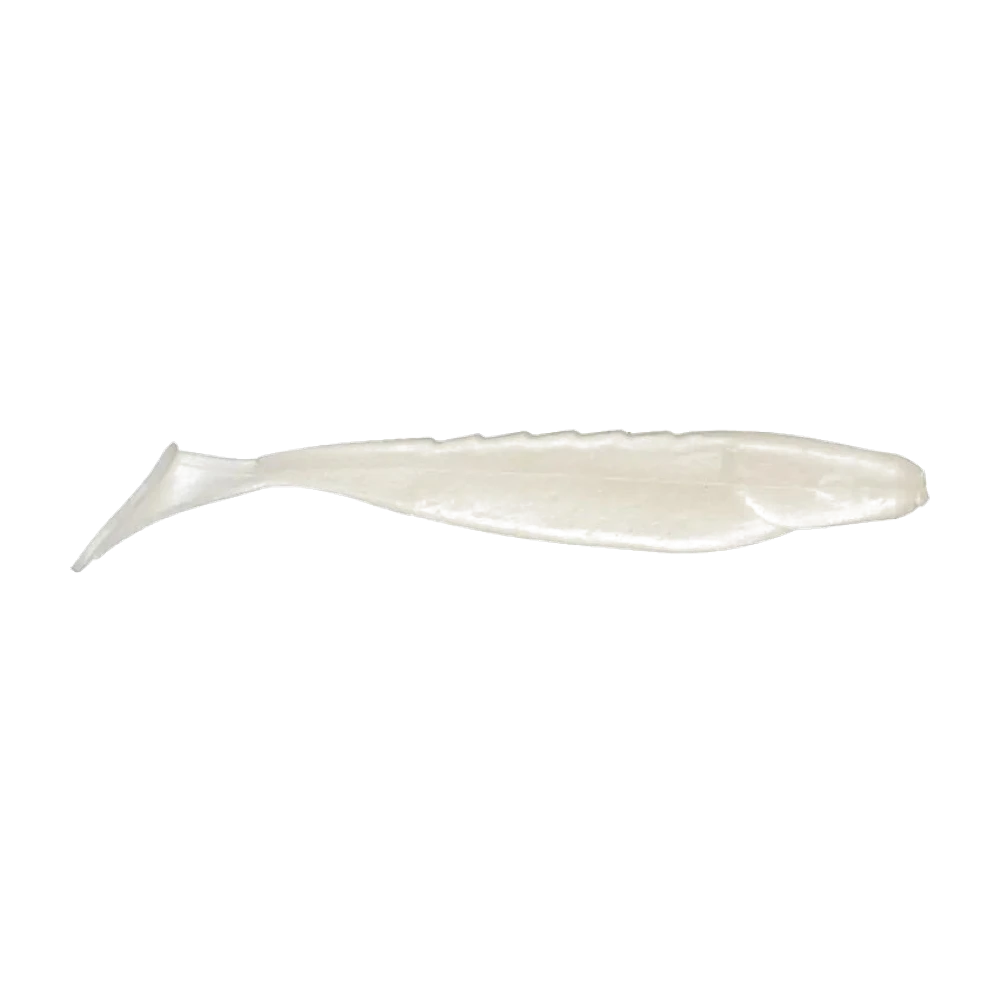
The detail that shapes the whole bait is the peduncle. Between the body and the paddle, the Shockwave narrows sharply: the photo of the bare bait shows it clearly, the tail sits on a band of plastic barely thicker than a fingernail. That soft hinge means the paddle fires within the first centimetre of retrieve, and more importantly that it keeps quivering on the fall, right when heavier-built shads go dead.
The manufacturer makes one measurable claim: the tail reacts to the smallest movement. In practice that means you can fish far slower than with a conventional paddle tail without the bait switching off. On a bladed jig crawled through cold water, that is exactly what you want — the blade supplies the low frequencies, the trailer's tail adds the fine signal a fish picks up last, within a metre.
The body itself is flat-sided with a lightly serrated back and a step along the belly. That flattened section produces a slight side roll on a straight retrieve, throwing alternating flashes rather than a continuous shine. It is a different signature from a round-bodied shad like the Keitech Swing Impact Fat 3.8, which pushes more water but flashes less.
Two sizes, and a weight nobody tells you
The manufacturer's table has only two columns: length and quantity per pack. It reads 8.9 cm / 3.5 in sold eight to a bag, and 10.8 cm / 4.25 in sold five to a bag. In other words, no weight is published and no buoyancy class either. That is logical for a bare soft bait meant to be weighted by the rig, but you need to know it: you cannot reason in grams before holding one, and your working weight comes entirely from the head, the blade or the bullet weight you pair it with.
In practice the 8.9 cm covers the perch and smaller bass bracket and serves as a trailer on compact blades. The 10.8 cm becomes a genuine mid-size bait: on a 10 to 14 g head it interests zander along a drop-off and bass down a deep bank.
Weigh your first one on a kitchen scale before building a box around it. On a soft bait with no published weight, that is the only way to know whether your A-rig is still castable once all five arms are dressed — I have seen a perfectly sensible wire frame turn unmanageable simply because the chosen trailer was denser than expected.
The rigs that use the hook pocket
Missile Baits cut a deep channel under the back of the bait. That design choice opens two opposite doors, and that is the whole point of the model.
Weedless Texas rig
The deep pocket lets the shank and the hook point bury entirely in the plastic. You get a genuinely snag-resistant rig that slides through light to moderate vegetation and over deadwood. A wide-gap worm hook in 3/0 for the 8.9 cm, 4/0 to 5/0 for the 10.8 cm, and you keep the freedom to add a bullet weight in front or fish it with nothing at all.
Jig head
Despite that pocket, the maker kept enough material to thread the bait onto a standard jig head. That matters: plenty of heavily hollowed shads tear on the second fish once they are pushed onto a barbed shank. Here the body stays full enough to hold. The plastic is deliberately soft, though, so a drop of glue at the collar seriously extends the life of each piece.
Bladed jig trailer
This is the use the description puts first. On a blade like the Zman ChatterBait JackHammer, the Shockwave brings a slim profile that does not choke the blade, unlike a bulky craw trailer. Thread it dead straight: a crooked trailer makes the whole rig spin, and that fault never corrects itself on the retrieve.
Carolina rig and A-rig
On a Carolina, the tail keeps working through the long pauses where the bait trails behind the weight — precisely what you want over hard bottom. On an A-rig, its slim build lets you dress several arms without turning the frame into a parachute. One caveat: umbrella rigs are banned or restricted on many waters in Europe, so check the local rules before you tie one on.
Where and when it takes over
The Shockwave takes over when the forage is slim and fish refuse bulk. Late autumn and winter on clear water, when baitfish schools tighten and fish feed without moving much: a thin trailer crawled slowly beats a bigger bait comfortably.
The classic mistake
The common reflex is to compensate for the bait's slimness with speed, assuming the tail will work harder. The opposite happens: past a certain pace the flat body starts to spin and the paddle flattens out, leaving a piece of plastic dragged in a straight line. If you want speed and bulk, pick a thicker-bodied shad; the Shockwave is built for the low range.
Not sure what to tie on?
Photograph your spot: CarnaFish reads the scene, cross-checks the conditions and gives you the zone, the lure and the retrieve. Free on iOS and Android.
Colours by water clarity
- Clear water: pearl white, the one in the photo, which matches silver forage and stays readable without flashing like a mirror.
- Lightly stained water: green pumpkin, the safe pick for a bladed jig trailer over weedy bottom.
- Dirty water or low light: a dark back with a chartreuse belly, giving a clean silhouette from below and an aiming point for the strike.
A trailer more than a headline bait
It deserves saying plainly: the Shockwave is not the bait that will carry your day on its own. It is a supporting piece, deadly behind a blade or under a light head, less convincing than creature baits like the Missile Baits D Bomb when you need to pick apart one precise piece of cover. Knowing what a bait does not do saves time on the water.
The right trailer never replaces reading the spot — you still need to know where the blade should pass. That is exactly what CarnaFish helps with: one photo of the spot, and the AI suggests the zone, the depth and the type of presentation that fit the day's conditions. To build the groundwork on tackle and typical lies, our guide to getting started on bass fishing is still the best entry point.
Key takeaways
- A very thin peduncle fires the tail on the slightest movement: this is a slow-range bait, not a fast-retrieve one.
- The maker lists two lengths, 8.9 cm / 3.5 in and 10.8 cm / 4.25 in, but no weight and no buoyancy class: all the loading comes from the rig.
- The deep hook pocket allows a genuine weedless Texas rig while leaving enough body for a jig head.
- Deliberately soft plastic: excellent for action, fragile in use, so plan on glue and spare bags.
FAQ
Which Shockwave size should I start with?
The 8.9 cm covers the most situations, as a blade trailer and on a light jig head, and the bag holds eight. Move up to the 10.8 cm when you are after bigger fish or want more bulk along a drop-off.
How much does the Shockwave weigh?
Missile Baits does not publish a weight: the table gives only length and quantity per pack. If you need a figure to balance an A-rig or match a rod, weigh your first one yourself.
Can it go on a jig head despite the hook pocket?
Yes, that is intended: the maker kept enough material in the body for the bait to thread onto a shank. Since the plastic stays soft, a drop of glue at the collar noticeably increases the number of fish per bait.
Does the Shockwave work in weed?
Texas-rigged, yes, through light to moderate vegetation. The deep pocket lets you bury the point completely. For thick pads or a solid mat, a hollow-body frog is still the right tool.
Is it a good zander bait?
In 10.8 cm on a 10 to 14 g head, yes: a tail that works at very low speed suits an inactive zander on a drop-off. You just have to accept soft plastic, so a higher bait count over a session than with a conventional shad.
Can I use it on an A-rig?
Technically it suits the job very well thanks to its slim profile, but umbrella rigs are banned or limited on many waters in Europe. Check the local regulations before building one, because the rules vary from one fishery to the next.
The full bass lure guideSeason-by-season strategy: which family of lure, when, and why.Go from theory to fish
CarnaFish reads your spot from a photo and gives you the game plan: zone, lure, retrieve. Free on iOS and Android.