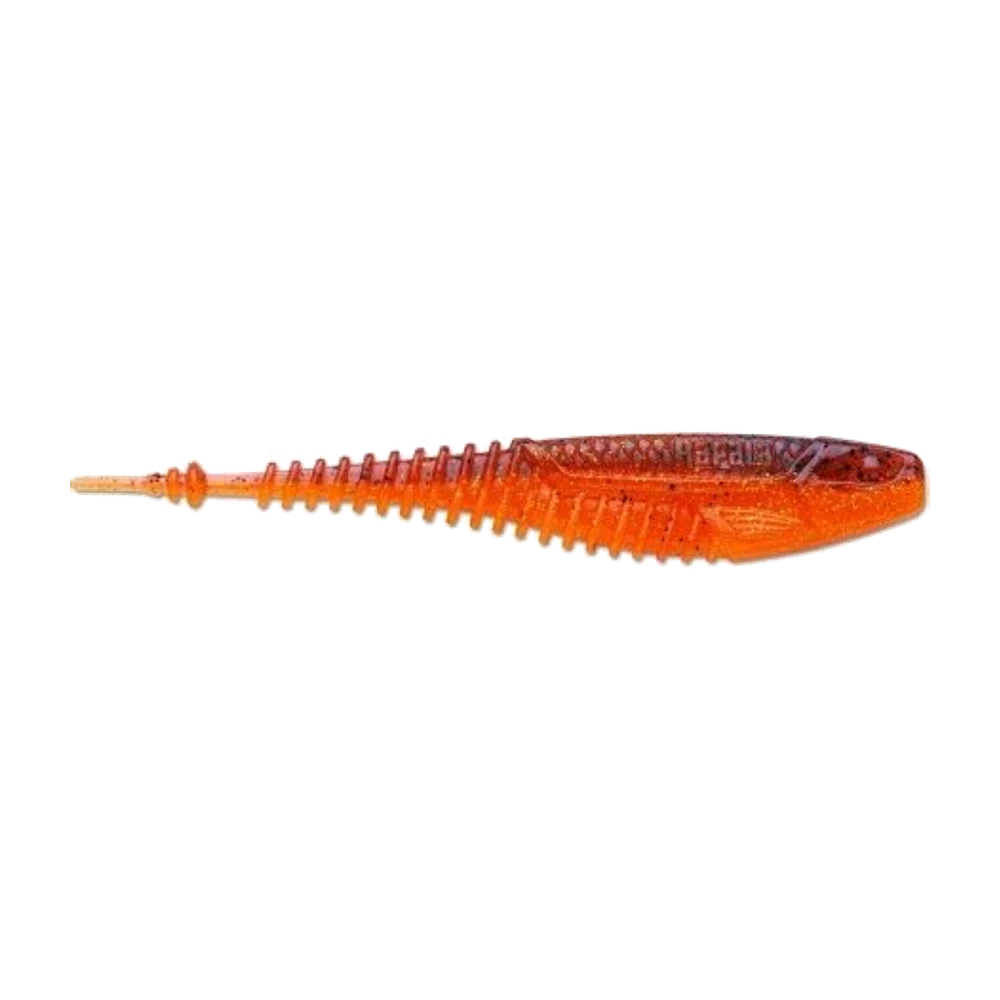
Rapala CrushCity Freeloader: the shad that starts at a ridiculous speed
One lure, endless conditions. CarnaFish reads your spot from a photo so you are not just guessing.
The weak point of most paddle tail shads is visible to the naked eye when you swim one along the bank: below a certain speed the tail stops beating and the lure becomes a piece of plastic sliding through the water. And the days when fish are pinned to the bottom and apathetic are precisely the days you want to slow down.
You end up stuck between two bad options: retrieve fast enough for the lure to work — and pass too high, too fast, over fish that will not follow — or slow down and drag a dead lure.
The Freeloader is built to erase that compromise. Its tail starts almost immediately, and above all the body goes into a roll before the tail even beats properly. The result: at a speed where a classic shad is asleep, this one is still sending out a signal.
Roll before tail
Most shads run on a single engine: the paddle tail. It beats, it transmits a vibration to the body, and the whole signal comes from there. Effective, but binary — above the threshold it works, below it does not.
The Freeloader stacks two engines that kick in at different points.
Body roll, first. The profile of the back and the section of the belly make the lure pivot on its long axis from the very first centimetres of the retrieve. That roll produces an intermittent sideways flash, visible from a distance, with no marked vibration at all.
Tail beat, second, layering on top when you speed up a little. It adds pressure and makes the lure detectable by the lateral line beyond visual range.
In practice that gives you two lures in one: at minimum speed, a discreet, visual lure for inactive fish; at moderate speed, a classic searching shad.
Working it: three approaches by species
For zander, settled pulls.
- Let it touch bottom, line half tight, and wait until you see the line fall slack.
- Two slow turns of the handle, without lifting the rod. The lure lifts 30 to 50 cm off the bottom.
- Cut and let it drop back while keeping contact. That is the phase where 80 % of the bites come.
- Repeat, counting the turns so you can reproduce the sequence that worked.
For bass, the grazing pass.
- Cast beyond the spot — stump, lily edge, break line.
- Count the sink so as to arrive 30 cm above the obstacle.
- Retrieve perfectly straight and very slowly, one turn of the handle per second.
- Hold a one-second stop exactly as you pass the spot, then set off again. The stop tips the lure over and triggers followers.
To search fast, the short yo-yo. Reduced rod amplitude, 40 cm maximum, taking up the slack during the fall. That is the mode to use when you do not yet know where the fish are.
On the water: when you cannot feel the tail working through the rod tip, do not conclude the lure is dead. On this shad, the pure roll phase sends almost nothing back up the rod — and that is exactly the setting that catches apathetic fish. Check the action once in the margin, then trust it.
Choosing the weight
| Depth | Current | Head / hook | Useful speed |
|---|---|---|---|
| 0 to 2 m | none | 5 g weighted Texas | Very slow and straight |
| 2 to 4 m | light | 10-14 g jig head | Slow straight or with stops |
| 4 to 6 m | moderate | 18-21 g jig head | Settled pulls |
| Cluttered margin | none | Unweighted or 3.5 g Texas | Gliding descent, long pauses |
Two common mistakes. Over-weighting to go faster: you kill the roll, which is the main point of the lure. Take the lightest weight that still lets you feel the bottom. Setting the hook badly on a Texas rig: the point has to come out a third of the way along the back, otherwise the body bows and the lure spins the moment you speed up.
On line, 0.12 to 0.16 mm braid with a 0.25 to 0.30 mm fluorocarbon leader covers bass; for zander in clear water, drop the fluoro to 0.22-0.26 mm to gain discretion and sink speed.
Not sure what to tie on?
Photograph your spot: CarnaFish reads the scene, cross-checks the conditions and gives you the zone, the lure and the retrieve. Free on iOS and Android.
Where it shines, where it disappoints
It is at its best on:
- Late autumn and early spring, when the water sits around 8-12 °C and fish will no longer follow anything fast.
- Plateaus and clean break lines, where you can fish long and slow without snagging.
- Post-front days, blue sky and fish glued down, where the discretion of the roll goes down better than a strong vibration.
It is poorly suited:
- In heavily stained water or in flood, where you need a strong pressure signal: a high-vibration shad or a chatterbait will do better.
- On fish actively feeding in open water, where a faster lure covers far more ground.
- In dense brush: a Texas rig limits snags but does not eliminate them on a lure this long.
Freeloader or a classic big-tail shad
A Keitech Easy Shiner 4 plays a neighbouring register but with a far more expressive tail: more vibration, more presence in dirty water, and a start-up that demands a little more speed. It is the right choice when the fish are active or the water is coloured.
When you want to remove vibration altogether, a slim shad on a drop shot goes one notch further into finesse, at the cost of searching: you fish a point, not a zone. The Freeloader sits between the two — it covers ground while remaining fishable at very low speed.
Our beginner's guide to zander fishing with lures sets out the pulling rhythms by season. And if you are unsure what head weight to rig when you reach the bank, CarnaFish analyses a photo of the spot and answers.
Key takeaways
- Two staggered engines: body roll at minimum speed, tail backing it up when you accelerate.
- Take the lightest head that still lets you feel the bottom — over-weighting kills the roll.
- The zander bite almost always comes on the drop phase after two turns of the handle.
- On a Texas rig, hook point a third of the way along the back, otherwise the lure spins.
- Not much use in heavily stained water or on fast-feeding fish.
FAQ
What jig head for the CrushCity Freeloader?
A range of 10 to 21 g covers most situations in lakes and calm rivers. Drop to 5-7 g to fish just under the surface and along margins, and only go up towards 21 g when the depth exceeds five metres or the current stops you feeling the bottom.
Can it be Texas rigged?
Yes, and it is even the rig to favour near obstacles. Use a 4/0 or 5/0 wide-gap hook, weighted 3.5 to 10 g depending on depth, and bring the point out a third of the way along the back so the body does not bow.
Does it work for zander?
Very well, on settled pulls: two slow turns of the handle, then a controlled drop. Its roll at low speed matches exactly the rhythm you need to hold on zander sitting on the bottom in cool water.
Why can't I feel anything in the rod?
Because at very low speed the lure works mainly in roll and transmits very little vibration. That is not a fault: it is the setting that catches apathetic fish. Check the action once, in sight, along the margin, then simply keep contact with the bottom.
What colour for stained water?
Pearl white, chartreuse, or a pattern with a dark back and a light belly. In genuinely dirty water, silhouette contrast counts for more than realistic colouring, and it is often better to change lure type for a high-vibration model.
What is the difference with a big-tail shad?
A very expressive shad sends out more pressure and works better in dirty water or on active fish, but it needs a minimum speed to express itself. The Freeloader accepts being fished more slowly while keeping a visual signal, which makes it better in clear, cold water.
The full bass lure guideSeason-by-season strategy: which family of lure, when, and why.Go from theory to fish
CarnaFish reads your spot from a photo and gives you the game plan: zone, lure, retrieve. Free on iOS and Android.