Reaction Innovations Little Dipper: the Skinny Dipper gone finesse
Rather not fish it blind? Photograph your spot — CarnaFish cross-checks the conditions and points you the right way.
Some days the fish follow all the way to the rod tip and never commit. You watch the shadow peel off the laydown, track the swimbait for ten feet, then turn away three feet from the boat. Slowing down won't fix that one: it's the volume you need to cut, not the speed. Reaction Innovations built the Little Dipper for exactly that — the Skinny Dipper's little brother, scaled back to 3.5 inches, or 8.9 cm.
Why 8.9 cm changes the maths
Reaction Innovations pitches this bait as the pick when a finesse approach is a must. That isn't empty wording: between a 12 cm swimbait and a 9 cm one, it isn't just the silhouette that shrinks, it's the amount of water being pushed. A smaller paddle puts out a tighter vibration, less audible from a distance but far less suspicious once the fish is already looking at it.
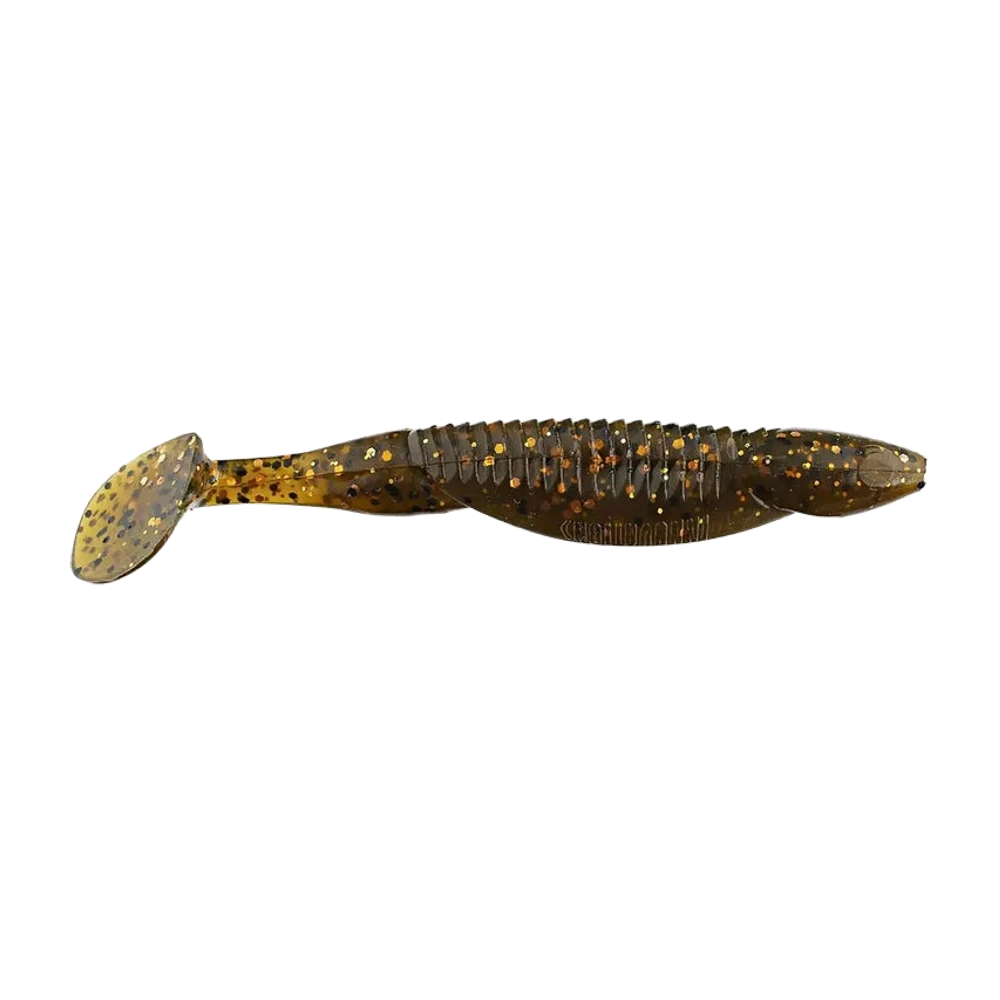
The product photo shows a stocky body rather than a slim one: the Little Dipper isn't a slug with a tail, it keeps enough flank volume to read as a proper baitfish from the side. The back carries a row of notches along its full length, and a molded gill-plate relief sits just behind the head. Treat that as an observation from a product photo, not a published specification — Reaction Innovations says nothing about what those ribs do, and they mostly look like a way to break up light and give the salt and flake something to catch on.
The manufacturer publishes no weight for this bait. The only figures in the chart are the length, 3.5 inches, and a count of 9 baits per pack. If you build your rigs to the gram, weigh one yourself before sizing a jighead: there is no official number to look up.
The three rigs the manufacturer puts forward
Reaction Innovations says the Little Dipper fishes the same way as the Skinny Dipper, but that it shines behind a fish head spinner — an underspin head of the Sworming Hornet type. The two other uses they list are drop shotting and a plain jighead. Three rigs, three different logics.
Behind an underspin
This is the one the brand leads with, and it holds up: the belly blade adds a flash and a low-frequency thump that the Little Dipper's small tail can't generate on its own. Fish it on a slow, steady retrieve with no rod work, letting the blade do the calling while the swimbait supplies the profile. It's the search rig on a drop-off or the edge of a flat, when fish are grouped but sluggish.
The common mistake is reeling too fast because you can feel the blade turning. The moment the bait climbs out of the strike zone, you've lost the depth you came for. Slow down to the point where the blade only just keeps spinning.
On a plain jighead
Without a blade, the Little Dipper goes back to being an ordinary swimbait — a quiet one. A round or bullet head of 3 to 7 g (roughly 1/8 to 1/4 oz) covers most of it, depending on depth and wind. The job is no longer to search but to present: drop on a fish you've marked, lift in short hops, let it fall back. It's also the rig that suits perch best in Europe, on a profile that matches late-summer young-of-the-year baitfish almost exactly.
On a drop shot
Nose-hooked on a fine-wire hook, 20 to 40 cm above the weight, it hangs in place while you work the line instead of the bait. The paddle responds to almost nothing: a shiver of the rod tip is enough to set it quivering on the spot. This is the last-resort rig on a fish you've marked on the sounder that has refused everything else — the same thinking as a Fox Rage Fish Snax Dropshot, but with a working tail instead of a flat flank.
Thread the Little Dipper dead straight on the hook, and check it after every fish. A paddle tail this size will spin your line the moment it sits two millimetres off-centre, and you'll only notice forty minutes later when the braid starts corkscrewing. On a finesse rig, that's the most expensive mistake there is.
Speed and rhythm
The tail starts working within the first few inches of the retrieve: there's no speed threshold to clear before the bait wakes up, unlike some big paddles that stay dead below a certain pace. That leaves you free to fish genuinely slowly and keep the bait in the right band of water far longer.
In practice, a steady retrieve is the baseline, and the variation comes from pauses rather than bursts of speed. A one-second pause drops the bait off its running plane and makes it tip over — that's usually when the follower decides. A bigger swimbait like a Keitech Swing Impact 4 needs more speed to come alive; the Little Dipper does not.
Its limit follows from the same logic: it won't replace a big bait when you need noise. In genuinely dirty water, with wind and chop, a 9 cm swimbait with no blade simply won't be detected from a distance. Either you add the underspin, or you change baits.
Not sure what to tie on?
Photograph your spot: CarnaFish reads the scene, cross-checks the conditions and gives you the zone, the lure and the retrieve. Free on iOS and Android.
Colors by water clarity
- Clear to lightly stained: Green Pumpkin with copper flake, exactly the tone of the bait in the photo. The default on lightly colored water over rock or gravel, subtle up close and still readable from a distance.
- Dirty water or post-rain: Chartreuse Shad, a contrast that registers in loaded water without going full fluorescent.
- Silver baitfish out in open water: pearl white, which throws light like a young shad and works well behind an underspin whose blade is already supplying flash.
The right size is worth nothing if you present it in the wrong place, and that's exactly where CarnaFish comes in: photograph the spot and the AI gives you the zone, the depth and the presentation that fit today's conditions. To build the groundwork on tackle and on which water to cover first, our beginner's guide to bass fishing remains the best way in.
The short version
- 3.5 inches, or 8.9 cm: the cut-down Skinny Dipper, aimed at the days when the usual profile gets refused.
- No weight is published by the manufacturer — only the length and a count of 9 baits per pack.
- The rig Reaction Innovations leads with is the belly-blade underspin, which makes up for the small paddle's modest vibration signature.
- Rigged crooked, it will corkscrew your line within the hour: check the alignment after every fish.
FAQ
How is it different from the Skinny Dipper?
The Little Dipper is the short version of the Skinny Dipper, at 3.5 inches or 8.9 cm. Reaction Innovations says it fishes the same way, but the reduced volume makes it the call on days when fish follow without eating.
What jighead weight should I use?
The manufacturer doesn't publish the bait's weight, so there's no official pairing. In practice 3 to 7 g (about 1/8 to 1/4 oz) covers most situations: stay on the lightest head that still holds your target depth.
Does the Little Dipper work for perch?
Yes, and it's one of its better uses in Europe. A 9 cm paddle tail on a light jighead matches what perch are eating in late summer, once the year's fry have grown into that size bracket.
What is a fish head spinner, and why does the manufacturer recommend one?
It's a jighead carrying a small blade under the chin that spins on the retrieve. It adds flash and a vibration a swimbait tail this size can't produce alone, which widens the distance at which a fish picks the lure up.
How many baits come in a pack?
Nine. That's the only other figure in the size chart besides the length, and this reference is offered in a single size.
Can you rig it Texas-style and weedless?
Nothing stops you, but it isn't one of the uses the brand puts forward — they list the underspin, the drop shot and the jighead. For a pass through thick weed, a thicker-bodied bait with a flat back designed to take a Texas hook stays the better tool.
The full bass lure guideSeason-by-season strategy: which family of lure, when, and why.Go from theory to fish
CarnaFish reads your spot from a photo and gives you the game plan: zone, lure, retrieve. Free on iOS and Android.