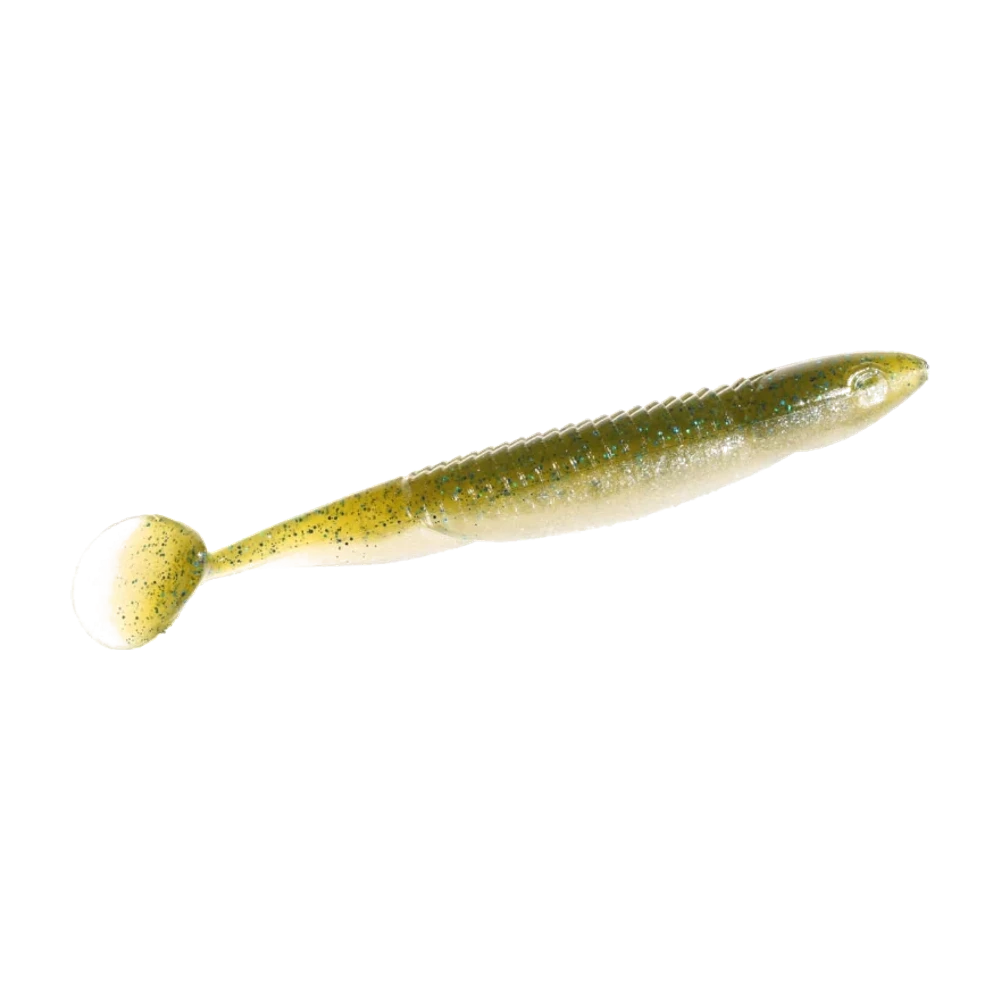
Reaction Innovations Skinny Dipper: the swimbait that kicks at a snail's pace
Not sure this lure fits YOUR spot today? CarnaFish tells you in 10 seconds, from a photo.
Weed topping out, twenty centimetres of water between the plants and the surface, and bass sitting in it. You have three options and each one has a flaw: the topwater passes too high and only convinces committed fish, the crankbait ploughs into the vegetation on the second turn of the handle, and a shad on a jig head sinks straight in and fouls.
What you actually need is a soft swimming lure that can hold exactly that twenty-centimetre band, weightless, and slow enough for an apathetic bass to have time to come out of the grass.
That is precisely the Skinny Dipper's brief, and it delivers thanks to one moulding detail: the joint between body and tail is unusually thin.
A hinge, not a rigid tail
On most paddle tail shads the tail root is thick, almost continuous with the body. It takes a minimum speed for the paddle to grip the water and start kicking. Below that, the lure just slides along doing nothing.
The Skinny Dipper reverses the relationship. The body is slim, almost flat, and the tail is joined by a very thin section that works like a hinge. The paddle starts kicking within the first few centimetres of the retrieve, at a speed where most rivals are mute.
That kick produces two visible effects:
- A crisp lateral whip, wide relative to the lure's size, which ripples the surface when you fish very high.
- A body roll driven by the tail. The lure does not track straight: it pivots slightly on its axis with every kick, flashing its flank alternately one side then the other.
It is that second effect that makes the difference on fish sitting in the vegetation: they do not see a lure passing above them, they see an intermittent flash.
The weightless rig, and when to break the rule
The reference rig is a Texas rig with no weight at all. A wide-gap EWG hook in 4/0, the point brought out and then buried just under the skin of the back, the body perfectly straight on the shank. The general principle is covered in our Texas rig page; the only extra requirement here is that the lure must be absolutely not kinked, otherwise it spins instead of rolling.
Weightless, the lure holds the top twenty to thirty centimetres as long as you keep winding. Three cases justify adding weight:
| Situation | Weight |
|---|---|
| Weed topping out, calm water | None |
| Headwind or chop | 1 to 1.5 g belly weight |
| Weed 1 m below the surface | 2 to 2.5 g belly weight |
| Deeper margin, 2 to 2.5 m | 3 to 3.5 g, or a weighted hook |
A belly weight glued or screwed under the body always beats a jig head: it preserves the freedom of the tail hinge, which a rigid head partly kills.
For line, 0.30 to 0.40 mm braid straight through as soon as there is vegetation. Fluorocarbon adds nothing here and is far less forgiving on a hookset in the grass.
The retrieve: do nothing, or nearly
- Cast beyond the zone and start winding before the lure hits the water, so it does not sink in.
- Straight retrieve, slow and constant. One turn of the handle a second, sometimes less. You should see or sense the tail kicking.
- Rod tip low and pointed at the lure. That keeps a short line and a direct hookset angle.
- Do not pause at all while nothing is happening. Unlike most soft plastics, it is the continuity of the kick that calls fish in.
- When a fish misses or boils behind it, and only then: a sharp one-second stop, then wind on. The lure drops a few centimetres and very often the fish comes back on it.
- Count a beat before setting the hook. On a bite in the grass, the classic mistake is setting on the sound rather than on the weight.
On the water: if you lose visual contact with your lure's wake, you are already fishing too fast. The right speed is the one at which you can still make out the tail beats in the wake — and it is almost always slower than the speed you naturally use.

Not sure what to tie on?
Photograph your spot: CarnaFish reads the scene, cross-checks the conditions and gives you the zone, the lure and the retrieve. Free on iOS and Android.
Its window, and its blind spots
The Skinny Dipper is a lure for warm water and vegetation. From May to October, over weed beds, scattered lily pads, reed margins and shallow flats, it fills a role few lures manage: covering a big area quickly while staying slow and discreet wherever it passes.
It is also very good at dusk, alternated with a topwater: when the surface strikes stop, it keeps catching.
Conversely, it makes little sense in cold water, where its continuous straight retrieve becomes monotonous against a lure worked on the fall. It is also unsuited to deep water and vertical fishing, and its slim profile makes it of little interest for pike, which will bite it off more often than it hooks up without a suitable leader.
Skinny Dipper or buzz toad
The Zoom Horny Toad covers the same ground with the opposite logic: it is fished on the surface, legs churning, with a noisy, visible wake. It is a calling lure, deadly on active fish, but its minimum speed is high — below that it sinks and does nothing.
The Skinny Dipper works just under the film, silently, at a speed where the toad is unusable. In practice, the sequence that works well is to run the toad first to identify the active areas, then come back through with the Skinny Dipper on the fish that missed or only boiled.
For the same vegetation but fished vertically, under a thick mat rather than over it, the Reaction Innovations Sweet Beaver takes over. The brand's two lures complement each other exactly: one goes through the ceiling, the other runs along it.
Our beginner's guide to bass fishing covers how to string these approaches together over a single day. And if you are torn between going over or through a weed bed you have just found, CarnaFish analyses a photo of the spot and answers.
Key takeaways
- The thin body-to-tail joint makes the paddle kick at speeds where other shads are mute.
- Reference rig: weightless Texas, 4/0 EWG hook, body perfectly straight.
- Continuous straight retrieve, no pauses, around one turn of the handle a second.
- A 1 to 3.5 g belly weight only to get deeper or beat the wind, never a jig head.
- A warm-water, weed-bed lure, of little use in cold or deep water.
FAQ
Does the Skinny Dipper need a weight?
Not in its main role: weightless Texas rigged, it holds the top twenty to thirty centimetres as long as you keep winding. Add a 1 to 3.5 g belly weight only to beat the wind or to get down over deeper weed.
What hook size should I use?
A wide-gap EWG in 4/0 for the standard size, 5/0 if you are fishing heavy braid in dense vegetation. What matters is that the body stays perfectly straight on the shank, or the lure will spin.
How fast should I retrieve?
As slowly as you can while keeping the tail kicking, which is around one turn of the handle a second. If you can no longer make out the beats in the wake, you are fishing too fast.
When should I pause?
Only after a miss or a boil: a one-second stop drops the lure a few centimetres and very often brings the fish back. On a normal retrieve, the continuity of the kick beats any pause.
Braid or fluorocarbon?
Braid of 0.30 to 0.40 mm straight through as soon as there is vegetation, so you can set the hook in the grass and get the fish out. Fluorocarbon buys no useful stealth on a presentation this high and forgives far less.
Is it suitable for pike?
Occasionally, but that is not what it is for: its slim profile and the lack of a wire leader lead to too many bite-offs. Keep it for bass and tie on something tougher if pike are around.
The full bass lure guideSeason-by-season strategy: which family of lure, when, and why.Go from theory to fish
CarnaFish reads your spot from a photo and gives you the game plan: zone, lure, retrieve. Free on iOS and Android.