River2Sea Phat Mat Daddy: Ish Monroe's frog for heavy mats
Rather not fish it blind? Photograph your spot — CarnaFish cross-checks the conditions and points you the right way.
Some spots take no lure at all. Not an airy pad field with pockets of open water: a genuine mattress of compacted vegetation, the kind where you can't see the surface any more. That's the ground the Phat Mat Daddy was drawn for, and River2Sea makes no secret of it — the brand developed it with Ish Monroe, an American professional angler known for his frog fishing.
A deliberately softer plastic
The central argument for this model isn't the shape, it's the material. River2Sea states the body is moulded from a softer, more collapsible plastic than usual. That detail solves the number one problem of the hollow-body frog: when a fish closes its mouth, the body has to give way far enough for both hook points to come clear. A body that's too stiff does the opposite — it protects the fish instead of protecting the lure.
The trade-off is familiar to anyone who frog fishes: the softer the plastic, the faster it tears. A tooth punctures it, the body takes on water, and you have to squeeze it out between casts. That's the accepted compromise on this kind of model, and it's worth carrying two of the same color on a serious day.
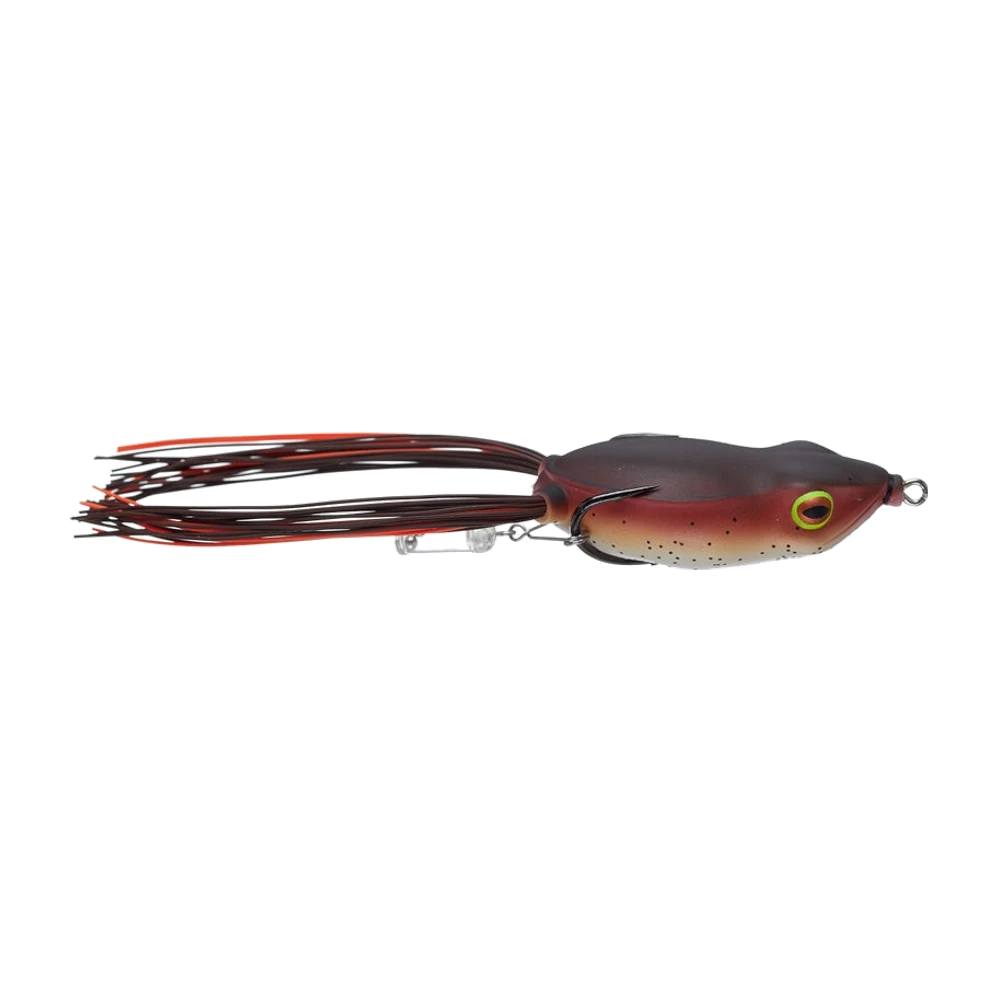
The second point the manufacturer claims is the hook: a dedicated frog double, described as super-sharp and above all set at a precise angle, worked out so the hookset holds. On the product photo the two points do indeed follow the line of the flanks rather than lying flat along the back.
One simple set of figures, and a detail the description skips
The manufacturer's chart fits on one line, and its first column carries the model name, not a measurement. The two real figures are 2-3/4 in, or 7 cm, at 3/4 oz, or 21.3 g. This is a compact, heavy frog: the weight isn't there to sink it, it's there to cast it a long way and to set it on a mat without having it bounce off.
The product photo, on the other hand, shows something the description never mentions: a small clear tube holding beads, clipped by a ring under the rear of the body. That's an observation from a product photo, not a specification published by River2Sea — there is no way to tell from an image whether that accessory ships on every color, or whether it comes off. If sound matters to you, check the packaging before you buy.
Against the other frogs
Against a River2Sea Bully Wa 2, which trades on a keel and easy lateral travel, the Phat Mat Daddy plays a different register: shorter, heavier for its size, and aimed at hook penetration rather than glide. A Deps Slither-K occupies a third slot again, longer in the body. Three different tools, not three versions of the same lure.
How to fish it on a genuine mat
On truly dense vegetation, forget walking: there isn't enough open water for the lure to pivot. The retrieve becomes a series of short moves of four to eight inches, got by pulling gently on the braid, broken by pauses of three to five seconds. The point isn't to cover water, it's to shake the vegetation under the lure long enough for a fish holding below to decide to come up.
The openings matter more than anything else. Every hole in the mat, every gap between two clumps, every channel edge deserves a long pause. That's where the fish has visibility and room to strike.
Spot the holes before you cast, not during the retrieve. Once the lure is sitting on the mat you can't see it any more and you no longer know exactly where it is. Pick your path from the boat or the bank, memorise two or three openings along the retrieve line, and fish them one after another, counting handle turns between each.
The hookset, and nothing else
That's the whole subject with this family of lures, and this model is built entirely around it. When you hear or see the strike, do nothing. Let the rod drop, count to two, then set with a hard sideways sweep once you feel weight. A hookset on sight pulls the lure out of a mouth that's still open nine times out of ten.
The tackle isn't optional: 55 to 70 lb braid tied straight through, no fluorocarbon leader, and a powerful fast-action rod. It isn't only about driving the hook home but about hauling a fish that's buried in vegetation out before it wraps itself up. In Europe that's also what keeps you from losing a pike that came up through summer weed for the frog — while accepting that a frog's double hook stays undersized for a big one.
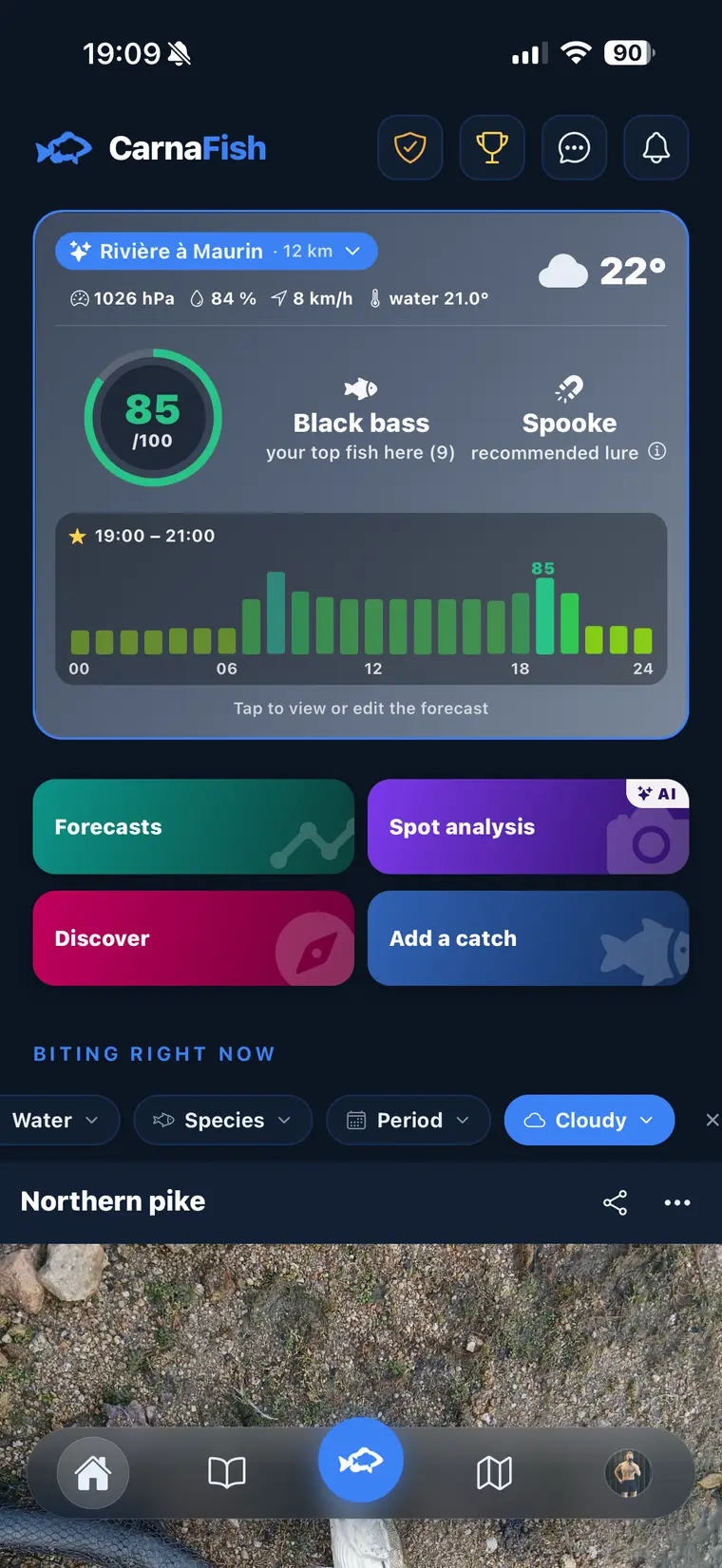
Not sure what to tie on?
Photograph your spot: CarnaFish reads the scene, cross-checks the conditions and gives you the zone, the lure and the retrieve. Free on iOS and Android.
Colors by mat and light
- Stained water, brown vegetation: the dark back with maroon flanks and speckled cream belly of the photographed sample, which stays readable without shining.
- Backlight, dawn and dusk: solid black. The predator only sees a silhouette cut against a bright sky, and black is what reads best.
- Duckweed mats or green weed: a speckled green back, which carries on the color of the vegetation and keeps the lure credible when it sits still for several seconds.
Choosing the right frog is worth nothing if you can't read the right mat or the right window in the day, and that's exactly what CarnaFish does: photograph the spot and the AI hands you the zone, the depth and the presentation that fit the conditions. For the groundwork on tackle and the first water to cover, our beginner's guide to bass fishing covers the rest.
The short version
- 7 cm for 21.3 g: a compact, heavy frog, developed by River2Sea with professional angler Ish Monroe.
- The plastic is claimed to be softer and more collapsible, to free the points on the set — at the price of faster wear.
- A dedicated frog double, claimed super-sharp and set at an angle worked out for the hookset.
- The bead tube visible under the rear on the product photo is not documented in the manufacturer's description.
FAQ
What size is the Phat Mat Daddy?
One only: 2-3/4 in, or 7 cm, at 3/4 oz, or 21.3 g. The manufacturer's chart has a single line, and its first column carries the model name rather than a measurement.
Why a softer plastic than a standard frog?
So the body collapses when a fish closes its mouth and lets both hook points come through. That's the main weakness of hollow-body frogs, and it's this model's central argument.
Does this frog have a rattle?
The product photo shows a small clear tube holding beads clipped under the rear of the body, but the manufacturer's description says nothing about it. Take it as an observation from an image, not a specification, and check the packaging if that point matters to you.
What tackle for fishing frogs in heavy cover?
55 to 70 lb braid tied straight through with no leader, and a powerful fast-action rod. The challenge isn't the cast but the extraction: you have to pull the fish off the mat before it wraps itself in.
How long should I wait before setting the hook?
About two seconds after the strike, and above all until you feel the weight of the fish in the rod. A hookset triggered by the sight of the blow-up pulls the lure out of a still-open mouth in the vast majority of cases.
My frog fills with water after a few fish — is that normal?
Yes, that's how every hollow body works, all the more so with a soft plastic. Squeeze the lure between casts to empty it, and bring a second one in the same color if you're fishing a full day over dense vegetation.
The full bass lure guideSeason-by-season strategy: which family of lure, when, and why.Go from theory to fish
CarnaFish reads your spot from a photo and gives you the game plan: zone, lure, retrieve. Free on iOS and Android.