Googan Poppin Filthy Frog: the frog that pops and walks across the pads
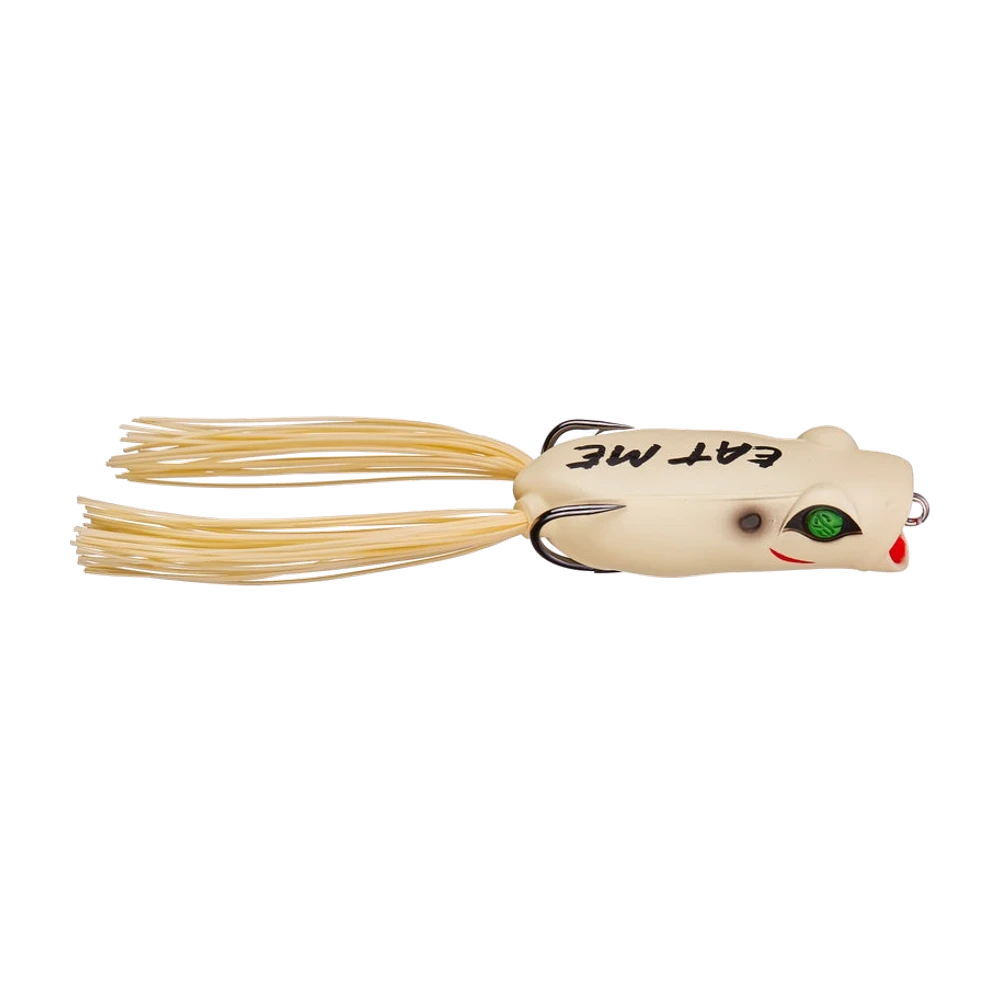
This lure shines under specific conditions. CarnaFish tells you in 10 seconds if today is one of them.
A lily pad field in August, ten in the morning, and not a fish in sight. Under that green ceiling the water is cooler, oxygen holds, and bass sit in the shade of the leaves with no intention of leaving. No crankbait and no swimbait is going in there. A hollow body frog will — and it is close to the only bait that does. Googan's Poppin Filthy Frog is the loud version of the family: instead of simply gliding, it carries a cupped mouth to make noise between two leaves.
Two baits inside one frog
Most frogs fall into two camps. On one side the pointed nose, built to glide and walk side to side without pushing water. On the other the cupped mouth, which splashes and sprays on every sharp pull, popper style. Googan lists a cupped mouth on the Poppin Filthy Frog aimed at exactly that spitting job, along with a body shape meant to make walking the dog easier.
In practice that means you pick the action with your wrist, not with the bait. One sharp pull, rod low, line tight: the cup bites the water and throws a spray. Three soft pulls strung together on slightly slack line: the frog zigzags and moves sideways with barely any forward travel. Being able to swap between the two on a single cast is what makes this kind of bait so hard to beat over matted vegetation.
Why it goes where nothing else does
The soft rubber hollow body is listed as fully weedless. The mechanism is simple and it is the whole trick of the category: the double hook lies flat along the back, points tucked rearwards, and only comes clear of the body when a fish crushes the bait. As long as nothing bites, the frog is smooth from above, without a single catch point. Googan states it set the hook angle so the points stay in that travelling position, and added protective tubing around the shanks to limit water ingress and add durability.
That last point deserves a word, because it is the historic weakness of hollow body frogs: the hole where the hook exits eventually lets water in. A frog full of water gets heavy, sits low and loses its action entirely. Tubing around the hooks delays that moment without preventing it. Get into the habit of squeezing the body between two fingers after every fish to push the water back out.
The internal weight, quiet but decisive
Googan lists an internal weight aimed at two things: casting distance and accuracy, and a guarantee that the bait lands upright every time. The second point is underrated. A frog that lands on its side or its back is a frog you cannot fish: you have to reel it several metres before it rights itself, and in the meantime you have crossed the best water without presenting anything. With the weight placed properly, the bait sits the right way up from impact, which lets you work it immediately, in the exact pocket you were aiming at.
The published numbers
The manufacturer's table is short but unambiguous, and it settles two questions that many product pages leave vague:
- Length: 2-1/2 in, or 6.4 cm. That is a compact frog, closer to a junior size than to the 7-8 cm flagship bodies. An advantage on average-sized fish, and a profile that slips through tight vegetation more easily.
- Weight: 5/8 oz, roughly 17.7 g. That is heavy for 6.4 cm: the density is deliberate, and it is what lets you cast a hollow bait a long way and drop it accurately into a hole between two leaves.
- Class: floating. No ambiguity here, the maker states it outright. The bait stays on the surface even at a dead stop, as long as the body has not taken on water.
That unusual weight-to-length ratio has a direct consequence on tackle: a light outfit will not cast 17.7 g all day, and above all will not set a hook properly inside vegetation.
Not sure what to tie on?
Photograph your spot: CarnaFish reads the scene, cross-checks the conditions and gives you the zone, the lure and the retrieve. Free on iOS and Android.
Working it and setting the hook
The cadence that works
Cast beyond your target, bring the frog onto the mat, then work the openings: every patch of open water between two islands deserves two pops and a long pause. The pause is the part everybody cuts short. A bass that has located the frog rises slowly, sits underneath and waits. Three to five seconds of stillness over a hole produce more bites than twenty metres of continuous retrieve.
Over fully closed mats, drop the pop and switch to gliding: crawl the frog across the leaves and stop dead the moment you reach an opening. The fish hears the bait pass above it before it ever sees it.
Count to two before you set. When the water erupts the reflex is to lift the rod instantly — and nine times out of ten the frog comes back empty because the fish has not closed on it yet. Wait until you feel weight in the rod, then set hard and winch, without pumping. That one-second delay is what separates a frog angler from a frustrated one.
The tackle mistake
Rigging the frog on fluorocarbon or monofilament. Two reasons not to. First, stretch: at twenty metres, in weed, a hookset on mono disappears entirely into line stretch and the hook never drives home. Second, density: fluorocarbon sinks, pulls the frog's nose down and kills the surface action. The only correct answer is straight braid, 30 to 40 lb, knotted to the eye. No leader, no heavy snap, and a heavy rod long enough to pull the fish off the mat the moment you set.
Colour by light and water
- Overcast sky, dirty water: the cream white in the photo. Under flat light a pale silhouette stands out better against a grey surface and gives the fish a clear aiming point.
- Clear water over pads: a natural leopard green, consistent with the real frogs living there when the fish has time to inspect.
- Bright sun, looking up into the light: black. Seen from below, a bass does not see a colour, it sees a shadow against a bright background, and black gives the cleanest silhouette there is.
Where it sits in a topwater box
The Poppin Filthy Frog fills the loud-frog slot, the one you reach for when vegetation is thick and the water is choppy or stained. For a quieter approach over the same cover, a pointed-nose model like the SPRO Bronzeye Frog still makes more sense, and the Booyah Poppin Pad Crasher covers exactly the same popping register in a rival line-up. On open water beside the mat, the Googan Blooper Popper makes the same noise with no weedless constraint, and a River2Sea Whopper Plopper 130 covers long banks faster.
Recognising the right mat, the right pocket and the right hour matters as much as choosing the frog. That is exactly the job CarnaFish does: a photo of the spot, and the app suggests the zone to attack and the presentation that suits the day's conditions. For tackle and spot-reading fundamentals, our beginner's guide to bass fishing lays the groundwork.
Key takeaways
- Two actions in one bait: a loud pop on a sharp pull, a silent zigzag on a softer one.
- Published numbers: 6.4 cm / 2.5 in, 17.7 g / 5/8 oz, floating — compact but dense, and it casts a long way.
- Straight braid is mandatory, 30 lb minimum, on a heavy rod: neither fluoro nor mono will set a hook in weed.
- Wait a second before setting, and squeeze the body after every fish to push the water out.
FAQ
How big is the Poppin Filthy Frog exactly?
The maker publishes 2-1/2 in, or 6.4 cm, at 5/8 oz, roughly 17.7 g, and lists it as floating. That is a compact body compared with full-size frogs, but considerably denser than it looks.
Do you really need braid for frog fishing?
Yes, with no serious alternative. Mono stretches too much to set a hook at distance in weed, and fluorocarbon sinks and pulls the bait's nose under. Braid of 30 to 40 lb tied straight to the eye, on a heavy rod, is the only rig that holds up.
Why do I miss so many frog bites?
Because you set too early. The surface explosion is spectacular and the reflex is instant, but the fish often has not closed its mouth yet. Wait until you feel weight in the rod, then set firmly and keep the fish coming with no slack.
Does this frog work for pike?
In Europe, a hollow body frog fished over thick weed takes pike regularly, and this model is no exception. Keep in mind it was designed for bass: on serious pike, check the hooks after every fish and watch how the hollow body is holding up.
Pop or walk — which should I pick?
Pop when the water is choppy or stained, or when the vegetation leaves clean openings you can work on the spot. Walk it on slick, clear water, or over closed mats where the bait has to crawl continuously across the leaves.
How do I stop the frog filling with water?
Squeeze the body between thumb and forefinger after every fish and after every serious snag: the water that came in through the hook slots goes straight back out. Googan lists protective tubing around the shanks to limit it, but no hollow body escapes the problem entirely over time.
The full bass lure guideSeason-by-season strategy: which family of lure, when, and why.Go from theory to fish
CarnaFish reads your spot from a photo and gives you the game plan: zone, lure, retrieve. Free on iOS and Android.