Deps Slither K: the rabbit-fur frog built for the thickest cover
Not sure this lure fits YOUR spot today? CarnaFish tells you in 10 seconds, from a photo.
Late July, a backwater carpeted with duckweed from bank to bank. Nothing crosses that: not a spinnerbait, not a Texas rig, not even a heavy jig. Nothing except a hollow body frog skated across the mat until a bulge rises underneath it. The Deps Slither K was drawn for exactly that water, and its outline — which looks like no real frog on earth — is explained entirely by what it has to do once it lands.
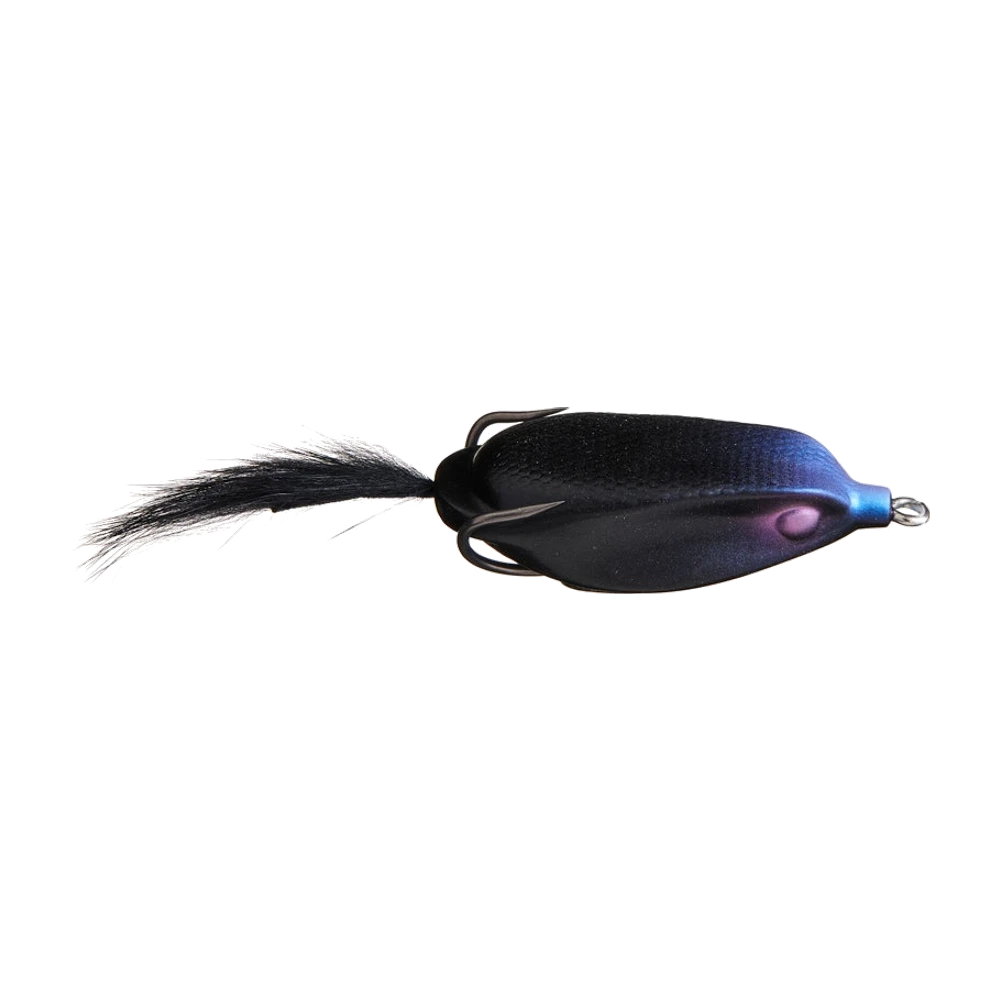
A shape built for side-to-side travel, not for imitation
Deps leans into an unorthodox body profile: cupped sides, a perfectly flat belly, and a calculated internal balancing system. All three chase the same single goal, which is a clean walk-the-dog action and a lot of surface turbulence.
The flat belly gives maximum support on a soft surface, which lets the bait skate over duckweed or a lily pad without sinking into it. A round body burrows into vegetation; a flat one rides over it.
The cupped sides bite the water the moment the bait swings sideways. That is the Slither K's signature, both visually and audibly: every rod stroke pushes a slug of water off to one side and leaves a far heavier boil than a smooth-flanked frog does. In water chopped up by wind or clouded with floating debris, that extra turbulence is precisely what gives a fish something to home in on.
The internal balancing system closes the loop. It brings the body back onto its axis between strokes, which is the absolute precondition for walking a bait: if the lure does not return straight, the next stroke will not send it the other way, it will simply spin it on the spot. Deps also states the bait is ready to fish straight out of the package with no tuning — not a trivial detail on a frog, where plenty of models need the line tie recentred before the first outing.
The rabbit fur is not decoration
Instead of the usual silicone strands, the Slither K carries a tuft of natural rabbit fur. That is not an aesthetic choice, and it changes two very concrete things.
The first happens at rest. Silicone is stiff: the instant the lure stops, the strands stop with it. Rabbit fur keeps moving long after the stroke has ended — it breathes, closes, opens again on the smallest back-eddy. And the strike on a mat usually comes during the pause, so something has to stay alive while the lure itself sits still.
The second is purely mechanical. Once soaked, the fur adds weight to the back of the bait. That rear ballast improves how the lure handles wind in flight and genuinely stretches casting distance — which, on a 10.6 g frog thrown into a summer breeze, is no small thing. The trade-off is that the first two or three casts with a brand new frog fall short until the tuft takes on water.
Before the first cast, dunk the tail and squeeze it between two fingers. Dry fur fans out, catches the wind and caps your distance. Ten seconds of soaking buys you several metres on every cast for the rest of the session.
Two rear holes: the detail that decides your hooksets
The Achilles heel of every hollow body frog is the hookset. The body is full of air, the double hook lies flat against the back, and for the points to reach anything the body has to collapse completely. If a pocket of air stays trapped inside, the bait acts as a cushion and the fish leaves with nothing in it.
Deps drills two evenly distributed holes in the rear of the body. Their job is to dump the air instantly as the jaws close, so the body — already moulded from a very soft material — flattens without resistance. The same holes work the other way on the cast: water taken on during the retrieve drains out on its own, which saves you squeezing the bait dry every ten minutes.
The double hook is specific to the model, custom-designed with a precisely calculated angle and tucked over the back. The result Deps claims, and it is consistent with the construction, is a bait that is extremely weedless and still converts a high share of bites.
The tackle that goes with it
A frog is not a fluorocarbon lure. You want braid, somewhere in the 40 to 60 lb range depending on how thick the mat is, tied straight to the eye — no snap, which snags every stem it touches. The rod has to be powerful without being broomstick-stiff from butt to tip: a completely dead tip cannot absorb the fish's pull and rips the bait away before the points are buried.
The classic mistake: setting on the sound
Everyone makes this one in their first season. The bass blows up on the frog, you set on the noise — and you reel back a bare lure. Four times out of five the fish does not actually have the bait in its mouth when you hear the strike.
The right sequence is counter-intuitive: you hear it, you do nothing, you let the slack come tight, and you only set when you feel weight. Counting one full second is usually enough. And if the frog comes back empty, drop it back on the same spot within seconds: a bass that missed tends to stay put.
Not sure what to tie on?
Photograph your spot: CarnaFish reads the scene, cross-checks the conditions and gives you the zone, the lure and the retrieve. Free on iOS and Android.
Where and when to pull out the Slither K
The lure's natural home is the heaviest cover on the lake: duckweed mats, surface-breaking weed beds, lily pad fields, flooded brush along the bank. The main window runs from late spring into early autumn, once water temperature climbs past 18-20 °C and fish tuck under the shade of the canopy. First and last light produce the most bites, but a frog stays surprisingly good at midday in summer: under a mat it is dark and cool all day long.
For pike, the bait works in the same weed beds across Europe, with two honest caveats. The first is that 5.7 cm is a modest profile for a big pike, which will often prefer more volume. The second is that frogs are fished without a wire trace, and hanging 15 cm of titanium in front of one ruins the action. On a confirmed pike spot, many anglers will rather reach for a bulkier surface bait such as a Zoom Horny Toad rigged on a weedless hook with a light wire leader.
Colors by light and by surface
- Overcast skies, stained water: the dark back with the blue-purple sheen shown in the photo. Seen from below it is the silhouette that matters, and a black back reads better against a grey sky than a mid-tone does.
- Clear water, bright sun: a natural back with a pale belly. In water where the fish genuinely sees the lure, the credibility of the profile matters again.
- Duckweed or lily pads: a green-dominant finish, which blends the bait into its background right up to the moment it drops into an open pocket — the instant of the strike.
A frog is worthless if it is not landing on the right edge, which is exactly where CarnaFish comes in: one photo of the spot, and the AI suggests the zone to attack and the presentation that fits the day's conditions. For the spot-reading that goes with it, our beginner's guide to bass fishing covers the basics of working a vegetated shoreline.
Key takeaways
- Flat belly, cupped sides and internal balancing form one system: skate across cover and produce a turbulent walk-the-dog.
- The rabbit fur keeps undulating at rest and, once wet, loads the rear of the bait for longer casts.
- The two rear holes dump air on the hookset, which is what lets the very soft body collapse and the points find purchase.
- A single size at 5.7 cm / 2.25 in for 10.6 g / 3/8 oz, classed as topwater: this is a heavy cover tool, not an all-rounder.
FAQ
Should I set the hook the moment a bass blows up on the Slither K?
No, and that is the number one reason frogs come back bare. Wait until you feel the fish's weight in the rod, roughly a second after the sound of the strike, then set hard into a tight line.
What rod and line does this frog need?
Braid in the 40 to 60 lb range tied straight to the eye with no snap, and a powerful rod whose tip still keeps a little give. Fluorocarbon is out: it sinks and pulls the frog's nose under the surface.
Does the Slither K come in several sizes?
No. Deps documents a single reference: 5.7 cm / 2.25 in for 10.6 g / 3/8 oz, classed as topwater. If you want a bigger profile for bigger fish, you need a different frog, not a different size of this one.
Why rabbit fur instead of silicone strands?
Because natural fur keeps undulating while the bait sits still, where silicone freezes. Since most strikes come during the pause, that is exactly the moment the lure still needs to look alive.
Does it need tuning before the first trip?
No, Deps supplies it ready to fish out of the package. Just check the line tie is still true after a hard snag, the way you would on any frog.
How is the Slither K different from a classic pointed-nose frog?
A pointed-nose frog such as a SPRO Bronzeye Frog or a Booyah Pad Crasher is built around penetration and glide. The Slither K does the opposite and pushes as much water as it can on each stroke: it is seen and heard from farther away, at the cost of a shorter glide.
The full bass lure guideSeason-by-season strategy: which family of lure, when, and why.Go from theory to fish
CarnaFish reads your spot from a photo and gives you the game plan: zone, lure, retrieve. Free on iOS and Android.