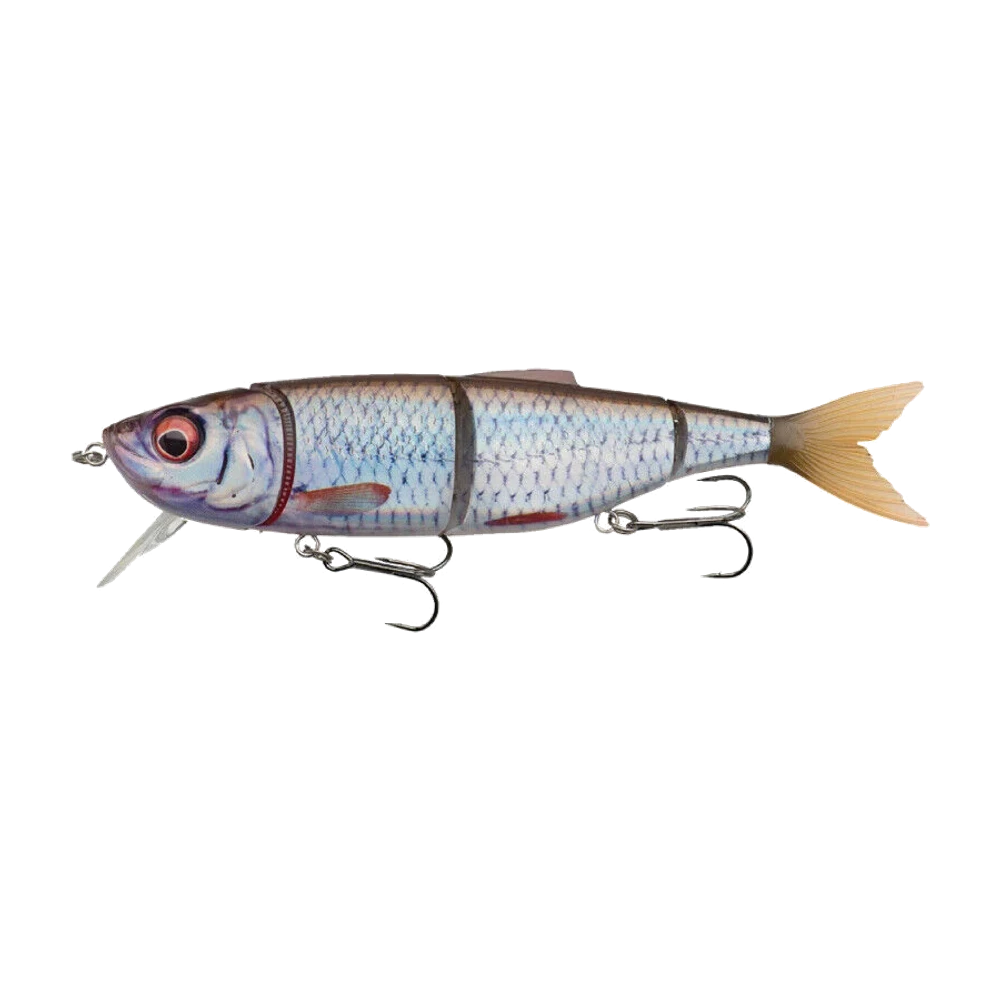
Savage Gear 4Play Herring Liplure: the jointed swimbait that holds its depth
Not sure this lure fits YOUR spot today? CarnaFish tells you in 10 seconds, from a photo.
The jointed swimbait has a deserved reputation on pike: the silhouette of a big fish, a ripple running from head to tail, a signal nothing else reproduces. It also has a flaw that gets talked about less. Without a lip, a multi-section swimbait never tells you where it is. It sinks at a rate set by its weight, it rises the moment you speed up, and its running depth changes with the amount of line out. On a three-metre margin with weed growing to a metre and a half, you spend your time guessing.
The 4Play Herring Liplure solves that problem simply: it keeps the four-section 4Play body and adds a lip. That is not a cosmetic detail. The lip changes the whole logic of fishing this lure.
The result: a swimbait that ripples like a swimbait but fishes like a crankbait — you cast, you retrieve, and the lure finds its layer on its own and stays there.
What the lip really changes
Three effects stack up, and they all point towards simplicity.
- Depth reached quickly and held. From the first turns of the handle, the lip pulls the lure down. Once the layer is reached it keeps it there as long as the speed does not change. You know where your lure is running without counting seconds of sink.
- A ripple that starts at low speed. The lip's resistance puts the body under tension: the first section pivots, the second follows, and the wave travels down to the tail. A lipless swimbait needs speed to wake up; this one works the moment you turn the handle slowly.
- Permanent contact through the line. You feel the lip. It tells you about the bottom, about weed you have brushed, and it warns you when you slow down too much.
In exchange you lose the freedom of a glidebait: no wide lateral glides, no gliding descent on the pauses. This lure does one thing, it does it well, and it does it predictably.
The retrieve: straight, with chosen breaks
- Cast and drop the rod tip towards the water immediately after the splash, so the lip bites from the first turns.
- Retrieve slowly and steadily, at a speed that lets you feel the beat in the rod. You should sense a clear, regular pulse.
- Count your turns of the handle to the first contact with the bottom or the weed, then take one or two turns off on the following casts. That is your working depth.
- Break the rhythm every five to ten seconds: a one-second stop, or a brief burst of two fast turns. The stop lifts the lure slightly and makes the sections tip over.
- Slow right down as you approach the bank, over the last two metres. A following pike very often makes up its mind at the moment you slow.
For sea bass the picture changes: the retrieve is a little quicker, and what matters is the passage through the current seam rather than the rhythm. Cast upstream, let the lure cross the current under tension, and fish the tail of the seam.
On the water: with a lipped swimbait, do not try to feel the bottom constantly. As soon as the lip scrapes, the ripple in the rear sections falls apart and the lure stops looking like a fish. Always fish one or two turns above that contact — that is where the signal is cleanest, and that is where the pike is looking.
Sizes, depths and uses
| Size | Indicative weight | Running depth | Typical use |
|---|---|---|---|
| 9.5 cm | around 10 g | 1 to 1.5 m | Sea bass over plateaus, difficult pike, big perch |
| 13 cm | around 25 to 30 g | 1.5 to 2.5 m | All-round pike, river margins and ponds |
| 19 cm | around 60 g | 2 to 3 m | Big pike, searching lakes, end of season |
Tackle follows the weight mechanically. For the 13 cm, a 20-60 g rod is enough. For the 19 cm you need at least 40-100 g, otherwise you cannot load the rod on the cast and you are worn out in ten minutes. Braid of 0.25 to 0.35 mm remains a good base for pike.
For the leader, supple steel or titanium is compulsory as soon as pike are in the picture: a lure this size is taken across the body, and the teeth reach well past the front hook. For sea bass, 0.50 to 0.70 mm fluorocarbon is enough, with the advantage of leaving the nose of the lure more freedom.
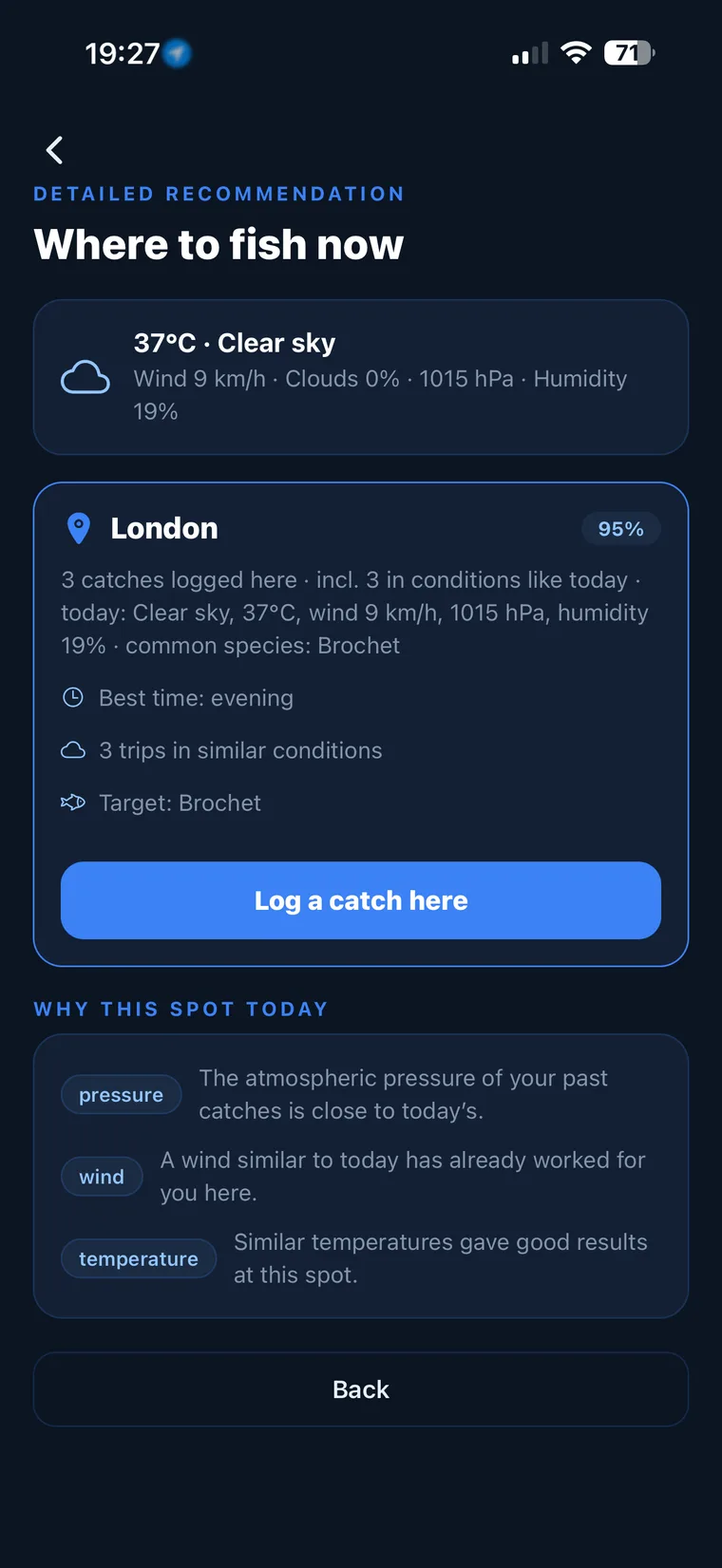
Not sure what to tie on?
Photograph your spot: CarnaFish reads the scene, cross-checks the conditions and gives you the zone, the lure and the retrieve. Free on iOS and Android.
Where it wins, where it loses
It takes the lead in the intermediate layers between one and three metres, exactly the zone standard lures cover badly: too deep for a topwater, too shallow for a jig head you bounce off the bottom. That is the window of lake margins, plateaus, the tops of drop-offs and low weed beds.
It is also very effective in slightly stained water, because the volume and the wave it generates are read on the lateral line well beyond visual range.
It is poorly suited, on the other hand:
- In deep water — beyond three metres the lip is no longer enough, you need a weighted lure or a jig head.
- In dense vegetation: the two trebles and the lip collect everything going.
- On ultra-wary fish in clear, flat water, where a slimmer, more discreet profile often gets through better.
- For vertical fishing or slow drifting, techniques it is simply not built for.
4Play Liplure or a lipless glidebait
A glidebait such as the Westin Mike the Pike works on a completely different register: wide lateral glides, a gliding descent on the pause, an action steered continuously by the angler. It is a lure for provoking, often deadly on a located pike or on a fish you want to make up its mind. But it demands active input from the start of the cast to the end, and it guarantees no depth at all.
The 4Play Herring Liplure occupies the opposite place: it is a searching lure with controlled depth, one you can fish straight for an hour without your concentration being the limiting factor. In practice many anglers combine them — the Liplure to comb a margin and find active fish, the glidebait to work on an identified follower.
In the same mid-depth searching spirit, a Savage Gear 3D Hybrid Pike offers a bulkier profile and a slower ripple. Our guide to choosing a pike lure places swimbaits among the other families. And if you are unsure which layer to fish when you reach an unfamiliar margin, CarnaFish analyses a photo of the spot and answers.
Key takeaways
- The lip locks the running depth: no more estimating the sink.
- Slow straight retrieve, broken every five to ten seconds by a stop or a burst of speed.
- Fish one or two turns above your first contact with the bottom.
- 13 cm is the do-everything pike size, 9.5 cm for sea bass and difficult fish.
- Unsuitable beyond three metres and in dense vegetation.
FAQ
How deep does the 4Play Herring Liplure run?
Between one and three metres depending on size and retrieve speed. The 9.5 cm stays around one to one and a half metres, the 19 cm drops towards two to three metres on a slow, steady retrieve.
Do I need a steel leader?
Yes for pike: a lure this long is often taken across the body and the teeth reach well past the front hook. For sea bass, 0.50 to 0.70 mm fluorocarbon does the job and leaves the nose more freedom.
What retrieve speed should I use?
Slow enough to feel a clear, regular pulse in the rod, no more. If the vibration becomes confused or disappears, you are going too fast; if you feel nothing at all, you are going too slowly and the body is not under tension.
Can it be fished in rivers for sea bass?
Yes, and it is a good use. Cast upstream of the current seam and let the lure cross it under tension: the lip holds the depth despite the push of the water, which an unweighted swimbait does not.
What rod for the 19 cm?
A 40-100 g rod at minimum, with 0.30 to 0.35 mm braid. A lighter outfit will not load on the cast with nearly 60 g and becomes exhausting after a few dozen casts.
How does it differ from a lipless swimbait?
The lipless model glides sideways, planes on the pause and is steered continuously, but guarantees no depth. The Liplure gives up those glides in exchange for a stable running depth and a ripple that starts at slow speeds.
The full pike lure guideSeason-by-season strategy: which family of lure, when, and why.Go from theory to fish
CarnaFish reads your spot from a photo and gives you the game plan: zone, lure, retrieve. Free on iOS and Android.