Imakatsu Javallon: the soft swimbait that filters instead of searching
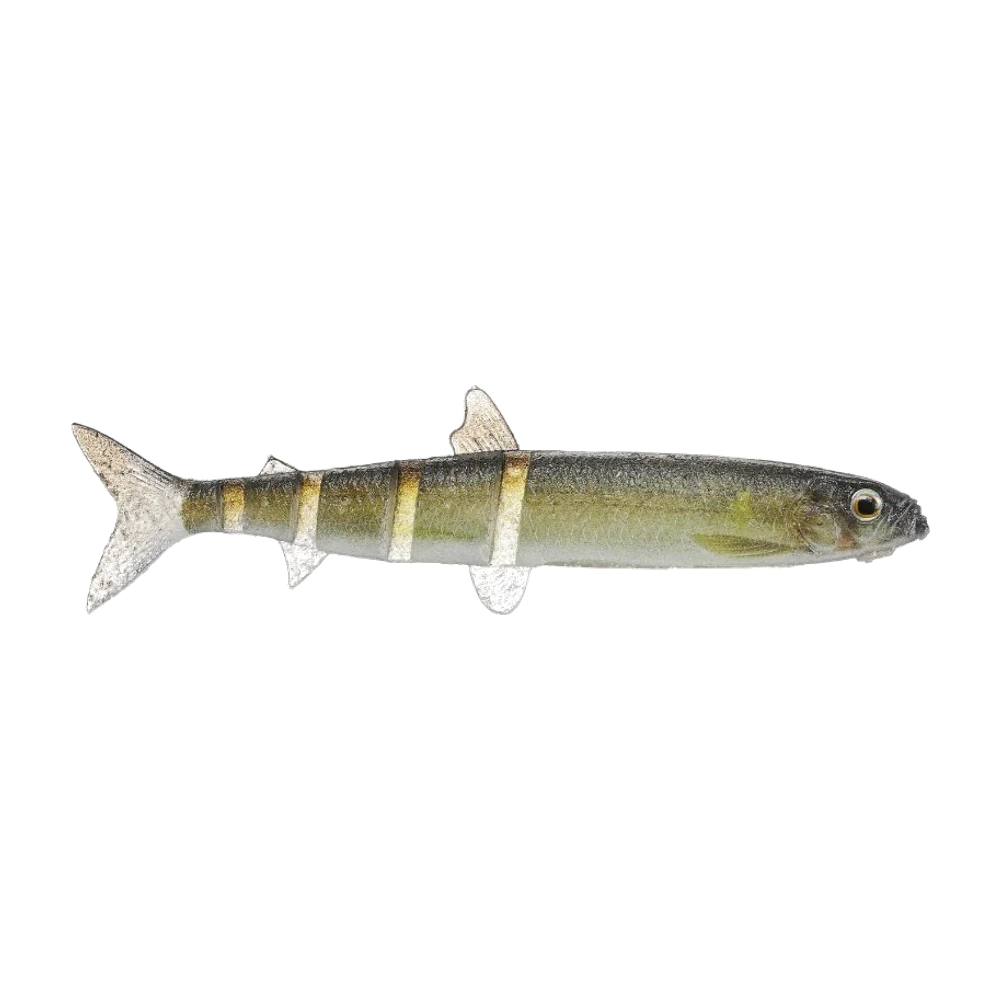
This lure shines under specific conditions. CarnaFish tells you in 10 seconds if today is one of them.
A big swimbait does not make more fish bite. It makes fewer bite, but bigger ones. That is the first thing to accept before you tie on a lure of fifteen centimetres and sixty grams: you are going to spend hours without a bite, and that is not a sign you are doing it wrong.
The real question becomes this: how do you make sure the rare bites turn into fish? On a jointed soft swimbait like the Javallon, the answer lies almost entirely in the hooks and the rhythm, not in the colour or the spot. A lure of that size takes up a lot of room in a fish's mouth; badly hooked, you register hits, you feel weight, and nothing happens.
So this page looks at a big lure through the lens of conversion rate.
What the joint actually brings
A one-piece soft swimbait undulates from the tail. A jointed model breaks the body into two sections linked by a joint, which changes three things.
- The action starts sooner. The rear section pivots around the joint under very little water pressure. You can wind extremely slowly and keep a wide action, which is impossible on a rigid body of that size.
- The movement is an S, not an undulation. Seen from above, the lure sweeps sideways over a wide amplitude. That travel, visible several metres away in clear water, is what pulls a fish out of its structure.
- The lure takes changes of speed better. A harder turn of the handle makes the rear break away for a fraction of a second before it settles back. That break is the only useful "animation" on this kind of lure.
On top of that there is the quality of the soft plastic itself: on the take, the fish bites into something that compresses rather than hitting a hard body. It holds the lure in its mouth for longer — which is precisely what you want on a lure that is hard to hook.
The retrieve: consistency above all
- Cast and count it down. Count systematically, even in a metre of water: it is your only depth reference.
- Start slowly and find the point where you feel the action settle in the rod tip. It is not a vibration, it is a heavy, regular sway.
- Hold that speed without varying through the whole retrieve. A badly fished swimbait is a swimbait that has been worked. Here, consistency is the animation.
- Force one single break per pass, as the lure goes past structure: two faster turns of the handle, then straight back to the original rhythm.
- Do not lift the lure out of the water straight away. Make a half circle under the rod tip before you recast: a good proportion of fish follow to the bank and hit on the turn.
For pike, the same retrieve is run slightly deeper, letting the lure sink three to five seconds longer before you start, and targeting the edges of dying weed beds and gentle drop-offs. For bass, you stay high and track the structure.
On the water: on a big swimbait, never strike on first contact. Keep winding at the same speed for a full second, and only strike when the rod really loads and the weight stops moving away. A reflex hookset on a fifteen centimetre lure almost always pulls it away before the fish has properly taken it.
Hooks, the critical point
This is the subject that decides your day.
| Situation | Setup | Note |
|---|---|---|
| Bass, open water | Stock harness + dorsal treble | Decent hook-up rate, few snags |
| Cluttered margins | Single dorsal hook, point tucked in | You trade hook-ups for passability |
| Pike | Add a rear stinger | Essential, takes come from behind |
| Fish that follow without taking | Light belly stinger | Picks up the soft, half-hearted hits |
Three concrete precautions:
The stinger. On pike, the take very often comes from behind and closes a third of the way up the body from the tail. A treble mounted back, linked by a short wire trace, converts those bites. Our stinger rig page covers the positioning.
The leader. Fluorocarbon of 0.45 to 0.60 mm for bass, wire or titanium compulsory as soon as pike are about. A lure at this price lost to a cut line costs more than the spool.
The tackle. A swimbait-power rod, 40 to 100 g, 1.95 to 2.20 m long, with a moderate-retrieve casting reel. A rod that is too soft will not set a hook at twenty metres with a bulky lure in the fish's mouth; a retrieve that is too fast stops you holding the slow speed you need.
Not sure what to tie on?
Photograph your spot: CarnaFish reads the scene, cross-checks the conditions and gives you the zone, the lure and the retrieve. Free on iOS and Android.
Its windows, and where it has no place
The Javallon is a lure of selection, not of production.
- Clear to moderately clear water, where its S-swim is visible from a distance.
- Late spring and autumn, when the big fish are feeding on large prey.
- Large structure: weed bed edges, submerged trees, plateaux, sharp drop-offs.
- Heavily fished waters, where the size of the lure screens out small fish and picks off the few big ones.
Conversely, it is useless in very murky water: it relies on the visual and on a slow action, two things that vanish when visibility falls below thirty centimetres. It is off the point in winter on inactive fish pinned to the bottom. And on a water with no big fish, it has no interest whatsoever: you will spend the day biteless for good reason.
Jointed soft or rigid glidebait
The Megabass Magdraft is the direct comparison: also a soft swimbait, but one-piece, with a rollier action and an internal harness that simplifies rigging. It is more forgiving and easier to fish on a pure straight retrieve. The Javallon trades that simplicity for markedly more sideways amplitude at low speed.
The Gan Craft Jointed Claw represents the other school: a rigid jointed body with a gliding action produced by twitches, and usable pauses. It demands constant input from the angler and produces a sharper signal. The soft swimbait, by contrast, is fished continuously and plays on texture at the moment of the take.
Our guide to choosing a pike lure places big lures within a fishing season. And if you are unsure what depth to run a swimbait past a drop-off, CarnaFish analyses a photo of the spot and answers.
Key takeaways
- A big swimbait selects fish: few bites, better sizes.
- The joint allows a wide S-swim at very low speed; consistency is the animation.
- Do not strike on contact: wait a second for the rod to really load.
- A rear stinger is compulsory on pike, and so is a metal leader.
- No interest in very murky water, in winter, or on a water with no big fish.
FAQ
Should you work the Javallon or just wind it in?
Wind it in, slowly and at constant speed. The joint already produces all the action; adding twitches breaks it up. Save one single acceleration per pass, as the lure tracks past structure.
Why do I miss so many bites on big swimbaits?
Because you strike too early. A fifteen centimetre lure is not immediately inside the mouth: the fish grabs it from one side first. Keep winding for a second and strike when the rod genuinely loads, never on first contact.
Do you need to add a stinger?
Yes as soon as pike are about, and as soon as you register hits without hooking up. Takes often land on the back third of the lure, an area the stock harness does not always cover.
What tackle do you need for this kind of lure?
A swimbait rod of 1.95 to 2.20 m rated 40-100 g, a strong casting reel, braid of 0.30 to 0.40 mm and a fluorocarbon leader of 0.45-0.60 mm or metal depending on the species. Undersized gear stops you setting a hook at range.
How many bites should you expect in a day?
Few, and that is normal. This kind of lure is judged on the average size of the fish, not on the numbers. One or two bites in a full session is a common result, even on rich waters.
What is the difference with a rigid glidebait?
A glidebait is fished with twitches and offers glides and pauses, with a hard body. A jointed soft swimbait is fished continuously, at low speed, and is held in the mouth longer thanks to the compressibility of the plastic.
The full bass lure guideSeason-by-season strategy: which family of lure, when, and why.Go from theory to fish
CarnaFish reads your spot from a photo and gives you the game plan: zone, lure, retrieve. Free on iOS and Android.